
Category: Dominican Saints
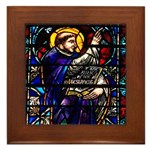
Blessed Lawrence of Ripafratta
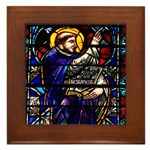
One of the outstanding characters in the Dominican reform of the late fourteenth century was Blessed Lawrence of Ripafratta, who was novice-master of several saints and blesseds of our Order.
Lawrence was born in the fortified city of Ripafratta, in 1359. His noble family had the duty of guarding the outer defenses of the city of Pisa against the depredations of its powerful neighbor cities. It was a warlike place and time to come into the world, but Lawrence gave early evidence of being a man of peace. At the age of twenty, after innocent and promising youth, he entered the convent of Saint Catherine, in Pisa. He made rapid progress, both in prayer and in study, and busied himself with the works of the Order for several years before being called upon to help in the reform movement that was headed by Blessed John Dominici.
In 1402, Lawrence was made novice-master in the novitiate of the reformed congregation of Tuscany, in Cortona. Here the novices were to be trained in the primitive rigor of the Order, in an attempt to by-pass the destructive elements of the past half century, which had reduced religious observance to an alarming state of indifference. Plague and schism had taken toll both in numbers and quality of the religious orders, and the remaining houses were living under a relaxed observance of the rule, in a struggle for survival. John Dominici, under the inspiration of Raymond of Capua, felt that the time had come to tighten up the observance once more and return to the first practices of penance and silence. His suggestions were not popular among those who lived in the relaxed convents. The only alternative was to begin again, with a new novitiate, and hope that the idea would take hold gradually and effect internal reform among the other houses.
Excellent novices soon made their appearances at Cortona: Saint Antoninus and Blessed Peter Capucci, and the artist brothers, Fra Angelico and Fra Benedetto. Several others who were to attain fame in the order came under Lawrence’s influence and were shaped by him and to saintly and useful members of the apostolate, not all in the same fashion- Saint Antoninus was to become Archbishop of Florence, Fra Angelico and his brother made San Marco world famous for its art. Blessed Lawrence is, indeed, an interesting study; a severe and exacting man when it came to keeping the rule, a man of broad vision and great resourcefulness in carrying out the work of preaching. He was obviously not at all afraid of talented people going astray if they were allowed to use their talents for God, and he displayed great insight into the development of each of his novices as individuals.
Eventually, Blessed Lawrence was appointed vicar-general of the reformed congregation and moved to the convent of St. Dominic of Pistoia. Here he preached almost continually, and had a reputation for compassion to the poor whom he tended, taught and visited, even in time of plague.
Lawrence of Ripafratta lived to be ninety-eight, and in his old age we have a touching picture of his novices-now men of distinction and authority- coming back to consult him about this or that detail of their work. He wrote often to St. Antoninus, perhaps feeling that being archbishop of Florence was a job with many worries.
Lawrence of Ripafratta died in 1457, and was beatified, after a long history of miracles at his tomb in 1851.
Born: in Ripafratta in 1359
Died: He died at Pistoia in his 98th year in 1457
Beatified: Pope Gregory XVI confirmed his cult in 1851
Blessed Dalmatius Moner
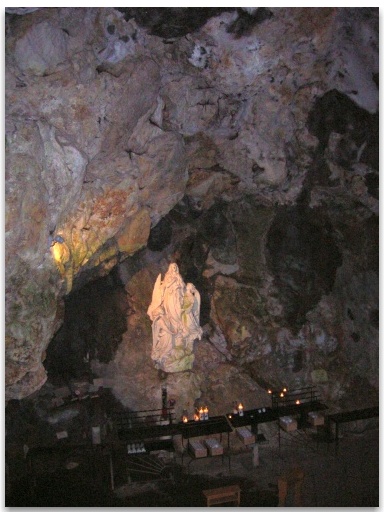
This Dominican Blessed, who was noted particularly for his observance of poverty, lived in the early years of the Order and helped to establish the high reputation of the Spanish religious.
Blessed Dalmatius was born in Aragon, in 1291, and we know nothing else about his life before he entered the Order. He was a member of the province of Aragon and gave a perfect example of strict observance of the rule and the spirit of religious detachment from things of earth. All that we know about him, are a few anecdotes, none of which can be fixed with certainty as to date or place.
We read that his spirit of poverty was so extreme that he never wore a habit or cappa that was not in tatters. He picked up his wardrobe from the cast-offs of his brethren, and, since the spirit of poverty was quite rigid in this providence, the cast-off clothes must have looked a sight. Dalmatius seemed to make a virtue of this, since all the records we have make mention of it. As to food, he never ate fish or eggs, and lived on a diet of hard bread and unseasoned vegetables, to which he added a few ashes during Lent. The beds in the house were hard enough for most people, but not for him. He slept on the bare earth when he could not get into the church to pray and take an occasional nap, his head rested on the altar step.
Dalamtius is credited with several miracles, which included healing and spiritual assistance. At one time, a novice was tempted to leave the Order. Dalmatius, going about it without being told, sought out the novice and solved his difficulties. At another time, a mother whose small child had a serious eye disease came looking for Dalmatius to heal her child. The friar refused, because, he said, this affliction would save her child from serious sin, and that God was waiting till some time in the future to heal him.
During the last forty years of his life, Dalmatius lived in the cave of Saint Mary Magdalene, in the south of France, where he had gone on a pilgrimage of devotion. Here he was favored with numerous ecstasies and great spiritual insight. One time, while he was in the cave, a group of friars from his own province where lost in the woods in a bad storm. They prayed to him to help them, and a young man came with a lantern and guided them home.
Dalmatius died in his own convent in the presence of all the friars and provincials who had gathered for a chapter. He was declared blessed in 1721.
Born: in 1291 near Gerona in Spain
Died: 1341
Beatified: Pope Innocent XIII confirmed his cult in 1721
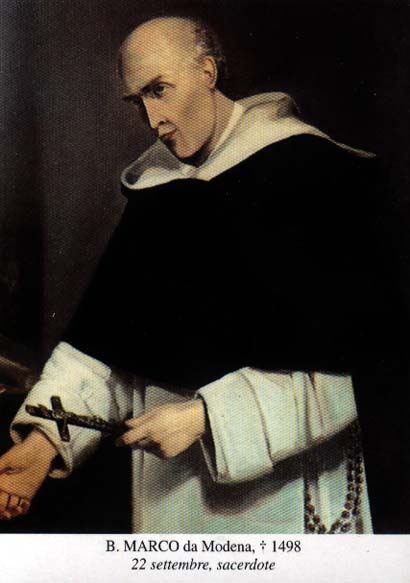
Blessed Mark of Modena
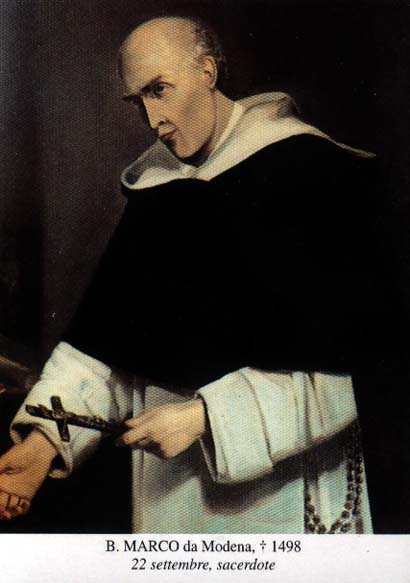
Mark was born in Modena and entered the convent of the order there in young manhood. He observed the rules with great fidelity, and became noted both for his learning and his holiness, which is a sentence that would fit into nearly every Dominican biography written, and tells us nothing in particular about Mark as a person. However, when we recall the times in which he lived , it becomes clearer to us that anyone who kept the Dominican Rule in its entirety is truly to our notice . The abuses which stirred Savonarola to thundering speech in the pulpits of Ferrara and Florence could not have been absent from all of Italy. It look solid virtue to hold out against the opulent worldliness of the times, and Mark of Modena apparently did a thorough job of it, since he has been beatified.
Mark was made prior of the convent of Pesaro, and the only miracle we have on record (he is supposed to have performed many) took place at his convent. A woman’s little boy had died, and she pleaded with Mark to restore the child’s life. After praying for awhile, Mark turned to her and said, “Madam, your little boy is in paradise. Do not try to get him back again, for his second loss will be worse than this one.” However, she insisted on his working the miracle, and he did so. The child returned to life, and, ten years later, covered with disgrace and opprobrium, died a second time, leaving his mother in worse grief than ever.
Mark of Modena died in 1498, the year that the city of Florence burned Savonarola at the stake. It was a time of terrible happenings in Italy and all Europe. The people of Modena mourned the death of Mark, and went to pray at his tomb. Many of their needs were answered there, and a number of prodigies were reported in connection with the translation of his relics to the Rosary chapel of the church. The bells were said to have rung by themselves, and sweet perfume filled the air. Until recently, his relics were still exposed yearly for veneration during the week of Whitsunday.
Born: in Modena at the beginning of the 15th century
Died: in at Pesaro in 1498
Beatified: by Pope Pius IX in 1857
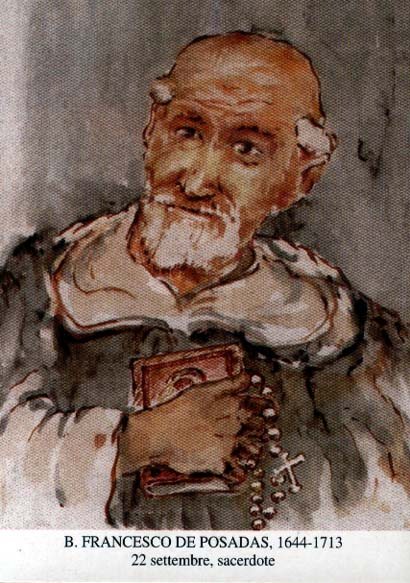
Blessed Francis Posadas
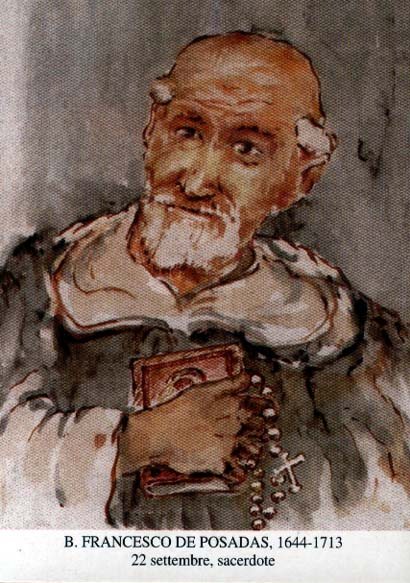
Few Dominicans have had more difficulty getting into the Order than Blessed Francis de Posadas, and he was one of the glories of the convent of the Scala Coeli, in Cordova. It is embarrassing for us to read that the reason for his exclusion was plain and simple snobbery on the part of the superiors of the convent of St. Paul, in Cordova.
Francis was born of a poor young couple who were war refugees, and who had been shunted from place to place until, when Francis was very small, his father’s health failed, and he died in Cordova. The young widow tried several types of work, and finally she was reduced to selling eggs and vegetables at a street stand. She tried to educate her child, for she knew he was very talented, but, without money, it simply was not possible to send him to school. She encourage him to go to the Dominican Church of St. Paul, and he served Mass there every morning from the time he was six or seven years old.
While he was still a very tiny child, he used to gather the other children together for rosary processions or other devotions. The smile of God seemed to rest upon him. For all his poverty, he was a very happy and attractive child, like by everyone; and he was a natural leader among his fellows. Twice during his childhood, he was miracuously saved from death. This fact and his undoubted piety, should have seemed sufficient reason for admitting him into a religious order. However, by the time Francis was old enough, there were two reasons to make his entry difficult: his mother had remarried, and the step-father would not permit him to enter. The Dominicans, moreover, would not have him. They said that they did not want the son of a street peddler.
Francis had friends in the Order, but the prior of the house he wished to enter took a violent dislike to him. It was several years before the young man could overcome the resistance of this man, who, having some influence with the provincial, was stubbornly determined that Francis should not be allowed to enter. Even when the fathers in the convent of Scala offered to take the boy and train him in Latin- so that he could qualify for clerical studies-the vindictive dislike of the prior followed him and almost prevented his acceptance.
Francis was finally accepted, made his novitiate, and gradually overcame all dislike and distrust by his charming manner and his unquestioned talents as student and preacher. After his ordination, he was sent out to preach, and he earned the reputation of being a second St, Vincent Ferrer. His talents as a preacher were rivaled only by his gifts as a confessor. He not only could read hearts and discover sins that had been willfully concealed, but sometimes he was called to one place or another by an interior spirit and shown someone badly in need of the sacraments.
Francis hated the thought of holding authority in the Order. When appointed prior of one of the convents, he remarked that he would much sooner be sentenced to the galleys. He twice refused a bishopric, and he skillfully eluded court honors.
Several remarkable conversions are credited to Francis Posadas. His last tears were a series of miracles wrought in the souls of his penitents. People followed him about to hear him preach, regarding him as a saint and miracle worker. One of his most noted converts was a woman more than one hundred years old- a Moor- with no intention of deserting Mohammedanism.
Francis of Posadas was the author of a number of books which he wrote to assist him in his apostolate. One was a life of St. Dominic. and several were biographies of other saintly people.
After a life filled with miracles, Francis died in 1713. Being forewarned of his death, he made private preparations, but to the last minute he was busy in the confessional before dying suddenly. By the time of his death, not only the Dominicans of Cordova, but the people of all Spain were happy to have him as a fellow countryman. He was beatified a century after his death, in 1818.
Born: Cordona in Spain in 1644
Died: In 1713 of natural causes
Beatified: He was declared Blessed by Pius VII in 1818
Blessed John of Massias
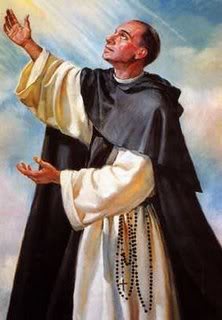
John Masias was born in Ribera, in Spain, and, when very small, he was left as orphan. He was adopted by a kindly uncle who set him to herding his sheep. The little boy was naturally pious, and passed his spare time in sayingthe Rosary. Our Lady and the Christ Child appeared to him several times, and he was often visited by his patron, St. John the Eveangelist, who once showed him a vision of heaven, telling him: “This is my country.”
When John was about twenty, he went to Mass in the church of the Dominicans in a neighboring city. For the moment, it seemed to him that vocation was joining the Friars Preachers now, but St. John appeared to him, telling him he must go elsewhere. In 1619 he embarked for the Indies, where many Spaniards were going, either to convert the natives or to seek a fortune. After a long and hazardous journey, he arrived in Lima.
There were at the time four convents of the Friar Preachers in Lima: the College of St. Thomas; the house of St. Rose, where Sister Rose of St. Mary had died just five years before; Santo Domingo or Holy Rosary, where the holy lay brother, Martin de Porres, was performing such astounding miracles; and the convent of St. Mary Magdalen, which was small and poor. John decided to enter St. Mary Magdalen and, in 1622, he received the habit of a lay brother there. On the night of his profession, devils appeared to tempt and reproach him. He was attacked bodily, and, although he was called on Jesus, Mary and Joseph for help, the demons continued what was to become twelve years of torture, by actually throwing him from one cloister to another.
John was appointed assistant to the porter, and lived in the gatehouse. There the poor came for food, and the rich for advice. He became adept at begging for the poor, always managing to find enough for the more than two hundred people who came daily for help. He had little use for the wealthy and curious, and would sometimes baffle them by simply disappearing while they were looking at hi,. Also, legend relates that he had a little burro that he would send out by itself, with a note asking for what was needed in one of the empty panniers on its back. Told where to go, the burro made his route faithfully; and if the rich man on whom he called was ungracious, or even hid himself to avoid giving alms, the little burro made quite a noise, and it quickly brought the desired results.
Rays of light streamed from the blessed’s face as he taught the catechism to the poor, or prayed by himself in the gatehouse. He said an amazing number of rosaries and made no less than twenty daily visits to the Blessed Sacrament. He is said to have liberated more than a million souls in purgatory, many of whom came back , while he was at prayer , to thank him for his help.
One day a certain ship captain came to the gatehouse and asked to look around. John took him by the arm and led him to the crucifix, warning him to look well on it and think of his sin. Terrified, the captain fell to his knees, confessing that he was an apostate religious, thirty years away from the sacraments, and he begged for a priest. On another occasion, the brothers were building a flight of steps and, having measured a beam wrong, they were annoyed because it did not fit. John took the beam in his hands and stretched it to fit their needs. These, and many other miracles, led people to venerate him as a saint during his lifetime. His recreation was to talk of the things of God with the other holy lay brother, Martin de Porres
At the time of his death, Our Lady, St. Dominic, his patron, St. John and many other saints, came to accompany him to heaven. They were seen by some of the brothers.
Born: March 2, 1585 at Ribera del Fresno, Estramadura, Spain
Died: September 16, 1645 in Lima, Peru of natural causes
Beatified: In 1837 by Pope Gregory XVI
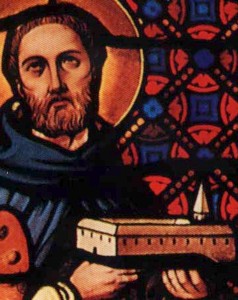
Blessed Bertrand of Garrique

Bertrand was a secular priest under the Cistercians, missioner, and ardent opponent of Albigensianism when he first met Saint Dominic in the party of Bishop Diego. Bertrand may have been the one to recruit Dominic in the battle against the French heretics because they worked closely together in this mission for the rest of their lives.
Bertrand joined the first Dominican friars by receiving the habit at Toulouse in 1216. Dominic left him in charge of the community when he traveled to Rome to seek papal approval of the order. Bertrand’s zeal and experience played an important role in the founding of the Friar Preachers. When the brothers were sent out in little groups on missions, Bertrand was left in Paris with Matthew of France, where he helped to form the Dominican tradition of learning and governed the first foundation at Paris.
While Bertrand’s advice and prayers helped to establish the order, he is best remembered as the closest friend and traveling companion of Saint Dominic, until he was appointed as provincial of Provence. He witnessed the miracles and heavenly favors bestowed upon his friend and provided us with insightful testimony about the heart and mind of the founder.
Bertrand himself was credited with many miracles, both during his life and after his death. Others considered him a “second Dominic” in austerity and holiness, but he humbly overlooked his own claims to sanctity in his loving insistence on those of his friend.
Bertrand was preaching a mission to the Cistercian sisters of Saint Mary of the Woods near Garrigue, when he fell sick and died. He was buried in the sisters’ cemetery until the frequency of miracles suggested that he should be given a more suitable shrine. His relics were lost and shrine destroyed during the religious wars, but pilgrimages were still made to “Saint Bertrand’s Cemetery” until the time of the French Revolution.
Born: at Garrigue, diocese of Nîmes, France, c. 1195
Died: In 1230 he died in Le Bouchet
Beatified: cultus confirmed by Pope Leo XIII in 1881
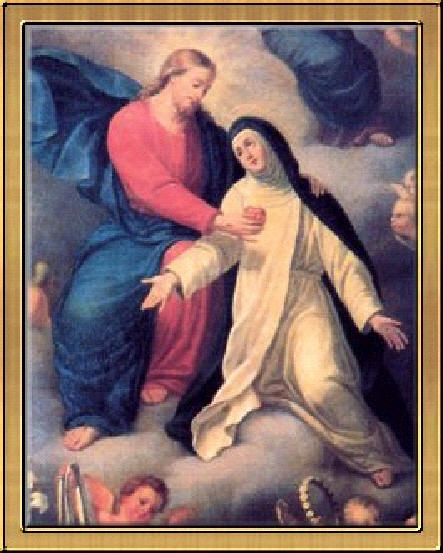
Blessed Catherine of Racconigi

Catherine was born into poverty and hunger following the devastation of war. Her father, an unemployed locksmith, became despondent and quarrelsome as so many do when they lose their livelihood. Her mother supported the family by weaving coarse cloth at home. Catherine and her brother grew up in an atmosphere that was absent the peace of Christ.
Surprisingly, God reached the heart of little Catherine when she was only five. It was then that her mystical experiences began. Our Lady appeared to her while the tiny child was praying alone in her tiny room and told Catherine that Jesus wished to make her His spouse. Then as a child her own age, Jesus himself appeared, accompanied by many other saints including Catherine of Siena and Peter Martyr, and the Blessed Mother place the ring of espousal on her finger. Like the ring of Saint Catherine of Siena, it was visible to today’s saint but could not be seen by others.
Thereafter Catherine had frequent ecstasies and visions. Jesus always appeared to her as a man her own age. He talked with her, taught her how to pray, and several times took her heart away to cleanse it. When He appeared with His Cross, he offered to help Him. He let it rest on her should a moment, and it left a wound for the rest of her life. She also received the stigmata, though it too remained invisible to others and, at her request, it was only revealed by her confessor after her death.
And, of course, Jesus worked many miracles on behalf of His friend: made a broken dish whole again, and provided money and food when the family’s poverty was extreme. In times of trial, the heavenly hosts came to comfort the girl who received great consolation from the aspiration, “Jesus, my hope!”
Because her family opposed her becoming a Dominican, she took the habit of a tertiary. Her mystical experiences roused a storm of gossip among her neighbors, who were terrified at the lights and sounds that came from her home. The devil stirred up more trouble to mitigate her influence over other souls. Even the Dominican fathers ostracized her and eventually she was forced out of town and settled in Racconigi.
There rich and poor sought out Catherine for her wise counsel, prayers, and material assistance. She was almost continually in ecstasy. The particular object of Catherine’s prayers was the salvation of soldiers dying in battle. Numerous miracles occurred before and after her death, and a cult arose at her tomb almost immediately. Even her persecutors were aware of her sanctity and retracted their bitter words.
Born: in the diocese of Cuneo in the Piedmont, Italy, 1487
Died: 1574
Beatified: Pope Pius VII confirmed her holiness and cult in 1810
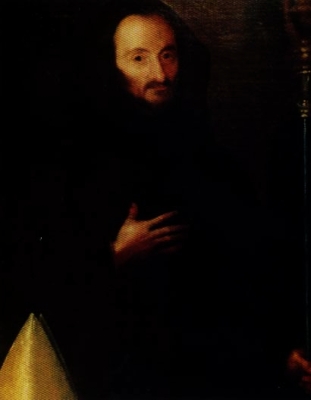
Blessed Guala

Guala was one of the first disciples of Saint Dominic, attracted by the Dominican ideal in 1219, when he heard the founder preach. He received the habit from Dominic at the time the friary opened in Bergamo. After a short novitiate, he was appointed prior there.
Guala proved to be an able superior and a practical administrator and builder. He was on the committee that planed the convent of Saint Agnes in Bologna. During a delay in the construction of the convent because of the opposition of the family of Blessed Diana d’Andalò, who was financing the project, Guala was sent to Brescia to assume the position of its first prior.
During this period Guala had the revelation of Saint Dominic’s greatness that became the subject of many early legends. Although they were good friends, Guala did not know that Dominic was dying on their return from a chapter. Guala had fallen asleep with his head leaning against the belltower of the conventual church at Brescia when he had a vision of two ladders coming down from heaven. Our Lord was visible at the top of one ladder, and Our Lady at the top of the other. Angels were ascending and descending on them. As Guala watched, a friar, who sat at the foot of one ladder with his face covered was drawn up to heaven and great glory surrounded him. Guala awoke, deeply affected by the vision, and went immediately to Bologna, where he found that Saint Dominic had died at the time of his vision.
In 1226, Guala was named the prior of Bologna’s Saint Nicholas abbey, famous for its regularity and fervor. While there, Pope Honorius III appointed him arbiter between Bologna and Modena. Guala worked hard to forge a treaty that lasted 10 years. The following year Pope Gregory IX asked him to negotiate between Emperor Frederick II and the Lombard confederacy–an even more daunting diplomatic task. Guala was also commissioned to convince Frederick to keep his vow to lead a crusade. He was unable to resolve matters between the parties, but at least they maintained the status quo of an uneasy peace.
In 1228, Guala was consecrated bishop of Brescia. As such, he negotiated a number of treaties between warring cities. Frederick broke all the promises he had made and attacked the cities that had remained loyal to the pope. In 1238, Frederick’s army besieged Brescia, but the attackers had to withdraw within three months, which is credited to Guala.
Guala’s contemporaries described him as “a man of great prudence, well acquainted with the world, and of accomplished manners,” and said that “he governed the diocese entrusted to his care with such holiness that, both during his life and after his death, he wrought many wonders through God.”
The years of labor and civil strife wore him down. He resigned his see in 1242 in order to enter complete seclusion and pray without interruption in preparation for death. Therefore, he retired to the Vallumbrosan monastery of San Sepolcro d’Astino, where he lived as a hermit until his death. He was buried in the Benedictine church, and after many miracles at his tomb, his cause was promoted.
Born: in Bergamo, Italy
Died: in San Sepolcro d’Astino, Italy, in 1244
Beatified: cultus approved in 1868 by Pope Pius IX.

Saint Rose of Lima
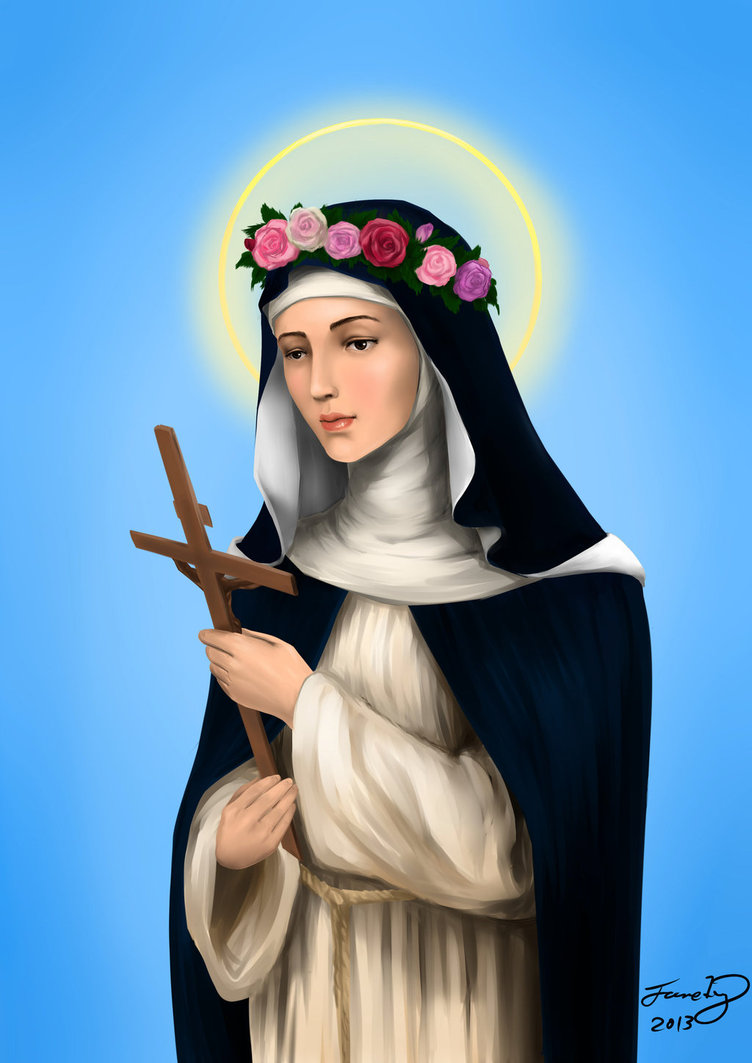
At her confirmation in 1597, she took the name of Rose, because, when an infant, her face had been seen transformed by a mystical rose. As a child she was remarkable for a great reverence, and pronounced love, for all things relating to God. This so took possession of her that thenceforth her life was given up to prayer and mortification. She had an intense devotion to the Infant Jesus and His Blessed Mother, before whose altar she spent hours. She was scrupulously obedient and of untiring industry, making rapid progress by earnest attention to her parents’ instruction, to her studies, and to her domestic work, especially with her needle.
After reading of St. Catherine she determined to take that saint as her model. She began by fasting three times a week, adding secret severe penances, and when her vanity was assailed, cutting off her beautiful hair, wearing coarse clothing, and roughening her hands with toil. All this time she had to struggle against the objections of her friends, the ridicule of her family, and the censure of her parents. Many hours were spent before the Blessed Sacrament, which she received daily.
Finally she determined to take a vow of virginity, and inspired by supernatural love, adopted extraordinary means to fulfill it. At the outset she had to combat the opposition of her parents, who wished her to marry. For ten years the struggle continued before she won, by patience and prayer, their consent to continue her mission.
At the same time great temptations assailed her purity, faith, and constance, causing her excruciating agony of mind and desolation of spirit, urging her to more frequent mortifications; but daily, also, Our Lord manifested Himself, fortifying her with the knowledge of His presence and consoling her mind with evidence of His Divine love. Fasting daily was soon followed by perpetual abstinence from meat, and that, in turn, by use of only the coarsest food and just sufficient to support life.
Her days were filled with acts of charity and industry, her exquisite lace and embroidery helping to support her home, while her nights were devoted to prayer and penance. When her work permitted, she retired to a little grotto which she had built, with her brother’s aid, in their small garden, and there passed her nights in solitude and prayer. Overcoming the opposition of her parents, and with the consent of her confessor, she was allowed later to become practically a recluse in this cell, save for her visits to the Blessed Sacrament.
In her twentieth year she received the habit of St. Dominic. Thereafter she redoubled the severity and variety of her penances to a heroic degree, wearing constantly a metal spiked crown, concealed by roses, and an iron chain about her waist. Days passed without food, save a draught of gall mixed with bitter herbs. When she could no longer stand, she sought repose on a bed constructed by herself, of broken glass, stone, potsherds, and thorns. She admitted that the thought of lying down on it made her tremble with dread. Fourteen years this martyrdom of her body continued without relaxation, but not without consolation. Our Lord revealed Himself to her frequently, flooding her soul with such inexpressible peace and joy as to leave her in ecstasy four hours. At these times she offered to Him all her mortifications and penances in expiation for offences against His Divine Majesty, for the idolatry of her country, for the conversion of sinners, and for the souls in Purgatory.
Many miracles followed her death. She was beatified by Clement IX, in 1667, and canonized in 1671 by Clement X, the first American to be so honored. Her feast is celebrated 30 August. She is represented wearing a crown of roses.
Born:1586 at Lima, Peru as Isabel
Died: August 24, 1617 at Lima, Peru
Beatified: April 15, 1668 by Pope Clement IX
Canonized: April 2, 1671 by Pope Clement X
Representation: anchor; crown of flowers; crown of roses; Holy Infant; roses; Dominican tertiary holding roses; Dominican tertiary accompanied by the Holy Infant
Patronage: against vanity; Americas; Central America; embroiderers; florists; gardeners; India; Latin America; Lima, Peru; needle workers; New World; people ridiculed for their piety; Peru; Philippines; diocese of Santa Rosa, California; South America; vanity; Villareal Samar, Phillipines; West Indies
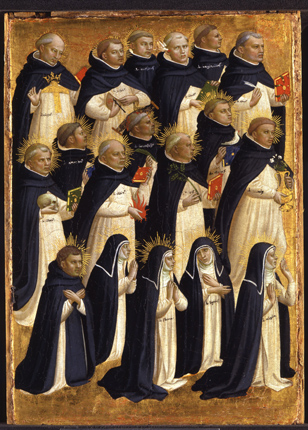
Blessed James of Mevania
Very early in life, prodigies surrounded Blessed James, for on the day of his birth three brilliant stars, each containing the image of a friar preacher, appeared in the sky over Bevagna. Children ran through the streets crying : “To the schools! To the schools! behold the new masters heaven is sending us !” The three preachers were later understood to be James, Blessed Ambrose of Siena, and St. Thomas Aquinas.
James was given a good education and was carefully trained in the ways of holiness. The power of his prayers was seen early. When still a small child, he brought about peace between two quarreling families. At the age of sixteen, he met the Dominicans. Two friars had come to preach in his native city during Lent. Deciding, after much prayer, that God was calling him to the Dominican apostolate, he went home with the two missioners and began his novitiate.
The early promises of his great learning were well fulfilled. In and age that shone with the brilliance of Albert, Thomas and Bonaventure, the preaching of James of Bevagna was still remarkable. He was particularly gifted at reconciling enemies and bringing peace to warring families and cities.
James was very severe with himself, particularly in the matter of poverty. On one occasion, his mother, shocked at the poor condition of the habit he was wearing, gave money to buy a new one. As he wanted very much more to get a crucifix for his cell, he did so. His mother reminded him that the money was given for clothing. James replied with the text, “Put ye on the Lord Jesus Christ,” assuring her that this was the garment he had bought with her gift.
At another time, praying before the same crucifix, James was overcome with a sense of his own unworthiness and begged of God some sign that his soul was to be saved. Blood gushed from the hands and side of the figure on the cross, and a voice from heaven told him that his token of God’s favor would reassure him. Some of the miraculous blood was preserved for more than two centuries. Kept at the tomb of Blessed James, it worked many miracles, but it was stolen by heretics.
Forewarned of the hour of his death, James was assured that Our Lady would come to meet him, because he had often sacrificed to adorn her altars. She came at the time foretold, and James went happily with her into the presence of God.
Born: Bevagna in Umbria, Italy in 1220
Died: 1301 at Mevania, Italy of natural causes
Beatification: 1400 (Cultus confirmed) by pope Boniface IX; again on May 18, 1672 (cultus confirmed) by Pope Clement X
 The Order of Preachers, Independent
You must be logged in to post a comment.