
Category: Dominican Saints
St. James the Apostle (the Greater)
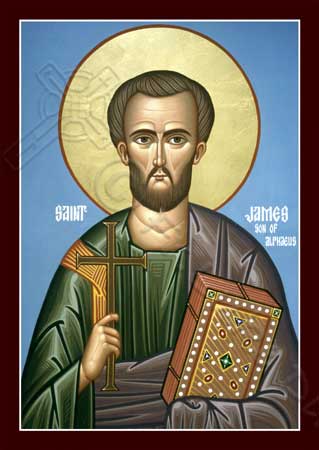 James, The Apostle – (Hebrew Yakob; N.T. Greek Iakobos)
Son of Zebedee and Salome, and brother of John the Apostle.
July 25
It was surely no coincidence that James and his brother John were sons of a fisherman and made their living off the Sea of Galilee. To live near and fish on a lake of that magnitude requires strength, knowledge, understanding, and at certain times of the year, bravery. It also takes fortitude, attention to detail, and temperance. Without all those qualities one could end up seriously hurt or worse yet, tangled in nets sinking to the bottom of the lake. James wasn’t alone in his calling – three others with whom he shared communal life were likewise called by Jesus to follow Him. Eventually they were even called upon to proclaim all they saw to the world. (Simon) Peter and Andrew who were coworkers, and his brother John were also called to follow Jesus around the same time as James. Jesus gathered together those He could trust who would witness the miracle of God’s love.
James was only one of three people Jesus invited to pray with Him in the Garden of Gethsemane. It was there James witnessed the transfiguration and was himself transformed in mind and spirit.
Saint James the apostle is sometimes referred to as the Greater to distinguish him from James the son of Joseph (who is sometimes called James the Lesser). Called to serve, he became a trusted friend and was instructed to serve and love those who followed our Lord. But there is more to James than his being a saint or follower of Jesus – he was first and foremost a hard worker, a friend, and a companion.
James was the first of the 12 apostles to be martyred for the newly forming community of believers. He was killed on the order of King Herod Agrippa I of Judea, about 44 A.D. (Acts 12:1-2) “1- It was about this time that King Herod arrested some who belonged to the church, intending to persecute them. 2 – He had James, the brother of John, put to death with the sword”.
Though we do not know much about the life of James the Greater, we know he was a man trusted by our Lord and he died for the early church. His strength and wisdom continue to guide and direct us all.
Blessed Augustine Fangi of Biella
Miracles around the tomb of Augustine of Biella led to his beatification in 1878, after he had long been forgotten by everyone, except the residents of the little town at the foot of the Alps where he lived. His is another example of a life noted for piety and regularity, but quite unremarkable for unusual events or venturesome projects.
Augustine’s father was a member of the Fangi family, who were wealthy and noble, and, because of this, he had planned a secular career for his son. But when the Dominicans came to Biella, his plans were changed, for Augustine was completely charmed by their way of life and begged to be admitted. He entered, while quite young, the new convent that the Dominicans had built at Biella.
Augustine’s had a reputation for penance, even at a time when people were not as squeamish as they are today. Not only did he inflict harsh penances upon himself, he also bore with patience whatever pain and annoyance life granted him gratuitously. At one time he was required to undergo a surgical operation without, of course, any anesthetic. He did so without making the slightest outcry. In fact, he said afterwards that his mind was so intensely focused on something else that he hardly noticed what was being done to him. His mind was on that “something else” most of the time, for he prayed continually.
In 1464, Augustine was made prior at Soncino. Several of his best known miracles were performed there. At one time, a deformed child, who had died without baptism, was restored to life, by Augustine’s prayer, long enough to be baptized. At another time, when he was passing down the street, he met a little boy who was crying bitterly, because he had broken a jug of wine. Augustine gathered up the shards and put them back together again. Then, with a prayer, he refilled the jug and handed it back to the startled child. Still another time, through his intercession, a woman was delivered from possession of five devils.
Augustine spent his last ten years in the convent in Venice, and he died there on the Feast of Saint Mary Magdalene. He was buried in a damp place. Forty years later, on the occasion of some repairs to the church, his coffin, found floating on water, was opened. His body and habit were still intact. This did much to promote interest in his cause. Nevertheless, it was more than three centuries before he was finally beatified.
Born: at Biella, Italy, 1430
Died: feast of Saint Mary Magdalen 1493 at Venice, Italy; in the 1530s, workmen found his coffin floating in the water that had seeped into the burial chamber – when opened, Augustine’s body and clothing were found to be incorrupt
Cultus Confirmed: in 1872 by Pope Pius IX
Beatified: in 1878 by Pope Leo XIII
Blessed Jane of Orvieto
One of the stigmatists of the Order who deserves to be better known is Blessed Jane of Orvieto, whose marvel-filled life was the edification of Umbria in the latter half of the thirteenth century. Jane was born near Orvieto, in 1264, and both parents died when she was very small. Left to the care of casual neighbors, the little girl gre up with a special reliance of her guardian angel. She was a pious and intelligent child, , spending her time in prayer , even when very young.
Since it was necessary for her to earn her living , Jane studied dressmaking and became proficient at it. For several years she worked at this trade , prayerful and happy and undisturbed about her future. However, she had a number of unhappy experiences on the street on her way to work, for young men were attracted by her beauty. It became apparent to her that she must make some public declaration of her intentions if she wanted any peace. She decided to enter the Third Order of St. Dominic. Dressed in the habit of the mantellate, she would be safe from rude remarks and from any misunderstandings.
Jane’s friends opposed her plans, because they had already helpfully chosen a husband for her, and were trying to arrange a meeting of Jane and the man they had selected. Because of her youth, the Dominicans delayed in accepting her. Only after a long period of prayer and fasting was she able to win the privilege of putting on the Third Order habit and living with the other members of the Tertiary chapter. Once a member of the Order she so much desired , she set her goal at the highest sanctity and worked at attaining it. She prayed all morning and part of the afternoon, leaving herself only time to do enough work to care for her few needs and some alms to give the poor. She soon reached a remarkable state of prayer; she participated bodily in whatever she was contemplating. Her director learned not to say anything that would send her into ecstasy until he was through instructing her. Once he mentioned the martyrdom of Catherine of Alexandria and said piously, “Arise, O blessed Catherine,” and Jane arose, in ecstasy, and remained suspended in the air for an hour. If he talked about the Crucifixion her arms would go out in the form of a cross, and she would rise in the air like a figure on a crucifix. On Good Fridays she experienced the terrible agony of the Passion, and one could hear her bones cracking and see the bloody sweat. She received the stigmata, but it was not always visible.
Along with her remarkable life of prayer, Jane had to contend with physical pain. Once she was cured of a serious illness by a miraculous appearance of our Lord on the cross. He appeared to her in the midst of a bright light and gave her a cup of wine to drink. She obediently drank it, and she was instantly cured. Another time, when she was too ill to go to church to receive Communion , Our Lady came and brought the Holy Child to her.
One of Jane’s principal crosses was the lack of privacy. The whole town knew about her ecstasies. As soon as she fell into one, people came running to look. Jane tired to persuade the prioress to keep them out, but the prioress was interested herself, and saw no reason why anybody should object to being watched if they were not doing anything wrong. Jane wept with embarrassment when people asked for her blessing, and assured them over and over that she was not a saint but a wicked sinner, a diagnosis which nobody believed but herself.
Blessed Jane died, in 1306, and was buried in the Third Order cemetery in Orvieto. The following year her body was transferred to the chapel of the Three Kings, and many prodigies occurred at that time, giving impetus to the process for beatification, which, however, was not completed until more than 400 years later, in 1754.
Born: c.1264 at Carniola, near Orvieto
Died: 1306
Beatified: September 11, 1754 by Pope Benedict XIV (cultus confirmed)
Saint Mary Magdalen, Protectress of the Order
Mary Magdalen is a model of contemplation, and is thus a suitable proctectress for an Order whose end is the salvation of souls by the preaching of the truths contemplated
Mary Magdalen, a sister of Lazarus and of Martha, of Bethany, was a notorious sinner in Jerusalem. Moved by the preaching of Jesus, she did public penance. She went openly into the house of the Pharisee with whom Jesus was sitting at table, threw herself at His feet, anointed them with precious ointment, washed them with her tears, and wiped them with her hair. Jesus, knowing her contrite heart, forgave her her sins (Luke 7:37, 38), and from that time forward she became the most zealous and faithful of the women who were disciples of Our Lord. She followed Him, always ministered unto Him of her substance (Luke 8:3), and when He died was standing under the cross.
Epistle: Canticle 3:2-5; 8:6,7
I will rise and will go about the city; in the streets and the broad ways I will seek him whom my soul loveth; I sought him and I found him not. The watchmen who keep the city found me: Have you seen him whom my soul loveth? When I had a little passed by them, I found him whom my soul loveth. I held him; and I will not let him go till I bring him into my mother’s house, and into the chamber of her that bore me. I adjure you, O daughters of Jerusalem, by the roes and the harts of the fields, that you stir not up, nor awake my beloved till she please. Put me as a seal upon thy heart, as a seal upon thy arm, for love is strong as death; jealousy as hard as hell; the lamps thereof are fire and flame. Many waters cannot quench charity, neither can the floods drown it; if a man should give all the substance of his house for love, he shall despise it as nothing.
The soul that, following the direction of the watchmen, that is, the priests, teachers, and rulers of the Church, seeks Jesus, He goes to meet, gives Himself up to, takes up His abode in, with all His love, with all His treasures. The soul which has found Christ for delight forgets all outward things, and no longer has love or joy but for and in Christ. How should it be otherwise? What can be wanting to him who truly possesses Christ? This love for Him Who loved us unto death shows itself by outward acts that are heroic. So Mary Magdalen loved Jesus. Follow her example.
Gospel: Luke 7:36-50
At that time: One of the Pharisees desired Jesus to eat with him. And He went into the house of the Pharisee, and sat down to meat. And behold a woman that was in the city, a sinner, when she knew that He sat at meat in the Pharisee’s house, brought an alabaster box of ointment, and standing behind, at His feet, she began to wash His feet with tears, and wiped them with the hairs of her head, and kissed His feet, and anointed them with the ointment. And the Pharisee, who had invited Him, seeing it, spoke within himself, saying: This man, if He were a prophet, would know surely who and what manner of woman this is that toucheth Him, that she is a sinner. And Jesus answering, said to him: Simon, I have somewhat to say to thee. But he said: Master, say it. A certain creditor had two debtors, the one owed five hundred pence, and the other fifty. And whereas they had not wherewith to pay, he forgave them both. Which, therefore, of the two loveth him most? Simon answering, said: I suppose that he to whom he forgave most. And He said to him: Thou hast judged rightly. And turning to the woman, He said unto Simon: Dost thou see this woman? I entered into thy house, thou gavest Me no water for My feet; but she with tears hath washed My feet, and with her hairs hath wiped them. Thou gavest Me no kiss; but she, since she came in, hath not ceased to kiss My feet. My head with oil thou didst not anoint; but she with ointment hath anointed My feet. Wherefore I say to thee: Many sins are forgiven her, because she hath loved much. But to whom less is forgiven, he loveth less. And He said to her: Thy sins are forgiven thee. And they that sat at meat with Him began to say within themselves: Who is this that forgiveth sins also? And He said to the woman: Thy faith hath made thee safe, go in peace.
Magdalen, who had sinned openly, openly did penance. In like manner, he who has given public scandal must seek to make amends for it by public good example.
Magdalen confessed her sins, says Saint Ambrose, not with words, but with abundant tears of penitence. To tell her sins to Christ, the All-knowing, was not necessary; but what a confession was there in the posture of humiliation, and in the tears that flowed from the contrite sinner. Would you obtain forgiveness? Confess with contrition, like Magdalen.
The words, “Thy faith hath made thee safe,” denote a faith active as love. Faith and love are in truth never separated, for he only truly believes who also loves; and he only loves according to God’s will who believes in Him. Therefore believe in truth, love, and show your love by earnest hatred of every sin, by flying from occasions of sin, by fighting against your passions, by change of your life, and by humble confession, and as true as God lives you will be saved, as was Magdalen; the peace of God will enter into your heart.
Blessed Ceslaus Odrowatz of Poland
Ceslaus Odrowatz was a near relative, probably a brother, of Saint Hyacinth, and shared with him the apostolate of Northern Europe. Little is known of his youth. He was born in the ancestral castle and educated with Saint Hyacinth, by his uncle, a priest of Cracow.
Both young men became priests and, being well-known for their holiness, were chosen to be canons in the cathedral chapter in Cracow. When their uncle received an appointment as bishop of Cracow, the two young priests accompanied him on his trip to Rome, where he would be consecrated.
It was in Rome that the two zealous young priests first heard of the work of Saint Dominic. The order was then only four years old, and its eager members had penetrated to almost all parts of Christendom and were pushing into the lands of the Tartars and the Mohammedans.
The new bishop strongly desired that some of the friars should come to Poland. Since Saint Dominic was then in Rome, they went to him for missionaries. Dominic was deeply regretful that he had no friars who were able to speak the languages of the North. However, he was much drawn to the bishop’s two young nephews, and promised to make them Dominican apostles if they would remain with him.
After their novitiate training, Hyacinth and Ceslaus went home. Ceslaus went to Prague, and other parts of Bohemia, where he founded convents of Friar Preachers and also established a group of nuns. Then he went to Silesia, where he founded the convent of Breslau that was to become his center of activities. He also acted as the spiritual director for duchess Saint Hedwig of Poland.
The life of Blessed Ceslaus, like that of Saint Hyacinth, is a record of almost countless miracles, of unbelievable distances travelled on foot through wild and warlike countries, and of miracles of grace. He cured the sick and the maimed, raised the dead to life, and accomplished wonders in building convents. His most remarkable miracle was the raising to life of a boy who had been dead for eight days.
In 1241 the Tartars swooped down upon the Christian kingdoms and laid waste the labor of centuries. Blessed Ceslaus was in Breslau at the time the Tartars laid siege to the city. He and his community fasted and prayed incessantly that the city would be saved, and when the cause looked darkest, Ceslaus mounted the ramparts with a crucifix in his hand. While the Tartars gazed in astonishment, a huge ball of fire descended from heaven and settled above him. Arrows of fire shot out from the heavenly weapon, and the Tartars fled in terror, leaving the city unmolested.
Our Lady came to receive the soul of Blessed Ceslaus, who had been tireless in preaching her glories.
Born: c.1180 at Cracow, Poland
Died: July 16, 1242
Beatified:August 27, 1712 by Pope Clement XI (cultus confirmed)
Blessed James of Voragine
James of Voragine has been beatified by the Church for the sanctity of his life. He lives in secular history for quite a different reason-he was a creative genius of his age. His so-called Golden Legends, which has enjoyed a circulation of nearly seven centuries, is only one of several projects which in his time, as in ours, are a tribute to the versatility of the man and the zeal of a saint.
Little is recorder of the childhood of James. He entered the order, in Genoa, and soon was known both for his virtue and for a singularly alert and practical mind. Tradition says that James was the first to translate the Bible into Italian. Whether this is true or not, it is ample evidence that he was a good scholar.
As Prior, provincial, and later Arch-Bishop, James gained a reputation for strict observance, heroic charity, and sound good sense. He was a builder where war had wrecked, a peace maker where others sowed trouble. He must of had a contagious zeal, for the wealthy gave to him as readily as the poor begged from him, and under his hand ruined churches and hospitals were built again, the sick and poor were cared for , and order was restored. He was a genius at getting things done; and , fortunately his whole heart was bent on doing for the glory of God.
Like others of his calling and training, James was first of all a preacher. For those many who could not read, one of the chief means of instruction was sermons which took their key note from the feast of the day. The saints, the stories of their live and examples of their virtues , became as much part of a Christians life as the people around him. The collection of stories – later called The Golden Legend – started as a series of sermons prepared by James for the various festival of the saints. Since he preached in Italian, rather than in Latin, his sermons had immense popular appeal, and they were rapidly copied by other preachers into all the languages of Europe. The Golden Legend was , next to the Bible, the most popular book of the middle ages.
James was rigorous in his observance of the Dominican Rule, which is of itself enough to canonize him. He had also the good sense to make use of changing trends to further the work of God. Today he would be using the radio, the press, the movies, and television; then he used what his century had to offer- sermons in the vernacular, religious drama, and music. How much present day drama and music owed to him, it would be impossible to say. There is an amusing story told of his efforts to fight fire with fire. He organized a troop of jugglers and acrobats from the student novices of San Eustorgio, in Milan, who were to mingle entertainment with doctrine in an effort to combat the indecency of the secular theater. This was one scheme which left no lasting effect on the order, but it does serve to show that James was a man of his times, alert to the changing needs of a fast moving world, and whole heartedly determined to win the world to the truth of the One Holy Catholic Faith by any honest means that came to hand.
Purity, poverty and charity were the outstanding virtues of this man whom the Church has seemed fit to enroll among Her blesseds. He will always be recognized in Dominican history as a man of many and peculiar gifts, who consecrated his talents to God, and, in trading with them , gained heaven.
Born: c.1230 at Varezze (modern Voragine), diocese of Savona, Italy (near Genoa)
Died: July 13, 1298
Beatified: 1816 by Pope Pius VII
Blessed Ignatius Delgado, Blessed Dominic Henares, O.P. & Companions
Continuing the saga of the martyrs of Tonkin, nearly a hundred years after the death of Blessed Peter Martyrs Sanz and companions, two more Dominicans bishops died for the faith . They were Bishop Ignatius Delgado and Bishop Dominic Henares. With them a tertiary catechist died, Francis Chien, and the group (beautified in 1900 by Pope Leo XIII) also includes a Spanish priest, Joseph Fernandez, Father Augustine Schoeffler of the Paris Foreign Mission Society, who was a Dominican Tertiary, and twenty-one native confraternity members.
Of the early years of these martyrs we know little. Both were born in Spain, Bishop Delgado in 1762 and Bishop Henares three years later. From the sentence of condemnation itself we learn that Bishop Delgado had labored for nearly fifty years in Tonkin, which argues that he must have been a resourceful man as well as a zealous one. In 1838 the two bishops and the catechist were captured, in a persecution recently stirred up by the mandarin. The prelates and a young priest had been hidden in the village of Kien-lao, and were accidentally betrayed by a little child who was cleverly questioned by a pagan teacher searching for the foreigners. Alarmed at the sudden activities, the captors of Bishop Delgado put him into a small cage which was locked around him, and then put into jail with criminals.
Communism had made us familiar with the type of questioning that Bishop Delgado had to face. A copy of his trial, which still existed a few years ago, showed that he answered truthfully and fearlessly where he himself was concerned, but that no amount of questioning or torture could make him reveal the whereabouts of his companions. A young priest in another place had taken to his heels when the alarm of the bishop’s arrest was heard, and was still at large. There was no proof that Bishop Henares had been caught, nor the catechists who worked with him. So Bishop Delgado, an old man of seventy six, endured the tortures rather than give any clue as to where they might be found.
The death sentence was passed on Bishop Delgado, and he was left in the open cage under the summer sun, to exist in misery until it should please the mandarin to kill him. Pagans jeered at him and threw waste in his face, and he was deprived of even the simplest necessities. Worn out by suffering but still silent as to his companions’ whereabouts, he died of dysentery before the mandarin was ready to behead him. The enraged solders cut off his head when they found that he had died, and threw the remains into a swift river. Fisherman promptly set about the dangerous business of rescuing the relics.
Bishop Henares was captured with a companion at the same time as Bishop Delgado. He had hidden himself in a boat, and the nervousness of the boatmen gave him away. Five hundred soldiers were detached to bring in the two “dangerous” criminals, the bishop and his catechist, Francis Chien. They too were questioned endlessly, and kept apart from Bishop Delgado. Two weeks after the death of the first bishop, the second was led out and beheaded in company with this catechist.
The relics of all three martyrs were recovered in part, and were honorably buried by the next Dominicans to come on the scene- Bishop Hermosilla and his companions, who would, as they knew, also be the next to die.
We have no information of the twenty-one members of the Confraternity of the Rosary who was honored with the three martyrs of 1838, nor about the Spanish Father Fernandez. Father Augustine Schoeffler of the Paris Foreign Mission Society should likewise hold a place of honor among Dominicans, as he was a Tertiary. Many of the records of these brave men were lost or deliberately destroyed, and many of them- we hope- may still be found in various neglected spots which war and trouble have caused to be overlooked.
Born: Spain: Bishop Ignatius Delgado (November 23, 1761 at Villafeliche, Spain), Dominic Henares (December 19, 1765 at Baena, Spain)
Died:July 12, 1838 of hunger and exposure in Vietnam (Ignatius Delgado), beheaded on June 25, 1838 in Vietnam (Dominic Henares, Francis Chien), Companions- various dates and unknown causes
Beatified: May 27, 1900 by Pope Leo XIII
Saint John of Cologne & Companions
The Reformation gained its foothold in the Netherlands in opposition to the Catholicism of the Spanish princes of the country–not primarily for religious, but rather for political reasons. Anti-Spanish and Calvinist soldiers banded together into lawless armies of pirates, and, unpaid and disillusioned, foraged for themselves in the seaports, looking for plunder.
Reproached by the clergy, they turned on the Church and one band of pirates led by the Gueux laid siege to the city of Gorkum, capturing it in June 26, 1572 after a struggle. For reprisal– because of the city’s determined defense–they gathered all members of the clergy in Gorkum into one miserable prison and set about taking revenge on the priests for their own grievances against the Spanish crown.
The priests were tortured, subjected to all kinds of indignities, and offered their freedom if they would abjure Catholic teaching on the Eucharist and the primacy of the pope. Angered by the endurance of the priests, the Calvinist increased their abuses. Some of the religious were very old and infirm, but one and all, even to an aged Augustinian who was so weak he could barely stand, they bore their martyrdom with patience and sweetness for ten terrible days.
They were repeatedly asked to deny the Real Presence, and just as repeatedly refused, which brought on more and more dreadful tortures. When they continued to refuse, despite a letter from Prince William of Orange ordering their release and protests from the magistrates of Gorkum, they were thrown half-naked into the hold of a ship on July 6, and taken to another city to be killed in the presence of a Protestant nobleman, Admiral Luney, a man noted for his hatred of Catholicism.
After being exhibited to the curious townspeople (who paid to see the spectacle) and subjected to every type of torture, the 19 priests and religious were hanged in an old barn at deserted Ruggen Monastery on the outskirts of Briel. Stripped of their habits and made, like their Master, “the reproach of men and the outcast of the people,” they benefited by their Christ-like sufferings and deaths. Their bodies, mutilated before or after death, were callously thrown into a ditch. The 19 martyrs included eleven Franciscans (called Recollects), two Premonstratensians, one Dominican, one canon regular of Saint Augustine, and four secular priests.
Two of those who died had led less than holy lives, but by their heroic constancy in the hour of trial blotted out the stains that might otherwise have kept them out of heaven. Sadly, there should have been 20 martyrs of Gorkum. One, who weakened and was released after he had denied the Real Presence, lived but 24 hours to enjoy his wretched freedom.
The other 19 gloriously went to heaven. The scene of the martyrdom soon became a place of pilgrimage, where all the Christian world reverenced the men who were so courageously obedient until death. Accounts of several miracles, performed by their intercession and relics, were used for their beatification and published by the Bollandists. Most of their relics are kept in the Franciscan church at Brussels to which they were secretly conveyed from Briel in 1616.
St. John’s companions were:
* Adrian Beanus, O. Praem.
* Adrian van Hilvarenbeek
* Fr. Andrew Wouters, OFM, was a priest at Heinot near Dortrecht. He led a scandalous life, but when the Calvinists tried to compel him to renounce the Catholic faith, he expiated his past by a brave confession, was imprisoned at Briel with the others and hanged.
* Fr. Antony van Hoornaer, OFM
* Fr. Antony van Weert, OFM
* Fr. Antony van Willehad, OFM, from Denmark
* Cornelius van Wyk (near Utrecht), OFM, was born at Dorestat near Utrecht. He took the Franciscan habit at Gorkum as a lay brother.
* Fr. Godefried of Mervel, OFM, was a painter and the custos of the Franciscan house at Gorkum.
* Fr. Godrey van Duynsen, native of Gorkum, was captured with Leonard Vechel and Nicholas Jannsen in Gorkum and sent to Briel, the Netherlands, where they were hanged. Previously, he had been the rector of a school in Paris.
James Lacops, O. Praem., was a native of Oudenarden, Flanders. He was a Norbertine at Middelburg and in 1566 apostatized, wrote, and preached against the Church. Then he repented, returned to his abbey, and was martyred by the Calvinists.
* Fr. Jerome Weerden, OFM, was born in Werden, the Netherlands, in 1522. He spent several years in Palestine as a Franciscan missionary. Jerome was a powerful preacher against Calvinism and at the time of his capture was the vicar of the friary of Gorkum under Saint Nicholas of Pieck.
* Fr. John van Hoornaer, OFM
* John van Oosterwyk, OSA, was a native of the Netherlands who joined the Augustinians at Briel. He was the director and confessor of a community of Augustinian nuns at Gorkum when the town was taken by the Calvinists.
* John of Cologne, OP, was a Dominican religious of his convent in Cologne, Germany who performed the duties of a parish priest in Horner, the Netherlands. When he heard of the plight of the poor priests captured in Gorkum, he left the relative safety of his parish and entered Gorkum in disguise to render whatever assistance he could. Several times he entered the city to dispense the sacraments, and to bring consolation to the priests who were being cruelly tortured. Eventually, he also was taken prisoner and subjected to torture.
* Leonard Vechel (Veehel, Wegel, Wichel), the elder pastor at Gorkum, was born in Bois-le-Duc, Holland. He studied in Louvain, where he earned a great reputation in his theological studies under the celebrated Ruard Tapper, was ordained, and became a parish priest at Gorkum known for his uncommon zeal, piety, eloquence, and learning. He had a remarkable ability to solve difficult problems. He tenderly cared for the poor, especially those that were sick, giving of himself as well as of his substance. He reproved vice without respect of persons, but his meekness and patience disarmed many who had been long deaf to remonstrations. He was in active opposition to Calvinism. He and his assistant Nicholas Jannsen Poppel of Welde, Belgium, were among those seized by a Calvinist mob at Gorkum.
* Fr. Nicholas Janssen Poppel (van Heeze), OFM, a native of Heeze, Brabant, from which he derived the name Nicasius van Heeze, was an associate pastor to Vechel. He was captured with his pastor, Leonard Vechel, and Godrey van Duynsen.
* Fr. Nicholas Pieck–Nicholas was the guardian of the Observant Franciscan house at Gorkum. This eminent, 38-year-old preacher was a native of the Netherlands who studied at Louvain and made missionary activities among the Calvinists his life’s work. He had an intense zeal for holy poverty and mortification, yet his constant cheerfulness rendered piety and penance itself amiable. He is known for repeating, “We must always serve God with cheerfulness.” Fr. Pieck had often expressed an earnest desire for martyrdom, but considered himself unworthy for that honor. He and four other priests were among the first seized when Calvinist forces opposed to the Spanish rule seized the town in June.
* Peter of Assche, OFM, from near Brussels, Belgium, was a Franciscan lay brother at Gorkum.
* Fr. Theodore van der Eem, OFM, from Amersfoort.
Born: Born in Germany in the 16th century
Died: burned, beaten, hanged and mutilated in 1572 at Gorkum, Holland
Canonized: Pope Pius IX canonized them in 1867.
Representation: elevating the Eucharist as he wears a rope around his neck
Blessed Pope Benedict XI, P.C.O.P.
Nicholas Boccasini was born into a poor family of which we know little else, though there are several different traditions concerning it. One claims that his father was a poor shepherd. Another that he was an impoverished nobleman. Whichever he was, he died when Nicholas was very small, and the little boy was put in the care of an uncle, a priest at Treviso.
The child proved to be very intelligent, so his uncle had him trained in Latin and other clerical subjects. When Nicholas was ten, his uncle got him a position as tutor to some noble children. He followed this vocation until he was old enough to enter the Dominican community at Venice in 1254. Here, and in various parts of Italy, Nicholas spent the next 14 years, completing his education. It is quite probable that he had Saint Thomas Aquinas for one of his teachers.
Nicholas was pre-eminently a teacher at Venice and Bologna. He did his work well according to several sources, including a testimonial from Saint Antoninus, who said that he had “a vast store of knowledge, a prodigious memory, a penetrating genius, and (that) everything about him endeared him to all.” In 1295, he received the degree of master of theology.
The administrative career of Nicholas Boccasini began with his election as prior general of Lombardy and then as the ninth master general of the Order of Preachers in 1296. His work in this office came to the notice of the pope, who, after Nicholas had completed a delicate piece of diplomacy in Flanders, appointed him cardinal in 1298.
The Dominicans hurried to Rome to protest that he should not be given the dignity of a cardinal, only to receive from the pope the mystifying prophecy that God had reserved an even heavier burden for Nicholas. As papal legate Nicholas traveled to Hungary to try to settle a civil war there.
Boniface VIII did not always agree with the man he had appointed cardinal-bishop of Ostia and dean of the sacred college. But they respected one another, and in the tragic affair that was shaping up with Philip the Fair of France, Cardinal Boccasini was to be one of only two cardinals who defended the Holy Father, even to the point of offering his life.
Philip the Fair, like several other monarchs, discovered that his interests clashed with those of the papacy. His action was particularly odious in an age when the papal power had not yet been separated completely from temporal concerns.
The French monarch, who bitterly hated Boniface, besieged the pope in the Castle of Anagni, where he had taken refuge, and demanded that he resign the papacy. His soldiers even broke into the house and were met by the pope, dressed in full pontifical vestments and attended by two cardinals, one of whom was Cardinal Boccasini. For a short time it looked as though the soldiers, led by Philip’s councilor William Nogaret, might kill all three of them, but they refrained from such a terrible crime and finally withdrew after Nicholas rallied the papal forces and rescued Boniface from Anagni.
Cardinal Boccasini set about the difficult task of swinging public opinion to the favor of the pope. Successful at this, he stood sorrowfully by when the pontiff died, broken-hearted by his treatment at the hands of the French soldiers. On October 22, 1303, at the conclave following the death of Boniface, the prophesied burden fell upon the shoulders of the cardinal-bishop of Ostia, who took the name Benedict XI.
The reign of Benedict XI was too short to give him time to work out any of his excellent plans for settling the troubles of the Church. Most of his reign was taken up with undoing the damage done by Philip the Fair. He lifted the interdict on the French people that had been laid down by his predecessor and made an uneasy peace with Philip. He worked to reconcile warring parties in Europe and the Church and to increase spirituality. His reign, short though it was, was noted for its leniency and kindness.
There are few personal anecdotes regarding Benedict, but at least one worth telling. Once, during his pontificate, his mother came to the papal court to see him. The court attendants decided that she was too poorly dressed to appear in the presence of the Holy Father, so they dressed her up in unaccustomed finery before allowing her to see her son. Benedict, sensing what had happened, told them he did not recognize this wealthy woman, and he asked them where was the little widow, pious and poorly dressed, whom he loved so dearly.
Benedict XI died suddenly in 1304. He had continued to the end with his religious observances and penances. Some people believed that he had been poisoned, but there has never been any evidence that this was the case. Many miracles were performed at his tomb, and there were several cures even before his burial.
Born: Born in Treviso, Italy, 1240
Papal Ascension: 1303
Died: died in Perugia, Italy, April 25, 1304
Beatified: beatified by Pope Clement XII in 1736
Representation: In art, Pope Benedict wears a Dominican habit and papal tiara, while holding the keys. He is venerated in Perugia.
Blessed Innocent V
Peter of Tarentaise was barely 10 years old when he was admitted to the Dominican Order by Blessed Jordan of Saxony as a boy-novice and sent to Paris to study. Like Saint Thomas Aquinas, Blessed Ambrose of Siena, and other luminaries of the 13th century, he fell under the masterly tutelage of Saint Albert the Great.
He received his master’s degree in theology in 1259, then he taught for some years in Paris, where he contributed a great deal to the order’s reputation for learning. He wrote a number of commentaries on Scripture and the Commentary on the Sentences of Peter Lombard, but he devoted most of his time to the classroom. He soon became famous as a preacher and theologian, and in 1259, with a committee including his friend Thomas Aquinas, composed a plan of study that is still the basis of Dominican teaching.
At age 37, Peter began the long years of responsibility in the various offices he was to hold in his lifetime as prior provincial of France. He visited on foot all Dominican houses under his care, and was then sent to Paris to replace Thomas Aquinas at the University of Paris. Twice provincial, he was chosen archbishop of Lyons in 1272 and administered the affairs of the diocese for some time, though he was never actually consecrated for that see.
The next year Peter was appointed cardinal-archbishop of Ostia, Italy, while still administering the see of Lyons. With the great Franciscan, Saint Bonaventure, assumed much of the labor of the Council of Lyons to which Saint Thomas was hastening at the time of his death. To the problems of clerical reform and the healing of the Greek schism the two gifted friars devoted their finest talents. Before the council was over, Bonaventure died, and Peter of Tarentaise preached the funeral panegyric.
In January 1276, Peter was with Blessed Pope Gregory X when the latter died at Arezzo. The conclave was held in the following month. On January 21, 1276, Peter of Tarentaise received every vote except his own. With a sad heart, he left the seclusion of his religious home to ascend the Fisherman’s Throne as Pope Innocent V.
The reign of the new pope, which promised so much to a harassed people, was to be very brief. But, imbued with the spirit of the early apostles, he crowded a lifetime into the short space given him.
He instigated a new crusade against the Saracens and began reforms in the matter of regular observance. He actually succeeded in solving many of the questions of the Greek schism and in establishing a short-lived truce. He struggled to reconcile the Guelphs and Ghibellines, restored peace between Pisa and Lucca, and acted as mediator between Rudolph of Hapsburg and Charles of Anjou. He restored the custom of personally assisting at choral functions with the canons of the Lateran, and he inspired all with the love that animated his heart.
Had the measures begun by Innocent V had time to be fully realized, he might have accomplished great good for the Church; he did at least open the way for those who were to follow him. Death stopped the hand of the zealous pope when he had reigned only five months. Like his friends Saint Thomas and Saint Bonaventure, he was untouched by the honors and dignity with which he had been favored, and death found him exactly what he had been for more than 40 years–a simple, humble friar.
Born: 1245 at Tarentaise, Burgundy, France as Petrus a Tarentasia
Papal Ascension: 1276
Died: 1277 at Rome of natural causes
Beatified: cult was confirmed by Leo XIII in 1898
 The Order of Preachers, Independent
You must be logged in to post a comment.