
Category: Lesson
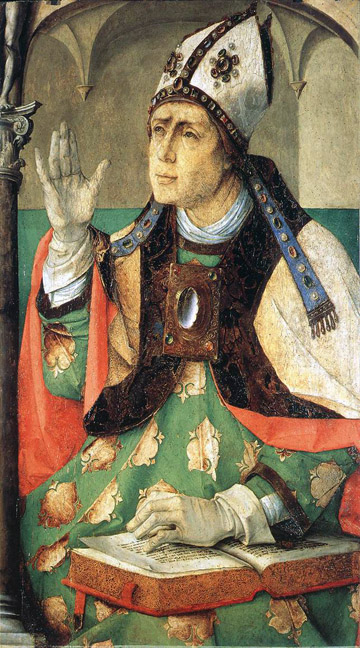
Blessed James of Voragine

James of Voragine has been beatified by the Church for the sanctity of his life. He lives in secular history for quite a different reason-he was a creative genius of his age. His so-called Golden Legends, which has enjoyed a circulation of nearly seven centuries, is only one of several projects which in his time, as in ours, are a tribute to the versatility of the man and the zeal of a saint.
Little is recorder of the childhood of James. He entered the order, in Genoa, and soon was known both for his virtue and for a singularly alert and practical mind. Tradition says that James was the first to translate the Bible into Italian. Whether this is true or not, it is ample evidence that he was a good scholar.
As Prior, provincial, and later Arch-Bishop, James gained a reputation for strict observance, heroic charity, and sound good sense. He was a builder where war had wrecked, a peace maker where others sowed trouble. He must of had a contagious zeal, for the wealthy gave to him as readily as the poor begged from him, and under his hand ruined churches and hospitals were built again, the sick and poor were cared for , and order was restored. He was a genius at getting things done; and , fortunately his whole heart was bent on doing for the glory of God.
Like others of his calling and training, James was first of all a preacher. For those many who could not read, one of the chief means of instruction was sermons which took their key note from the feast of the day. The saints, the stories of their live and examples of their virtues , became as much part of a Christians life as the people around him. The collection of stories – later called The Golden Legend – started as a series of sermons prepared by James for the various festival of the saints. Since he preached in Italian, rather than in Latin, his sermons had immense popular appeal, and they were rapidly copied by other preachers into all the languages of Europe. The Golden Legend was , next to the Bible, the most popular book of the middle ages.
James was rigorous in his observance of the Dominican Rule, which is of itself enough to canonize him. He had also the good sense to make use of changing trends to further the work of God. Today he would be using the radio, the press, the movies, and television; then he used what his century had to offer- sermons in the vernacular, religious drama, and music. How much present day drama and music owed to him, it would be impossible to say. There is an amusing story told of his efforts to fight fire with fire. He organized a troop of jugglers and acrobats from the student novices of San Eustorgio, in Milan, who were to mingle entertainment with doctrine in an effort to combat the indecency of the secular theater. This was one scheme which left no lasting effect on the order, but it does serve to show that James was a man of his times, alert to the changing needs of a fast moving world, and whole heartedly determined to win the world to the truth of the One Holy Catholic Faith by any honest means that came to hand.
Purity, poverty and charity were the outstanding virtues of this man whom the Church has seemed fit to enroll among Her blesseds. He will always be recognized in Dominican history as a man of many and peculiar gifts, who consecrated his talents to God, and, in trading with them , gained heaven.
Born: c.1230 at Varezze (modern Voragine), diocese of Savona, Italy (near Genoa)
Died: July 13, 1298
Beatified: 1816 by Pope Pius VII
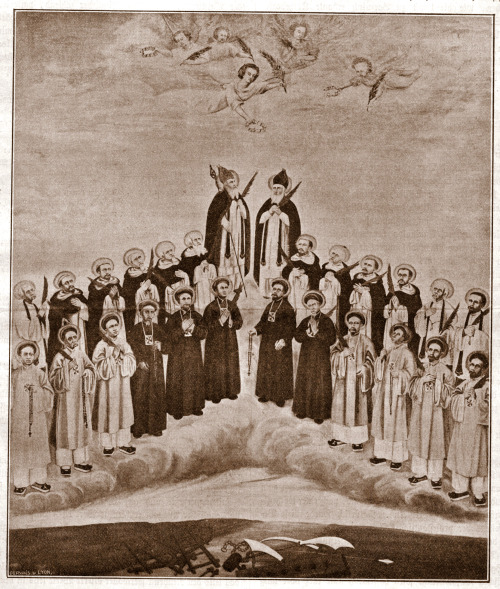
Blessed Ignatius Delgado, Blessed Dominic Henares, O.P. & Companions,

“This stranger, who was introduced clandestinely into the kingdom, spends his life in the study of things of the heart and in meditation on what is incomprehensible…(From the death sentence of Bishop Ignatius Delgado.)”
Continuing the saga of the martyrs of Tonkin, nearly a hundred years after the death of Blessed Peter Martyrs Sanz and companions, two more Dominicans bishops died for the faith . They were Bishop Ignatius Delgado and Bishop Dominic Henares. With them a tertiary catechist died, Francis Chien, and the group (beautified in 1900 by Pope Leo XIII) also includes a Spanish priest, Joseph Fernandez, Father Augustine Schoeffler of the Paris Foreign Mission Society, who was a Dominican Tertiary, and twenty-one native confraternity members.
Of the early years of these martyrs we know little. Both were born in Spain, Bishop Delgado in 1762 and Bishop Henares three years later. From the sentence of condemnation itself we learn that Bishop Delgado had labored for nearly fifty years in Tonkin, which argues that he must have been a resourceful man as well as a zealous one. In 1838 the two bishops and the catechist were captured, in a persecution recently stirred up by the mandarin. The prelates and a young priest had been hidden in the village of Kien-lao, and were accidentally betrayed by a little child who was cleverly questioned by a pagan teacher searching for the foreigners. Alarmed at the sudden activities, the captors of Bishop Delgado put him into a small cage which was locked around him, and then put into jail with criminals.
Communism had made us familiar with the type of questioning that Bishop Delgado had to face. A copy of his trial, which still existed a few years ago, showed that he answered truthfully and fearlessly where he himself was concerned, but that no amount of questioning or torture could make him reveal the whereabouts of his companions. A young priest in another place had taken to his heels when the alarm of the bishop’s arrest was heard, and was still at large. There was no proof that Bishop Henares had been caught, nor the catechists who worked with him. So Bishop Delgado, an old man of seventy six, endured the tortures rather than give any clue as to where they might be found.
The death sentence was passed on Bishop Delgado, and he was left in the open cage under the summer sun, to exist in misery until it should please the mandarin to kill him. Pagans jeered at him and threw waste in his face, and he was deprived of even the simplest necessities. Worn out by suffering but still silent as to his companions’ whereabouts, he died of dysentery before the mandarin was ready to behead him. The enraged solders cut off his head when they found that he had died, and threw the remains into a swift river. Fisherman promptly set about the dangerous business of rescuing the relics.
Bishop Henares was captured with a companion at the same time as Bishop Delgado. He had hidden himself in a boat, and the nervousness of the boatmen gave him away. Five hundred soldiers were detached to bring in the two “dangerous” criminals, the bishop and his catechist, Francis Chien. They too were questioned endlessly, and kept apart from Bishop Delgado. Two weeks after the death of the first bishop, the second was led out and beheaded in company with this catechist.
The relics of all three martyrs were recovered in part, and were honorably buried by the next Dominicans to come on the scene- Bishop Hermosilla and his companions, who would, as they knew, also be the next to die.
We have no information of the twenty-one members of the Confraternity of the Rosary who was honored with the three martyrs of 1838, nor about the Spanish Father Fernandez. Father Augustine Schoeffler of the Paris Foreign Mission Society should likewise hold a place of honor among Dominicans, as he was a Tertiary. Many of the records of these brave men were lost or deliberately destroyed, and many of them- we hope- may still be found in various neglected spots which war and trouble have caused to be overlooked.
Born: Spain: Bishop Ignatius Delgado (November 23, 1761 at Villafeliche, Spain), Dominic Henares (December 19, 1765 at Baena, Spain)
Died: July 12, 1838 of hunger and exposure in Vietnam (Ignatius Delgado), beheaded on June 25, 1838 in Vietnam (Dominic Henares, Francis Chien), Companions- various dates and unknown causes
Beatified: May 27, 1900 by Pope Leo XIII
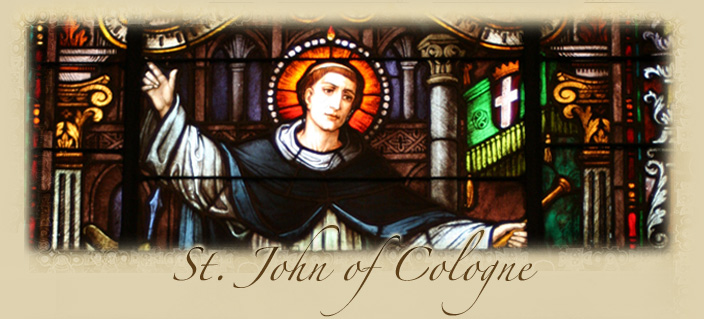
Saint John of Cologne & Companions

The Reformation gained its foothold in the Netherlands in opposition to the Catholicism of the Spanish princes of the country–not primarily for religious, but rather for political reasons. Anti-Spanish and Calvinist soldiers banded together into lawless armies of pirates, and, unpaid and disillusioned, foraged for themselves in the seaports, looking for plunder.
Reproached by the clergy, they turned on the Church and one band of pirates led by the Gueux laid siege to the city of Gorkum, capturing it in June 26, 1572 after a struggle. For reprisal– because of the city’s determined defense–they gathered all members of the clergy in Gorkum into one miserable prison and set about taking revenge on the priests for their own grievances against the Spanish crown.
The priests were tortured, subjected to all kinds of indignities, and offered their freedom if they would abjure Catholic teaching on the Eucharist and the primacy of the pope. Angered by the endurance of the priests, the Calvinist increased their abuses. Some of the religious were very old and infirm, but one and all, even to an aged Augustinian who was so weak he could barely stand, they bore their martyrdom with patience and sweetness for ten terrible days.
They were repeatedly asked to deny the Real Presence, and just as repeatedly refused, which brought on more and more dreadful tortures. When they continued to refuse, despite a letter from Prince William of Orange ordering their release and protests from the magistrates of Gorkum, they were thrown half-naked into the hold of a ship on July 6, and taken to another city to be killed in the presence of a Protestant nobleman, Admiral Luney, a man noted for his hatred of Catholicism.
After being exhibited to the curious townspeople (who paid to see the spectacle) and subjected to every type of torture, the 19 priests and religious were hanged in an old barn at deserted Ruggen Monastery on the outskirts of Briel. Stripped of their habits and made, like their Master, “the reproach of men and the outcast of the people,” they benefited by their Christ-like sufferings and deaths. Their bodies, mutilated before or after death, were callously thrown into a ditch. The 19 martyrs included eleven Franciscans (called Recollects), two Premonstratensians, one Dominican, one canon regular of Saint Augustine, and four secular priests.
Two of those who died had led less than holy lives, but by their heroic constancy in the hour of trial blotted out the stains that might otherwise have kept them out of heaven. Sadly, there should have been 20 martyrs of Gorkum. One, who weakened and was released after he had denied the Real Presence, lived but 24 hours to enjoy his wretched freedom.
The other 19 gloriously went to heaven. The scene of the martyrdom soon became a place of pilgrimage, where all the Christian world reverenced the men who were so courageously obedient until death. Accounts of several miracles, performed by their intercession and relics, were used for their beatification and published by the Bollandists. Most of their relics are kept in the Franciscan church at Brussels to which they were secretly conveyed from Briel in 1616.
St. John’s companions were:
* Adrian Beanus, O. Praem.
* Adrian van Hilvarenbeek
* Fr. Andrew Wouters, OFM, was a priest at Heinot near Dortrecht. He led a scandalous life, but when the Calvinists tried to compel him to renounce the Catholic faith, he expiated his past by a brave confession, was imprisoned at Briel with the others and hanged.
* Fr. Antony van Hoornaer, OFM
* Fr. Antony van Weert, OFM
* Fr. Antony van Willehad, OFM, from Denmark
* Cornelius van Wyk (near Utrecht), OFM, was born at Dorestat near Utrecht. He took the Franciscan habit at Gorkum as a lay brother.
* Fr. Godefried of Mervel, OFM, was a painter and the custos of the Franciscan house at Gorkum.
* Fr. Godrey van Duynsen, native of Gorkum, was captured with Leonard Vechel and Nicholas Jannsen in Gorkum and sent to Briel, the Netherlands, where they were hanged. Previously, he had been the rector of a school in Paris.
James Lacops, O. Praem., was a native of Oudenarden, Flanders. He was a Norbertine at Middelburg and in 1566 apostatized, wrote, and preached against the Church. Then he repented, returned to his abbey, and was martyred by the Calvinists.
* Fr. Jerome Weerden, OFM, was born in Werden, the Netherlands, in 1522. He spent several years in Palestine as a Franciscan missionary. Jerome was a powerful preacher against Calvinism and at the time of his capture was the vicar of the friary of Gorkum under Saint Nicholas of Pieck.
* Fr. John van Hoornaer, OFM
* John van Oosterwyk, OSA, was a native of the Netherlands who joined the Augustinians at Briel. He was the director and confessor of a community of Augustinian nuns at Gorkum when the town was taken by the Calvinists.
* John of Cologne, OP, was a Dominican religious of his convent in Cologne, Germany who performed the duties of a parish priest in Horner, the Netherlands. When he heard of the plight of the poor priests captured in Gorkum, he left the relative safety of his parish and entered Gorkum in disguise to render whatever assistance he could. Several times he entered the city to dispense the sacraments, and to bring consolation to the priests who were being cruelly tortured. Eventually, he also was taken prisoner and subjected to torture.
* Leonard Vechel (Veehel, Wegel, Wichel), the elder pastor at Gorkum, was born in Bois-le-Duc, Holland. He studied in Louvain, where he earned a great reputation in his theological studies under the celebrated Ruard Tapper, was ordained, and became a parish priest at Gorkum known for his uncommon zeal, piety, eloquence, and learning. He had a remarkable ability to solve difficult problems. He tenderly cared for the poor, especially those that were sick, giving of himself as well as of his substance. He reproved vice without respect of persons, but his meekness and patience disarmed many who had been long deaf to remonstrations. He was in active opposition to Calvinism. He and his assistant Nicholas Jannsen Poppel of Welde, Belgium, were among those seized by a Calvinist mob at Gorkum.
* Fr. Nicholas Janssen Poppel (van Heeze), OFM, a native of Heeze, Brabant, from which he derived the name Nicasius van Heeze, was an associate pastor to Vechel. He was captured with his pastor, Leonard Vechel, and Godrey van Duynsen.
* Fr. Nicholas Pieck–Nicholas was the guardian of the Observant Franciscan house at Gorkum. This eminent, 38-year-old preacher was a native of the Netherlands who studied at Louvain and made missionary activities among the Calvinists his life’s work. He had an intense zeal for holy poverty and mortification, yet his constant cheerfulness rendered piety and penance itself amiable. He is known for repeating, “We must always serve God with cheerfulness.” Fr. Pieck had often expressed an earnest desire for martyrdom, but considered himself unworthy for that honor. He and four other priests were among the first seized when Calvinist forces opposed to the Spanish rule seized the town in June.
* Peter of Assche, OFM, from near Brussels, Belgium, was a Franciscan lay brother at Gorkum.
* Fr. Theodore van der Eem, OFM, from Amersfoort.
Born: Born in Germany in the 16th century
Died: burned, beaten, hanged and mutilated in 1572 at Gorkum, Holland
Canonized: Pope Pius IX canonized them in 1867.
Representation: elevating the Eucharist as he wears a rope around his neck
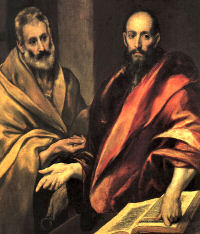
Different But the Same ~ The Rev. Lady Sherwood, OPI
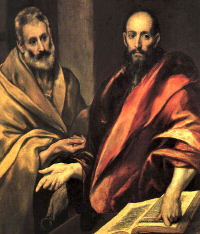
Today we as a church and as Christians come together to commemorate St Peter and St Paul.
Many, when thinking about the early church, mistakenly believe that in the times of Peter and Paul, that the church was filled with love, respect and agreement; but in fact, it was much the same in many ways as the experience we have in churches today. However, there was turmoil, dissension, and disagreement. In the times of Peter and Paul, it was even more difficult than we have it today to iron things out, to come to an agreement that it is today, as we have two thousand years of experience helping us to to deal with issues that the church. In the time of Peter and Paul they didn’t have a history to draw upon to assist them.
Let us look at Peter and Paul. Both Peter and Paul were very gifted church leaders, however both came from entirely different backgrounds. They each had different educational backgrounds and distinct personalities. Due to this, some of the churches, mostly in Corinth, were divided into rival parties depending on whether they preferred Peter or Paul.
What made them so different from each other, these two great church leaders and Apostles?
Peter was a person who had much less education than Paul. He was a fisherman by trade and was married with a family. Peter had the blessed privilege of having both known and worked alongside Jesus during his earthly ministry. Peter was a simple man, who our Lord Jesus chose to lead the other Apostles, but he was also a rather impulsive by nature and would often speak and act without thinking first.
Peter was passionately sincere in his love of our Lord, but seemed to find it difficult to put things into writing and this can be seen if you compare his letters with those of Paul.
Paul, by contrast, was a graduate of the universities of that day. He had been tutored by Gamaliel, who was a famous leader of a school of Rabbis. Largely due to this, Paul knew the scriptures inside-out and was a person who lived strictly by Jewish law. He was fluent in Greek, and knew enough Latin to get by. Paul had spent his early years persecuting Christians, so because of his experience, he was able to see things both from the Jewish and the Christian perspectives.
Because of their differences, Peter and Paul didn’t always get along of agree with each other and we know from Paul’s letter to the Galatians that the two had a major row in Antioch about the question of whether Jews who had converted to Christianity could eat separately from their Gentile brethren.
Paul was firmly in favour of the principle that both Jews and Gentiles should eat together, because he saw that unless this happened, it would lead to two separate Eucharists, one for the Jews and a separate one for the Gentiles in each church and that from there it would only be a short step to rebuilding the division which Our Lord Jesus, through his cross and resurrection had broken down.
Peter, however, felt differently. He felt sorry for the Jewish Christians because they were expected to leave behind the habits they had done all their lives upon becoming Christian. So, he agreed to eat with the Jews separately and even persuaded Paul’s friend, Barnabas to join him.
So although both Peter and Paul had the best of intentions, they both came to see each other as one who was letting the side down.
However, years later, both Peter and Paul were able to make up their differences.
Even in our churches today we see similar issues. We have the people like St Peter, who are kind and generous, and who want the church to be a welcoming place where everyone gets on happily together, but in doing so, are a bit too lenient and cause the message of Christ’s salvation to be blurred.
Then we have people like St Paul, who realise that if the truth which is in Jesus is allowed to be obscured or rejected in the cause of kindness, generosity and inclusion, that the church could end up more like a club of kind people and less like the living Body of Christ on earth, losing the message of salvation.
From their disagreement, we can see that, regardless of our personal beliefs, there are specific truths to which we must cling in order to fully serve the Lord. As our Lord prayed, so do we: That we all may be one, as Christ and the Father are One.
Both Peter and Paul were put to death in a great persecution that had broken out in Rome under the Emperor Nero, following a great fire in AD 64, which Nero probably started and blamed upon the Christians.
We know that before this, Peter had wrote his second letter and had come to realise the importance of Paul, just as Paul had also realised the importance of Peter.
Grant, we pray, O Lord our God, that we may be sustained by the intercession of the blessed Apostles Peter and Paul, that, as through them you gave your Church the foundations of her heavenly office, so through them you may help her to eternal salvation. Through our Lord Jesus Christ, your Son, who lives and reigns with you in the unity of the Holy Spirit, one God, for ever and ever. Amen

Zen Master!!! ~ Br. Chip Noon, Novice
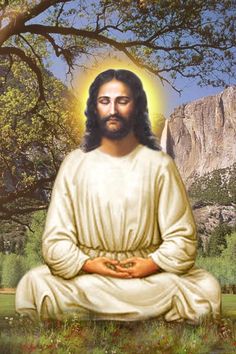
I have always been struck by the similarities of Jesus’ teachings to the koans of the Zen Masters, who were so popular in my youth. “Two hands clap and there is a sound. What is the sound of one hand?” (Hakuin Ekaku) But this one is immediately applicable to today’s readings: “If you meet the Buddha, Kill Him.” (Linji).
Jesus was a Zen Master of his time.
In the first reading, we have the makings of a typical koan:
Elisha left the oxen, ran after Elijah, and said,
“Please, let me kiss my father and mother goodbye,
and I will follow you.”
Elijah answered, “Go back!
Have I done anything to you?”
As we know, Old Testament scripture pre-figured the life and teachings of Jesus, so here we see the Master saying, “Once you start along my path, there is no going back.” It took a simple question to put Elisha on the right path.
In the Koan, the Master Linji is saying that we are always searching for a tangible presence. But Zen teaches that there is no duality: there is no “here” nor “there”; or, there is no “I am searching for enlightenment” nor “I have found enlightenment.” There is no way to describe enlightenment to ourselves or to others. When we reach it, we will know it…and then have no need to discuss it.
Doesn’t Jesus imply the same as Luke records:
“When asked by the Pharisees when the kingdom of God would come, Jesus replied, “The kingdom of God will not come with observable signs. Nor will people say, ‘Look, here it is,’ or ‘There it is.’ For you see, the kingdom of God is in your midst.””
So in today’s Gospel we encounter several other koans. In the first, someone tells Jesus he will follow him wherever he goes. And Jesus answers he has nowhere to go.
Then he says to another, “Follow me.” But the man says he has sacred obligations, that is, to bury his father. Jesus says, “Let the dead bury their dead.”
And the third man asks leave to say goodbye to his family, at which point Jesus says, in metaphor, if you look behind, you will lose your way. Keep your eyes ahead to the Kingdom. In other words, you can only plow a straight furrow if you keep your eyes on your work.
To us today, with all that we have absorbed and been taught about our catholic faith, these scripture readings are somewhat intelligible. Some of us have to work at them, others get the meaning immediately. But imagine the followers of Jesus as they hear these off-the-wall comments from their Rabbi. What must they have thought? We know that some went away confused, and we know that some understood and followed.
But we also know that with the descent of the Holy Spirit, the Apostles and Jesus’ followers were given the answers to these mysterious koans. Would that we could have the answers like that!
But wait! What does the Apostle Paul say in today’s reading to the Galatians?
“I say, then: live by the Spirit
and you will certainly not gratify the desire of the flesh.
For the flesh has desires against the Spirit,
and the Spirit against the flesh;
these are opposed to each other,
so that you may not do what you want.
But if you are guided by the Spirit, you are not under the law.”
Isn’t he saying what the Zen Master said? You can search all you want in this physical realm for God, you can long for heaven in some far off corner of the sky, you can follow all the rules you want, but The Kingdom of God is right here, right now, within, without…in fact, you are the Kingdom of God.
But finally, there is a corollary to these readings. And that is, “Take up your cross and follow me.” In other words, not only are you expected to forget the past, keep your eyes on the prize, and steer straight for the Promised Land. But you are also expected to do some work along the way. As James tells us: “In the same way, faith by itself, if it is not accompanied by action, is dead.”
Then what about that business of “my yoke is easy and my burden is light”? It seems to me the difference here between what Jesus teaches us and how Zen is practiced is that Zen is focused on the individual’s path to enlightenment. Jesus is telling us we have to bring others along on this path.
How appropriate, then, for Dominicans! If the Kingdom is right here, right now, then we are tasked with showing this truth to everyone we meet, right here, right now. There is no holiday, no time off. As Christians we must live our faith, not simply express it. And when you come to think of it, how hard is that? What kind of burden is it to live in the “now” of our faith and knowledge of God’s magnificent goodness as taught to us by the Son and as impelled by the Holy Spirit?
Lord, as we contemplate the meaning of the lessons of scripture, help us to remember that the Kingdom of God is at hand and that all we have to do is stretch out our hands and grasp it.
Amen.
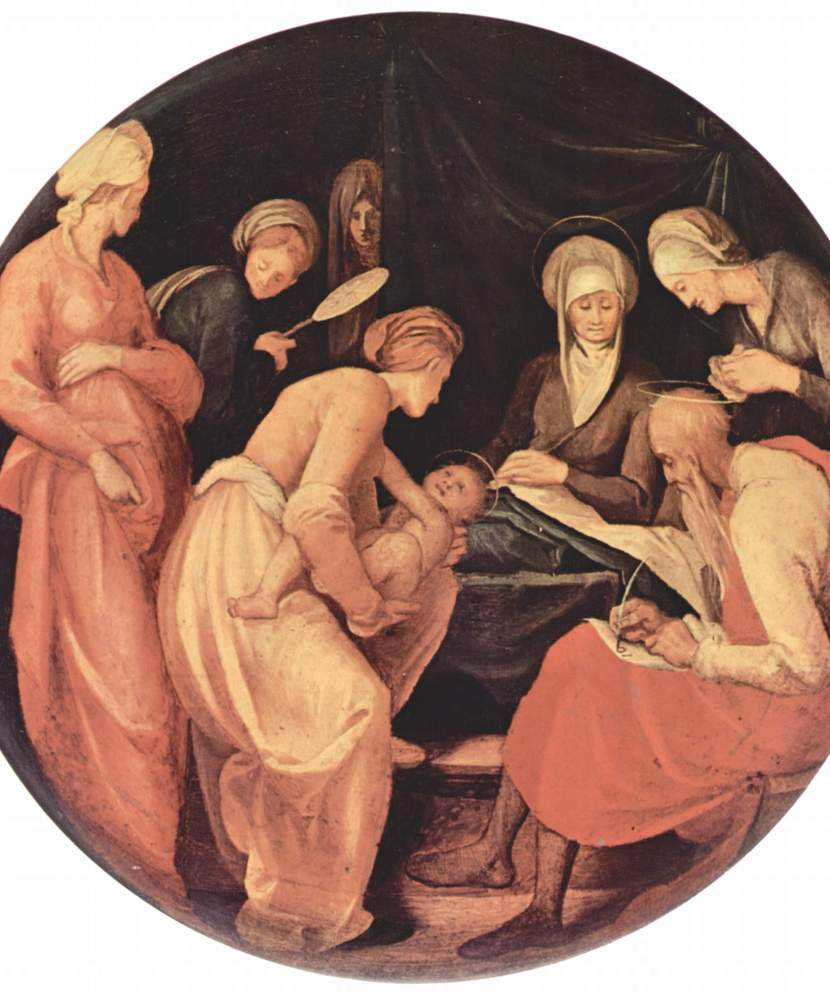
The Nativity of John the Baptist
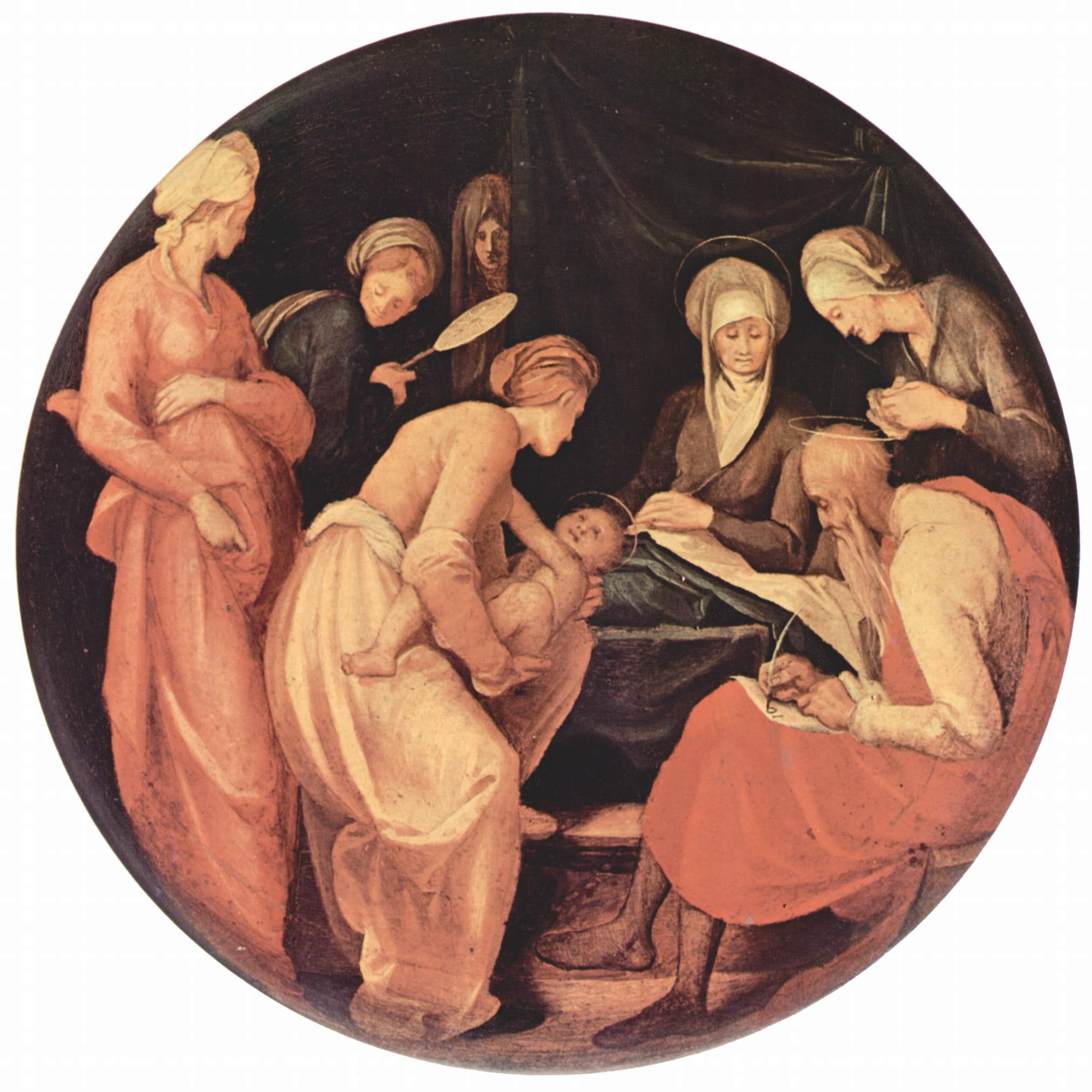
Today, we celebrate the birth of St John the Baptist, the forerunner to the Lord Jesus.
Firstly, let us look together at what the holy scriptures tell us about this blessed and miraculous event in Lk 1:5=25 (NIV):
5 In the time of Herod king of Judea there was a priest named Zechariah, who belonged to the priestly division of Abijah; his wife Elizabeth was also a descendant of Aaron. 6 Both of them were righteous in the sight of God, observing all the Lord’s commands and decrees blamelessly. 7 But they were childless because Elizabeth was not able to conceive, and they were both very old. 8 Once when Zechariah’s division was on duty and he was serving as priest before God, 9 he was chosen by lot, according to the custom of the priesthood, to go into the temple of the Lord and burn incense. 10 And when the time for the burning of incense came, all the assembled worshipers were praying outside. 11 Then an angel of the Lord appeared to him, standing at the right side of the altar of incense. 12 When Zechariah saw him, he was startled and was gripped with fear. 13 But the angel said to him: “Do not be afraid, Zechariah; your prayer has been heard. Your wife Elizabeth will bear you a son, and you are to call him John. 14 He will be a joy and delight to you, and many will rejoice because of his birth, 15 for he will be great in the sight of the Lord. He is never to take wine or other fermented drink, and he will be filled with the Holy Spirit even before he is born. 16 He will bring back many of the people of Israel to the Lord their God. 17 And he will go on before the Lord, in the spirit and power of Elijah, to turn the hearts of the parents to their children and the disobedient to the wisdom of the righteous—to make ready a people prepared for the Lord.” 18 Zechariah asked the angel, “How can I be sure of this? I am an old man and my wife is well along in years.” 19 The angel said to him, “I am Gabriel. I stand in the presence of God, and I have been sent to speak to you and to tell you this good news. 20 And now you will be silent and not able to speak until the day this happens, because you did not believe my words, which will come true at their appointed time.” 21 Meanwhile, the people were waiting for Zechariah and wondering why he stayed so long in the temple. 22 When he came out, he could not speak to them. They realized he had seen a vision in the temple, for he kept making signs to them but remained unable to speak. 23 When his time of service was completed, he returned home. 24 After this his wife Elizabeth became pregnant and for five months remained in seclusion. 25 “The Lord has done this for me,” she said. “In these days he has shown his favour and taken away my disgrace among the people.”
So let us now try to picture this joyous scene:
We have the parents, the Jewish Priest Zechariah and Elizabeth who were both advanced in age and were beyond the child=bearing years. Also, Elizabeth was barren and unable to conceive. The blessings and sheer joy at the birth of their son must have been immeasurable! All the family would have been there celebrating this wonderful event because in those days, the birth of a Son was a major celebration of joy and music. This sadly wasn’t the case in those days for female births. The Lord our God truly blessed his parents by giving them and also us as a world, John.
But the significance of John’s birth,his life and ministry goes way beyond that of a usual birth. John was sent with a purpose, he was sent to be the forerunner who would pave the way for the coming into the world of Our Lord Jesus Christ, and who would also be the person who later baptised our Lord. John the baptist shows us by his life how we truly should be living as a child of God, and there are several lessons we can learn from him. Firstly, whole-hearted belief in Jesus Christ is possible. John could have chosen to believe in and worship any number of gods available to him before Jesus arrived on the scene. But in his life John knew that the Messiah was coming. He believed this with his whole heart and spent his days “preparing the way” for the Lord’s coming (Matthew 11:10). But the road was not an easy one to prepare. Daily he faced doubters of various influence and popularity who did not share his enthusiasm for the coming Messiah. Under hard questioning from the Pharisees, John shared his belief: “‘I baptize with water,’ John replied, ‘but among you stands one you do not know. He is the one who comes after me, the thongs of whose sandals I am not worthy to untie’” (John 1:26-27). John believed in the Christ and his great faith prepared him for hardships, but it kept him steadfast on his course until the time when he could say as he saw Jesus approach, “Look, the Lamb of God, who takes away the sin of the world!” (John 1:29). As believers, we can all have this steadfast faith.
Secondly, anyone can be a strong and devoted witness for Jesus Christ. John’s life is an example to us of the seriousness with which we are to approach the Christian life and our call to ministry, whatever that may be. We pattern our lives after John’s by first examining ourselves to be sure we are truly in the faith (2 Corinthians 13:5). Second, like John, we are to know and believe that “to live is Christ and to die is gain” (Philippians 1:21), so we can be fearless in the face of persecution and death. John lived his life to introduce others to Jesus Christ, and knew the importance of repenting of one’s sins in order to live a holy and righteous life. And as a follower of Jesus Christ, he also was unafraid of calling out people such as Herod and the Pharisees for their sinful behaviour.
Thirdly, John shows us how to stand firm in our faith no matter what the circumstances. Paul reminded Timothy that “everyone who wants to live a godly life in Christ Jesus will be persecuted” (2 Timothy 3:12). But for many of us who live in freedom, persecution takes on a very mild form. As he lived in an occupied country, John had to be aware that anything contrary to utter devotion to the king or emperor was asking for trouble. Yet his message was unchanging, bold and strong. It was John’s belief, his message, and his continual rebuke of King Herod that landed him in prison. While it is hard to know for sure what John was feeling as he sat in prison, we can be sure that he might have had some doubts about the Lord who tested his faith.
Let us look at the examples that we can learn from the birth and life of John the baptist and let us incorporate these lessons more fully within our own lives as the children of God.
Let us pray:
Father, we thank you for sending John the Baptist into the world to prepare the way for the coming of your Son, Our Lord Jesus Christ.
Help us to learn from the examples of his life and to more fully incorporate them into our own lives, so that just as the life of John the Baptist gave you glory, that our lives may also glorify you.
Amen.

Asking Price – Br. Michael Marshall, Novice
 Come undone, surrender is stronger
I don’t need to be the hero tonight
We all want love we all want honor
Nobody wants to pay the asking price
Fall on my knees, fall on my pride
I’m tripping over all the times I’ve lied
I’m asking please, but I can see in your eyes
You don’t need tears for alibis
It’s true what they say
Love must be blind
It’s why You’re still standing by this sinner’s side
You’re still by my side when all the things I’ve done have left you bleeding
Come undone, surrender is stronger
I don’t need to be the hero tonight
We all want love we all want honor
Nobody wants to pay the asking price
This excerpt of lyrics is from one of my favorite Christian songs titled “Undone” by the band FFH. The lyrics are quite bold, are they not??? We may think it is easy being a Christian, yet while the reality is that it is easy to SAY we are Christian, BUT it is not easy to BE a Christian. People open up the Bible to “read” it, throw a couple bucks in the offering plate, and say “I will pray for you”; while in reality they are just looking at the words, give a couple bucks because they feel obligated instead of doing it with the right intention, and the “I will pray for you” is just a phrase that rolls off the tongue to console another person, when no prayer is actually said at all.
In Paul’s Letter to the Galatians, he tells the people that through baptism in Christ the people have become clothed in Christ. He is making a point that they have chosen not only say they have faith, but also are to follow the teachings of Jesus and by doing so they are in God’s favor. Within Christianity, we see people preaching about following Jesus yet not putting what they are preaching into practice. Paul is talking to the Galatians about that very thing. He is instructing the Galatians that there is a responsibility by following Christ, as much as they have faith. Paul is reminding the Galatians, and us, that Jesus said:
“If anyone wishes to come after me, he must deny himself
and take up his cross daily and follow me.
For whoever wishes to save his life will lose it,
but whoever loses his life for my sake will save it.”
In our world today, for example, let us look at condemnation of different groups of people; there is hatred toward them. Love is not being shown toward one’s neighbor, often because a person may be afraid of being persecuted by another “Christian peer”. But is that not what the point Jesus is trying to make??????? We can feel comfortable in saying, “I believe that Jesus died for my sins so I was baptized to show it, I read the Bible and go to church, and I put money in the offering plate.” Sure that is part of being a Christian, but that is merely a “one-way street!” That is saving one’s own life. There is more to it when it comes to being a Christian… We must listen to what God asks of us; do what is right to not save our life, but do what it takes to lose it so that Jesus will save it.
Jesus is quick to boldly tell his disciples not to say in public that he is “The Christ of God”. There is good reason for that related to what we read further in the passage from the Gospel of Luke; where not only does foretelling of the persecution and Passion of Christ will take place, but also will those who choose to believe and follow Jesus will be persecuted for their actions. Jesus bluntly puts it that there is going to be an “asking price” by choosing to follow Christ, and that one has to be willing to accept the negative consequences imposed by humanity; yet that asking price will lead to glory if people choose to accept the consequences.
Now back to the song… The lyrics, “Love must be blind, It’s why You’re still standing by this sinner’s side, You’re still by my side when all the things I’ve done have left you bleeding” is the story of humanity since Jesus’ death and Resurrection. Humanity has continued to mess up, even myself. We have seen it in the Crusades, in racism, in discrimination against women, our LGBTQ brothers and sisters, against minorities, and in oppression of the poor. As much as God continues to love us despite our continual mistakes, people often just use that as an excuse; “God will forgive me”. Or there is some other “justification” like, “The Bible SAYS…” trying to prove some point that people are sinning. The message that Jesus died for our sins is not missed, yet following the example which Christ set before us is totally being missed; the message of love for our neighbor, helping those in need, not pointing the finger. As in the song, if love is blind, then should we not also love everyone blindly, in the way that Christ loves us?
Everybody wants to say they follow Christ, wants others to see it, and wants reward for proclaiming they follow Christ. YET that is not the “asking price”!!! The asking price is truly doing what is right and even facing persecution for doing so. It is not about reading the Bible and spouting out Bible verses to prove one knows the Bible, but rather putting what is read into practice and action, even if it goes against the norm.
Lord, may we truly recognize the asking price which Your Son boldly stated to the disciples and to us through Your Word. Help us to have the courage to put the teachings into action, as much as it is not always easy. This we ask through Christ our Lord. Amen.
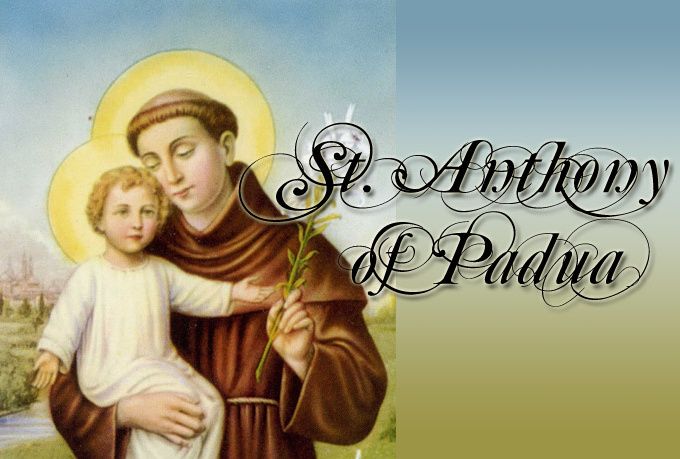
St. Anthony of Padua

St. Anthony of Padua is one of the Catholic Church’s most popular saints. Saint Anthony of Padua, patron saint of lost and stolen articles, was a powerful Franciscan preacher and teacher. He’s typically portrayed holding the child Jesus—or a lily—or a book—or all three—in his arms. Anthony of Padua, also venerated as Saint Anthony of Lisbon, was born in Lisbon, Portugal, which was then a part of Spain, in 1195 A.D., and named Fernando de Bulhoes. He is one of the most beloved Catholic saints today, and he was much loved even in his own time. Saint Anthony’s physical appearance was unremarkable; he was short and slightly plump, but everyone who heard him speak was drawn to him. St. Anthony was known to have a winning smile, a loud voice and a prodigious memory. His fervent faith must have been apparent from a young age, for by fifteen, he had entered the Augustinian Abbey of St. Vincent at Lisbon against his well-to-do family’s wishes.
Then, in 1219, St. Anthony had a portentous meeting with five Franciscans who were on their way to preach to the Muslims in Morocco. The friars were martyred during their mission, and their mutilated bodies brought back to Spain where they were carried in solemn procession. St. Anthony was apparently very moved by the Franciscans’ sacrifice and their simple lifestyle. He asked his order for permission to join the Franciscans, and in the summer of 1220, received his habit. He took the name Anthony, after St. Anthony the Great.
Saint Anthony greatly desired to follow in the footsteps of the five Franciscans who had so affected him, and preach in Morocco, but ill health forced him to return soon after his arrival there. However, his home bound ship was never to reach Spain; a storm forced it to land instead on the coast of Italy. Franciscans there had pity on the ailing Anthony and assigned him to the rural hospice of San Paolo outside of Bologna. In that location, St. Anthony lived as a hermit and worked in the kitchen, his educated background either unknown or ignored.
The hermitage was, in time, visited by a gathering of Dominicans. As that order was known for its preaching, the Franciscans did not prepare a homily themselves. When it was found that the Dominicans had expected their hosts to provide a preacher, the head of the hermitage, in desperation, called upon Anthony to speak some simple words from his heart. The friars were probably hoping at most for a minimal amount of embarrassment in front of the more learned Dominicans. Instead, the whole company was awestruck by the brilliant words emanating from the mouth of St. Anthony. It was the beginning of his fame as a preacher. St. Francis himself learned of St. Anthony’s extraordinary speaking abilities and sent Anthony a note exhorting him to preach to the other Franciscans.
In 1226 the Franciscans chose St. Anthony as an envoy to Pope Gregory IX from the general chapter, and on May 30, 1227 he was elected minister provincial of part of Italy. St. Anthony humbly served as directed but in June of 1230 he asked for release from his duties in order to devote himself to preaching. His request was granted, and from then on, St. Anthony resided in the monastery at Padua where he wrote, among other things, his famous sermons on the saints.
The beloved preacher became ill with dropsy in 1231 and on June 13, now his feast day, he died at the Poor Clare convent in Arcella at the young age of 36. Legend has it that children cried and angels rang bells when St. Anthony died. His body was buried in a chapel, which is now enclosed by the Basilica of St. Anthony in Padua. In 1263, when his relics were transferred to the Basilica, his tongue was found to be still fresh and red in color. Saint Anthony’s was the second fastest canonization in history; he was declared a saint 352 days after his death, by the same Pope Gregory he had met in life .In canonizing Anthony in 1232, Pope Gregory IX spoke of him as the “Ark of the Testament” and the “Repository of Holy Scripture.” That explains why St. Anthony is frequently pictured with a burning light or a book of the Scriptures in his hands.
Heartbreak and Happiness, Compassion and Faith ~ Br. Chip Noon, Novice
What is a parent’s worst nightmare? Those of us who are parents know the answer immediately: the death of a child. What could be more heartbreaking? How could we live the rest of our lives with such grief? How could God let such a thing happen?
Two of today’s readings tell of the death of a child and its return to life. In the first, Elijah “stretched himself out upon the child three times and called out to the LORD: O LORD, my God, let the breath return to the body of this child.” And the child revived and Elijah gave him back to his mother.
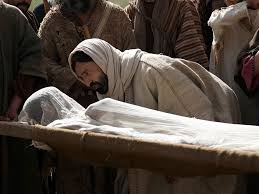
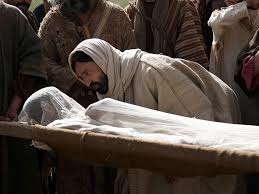
In the second, Jesus sees a funeral cortège and stops the coffin bearers with the touch of his hand on the bier. He says to the mother, a widow of the town of Nain, “Do not weep.” And then he says to the dead man, “Young man, I tell you, arise!” And Jesus gave him to his mother.
How can this be? A worst nightmare comes true, and then is driven away by the resurrection of two dead children?
Now notice in the first reading, the mother berates Elijah. She thinks he has killed her son because of some past transgression of hers. She does not blame God, neither Elijah’s God nor her own, but accuses her guest, whom she acknowledges as a “man of God.”
Without being asked, Elijah takes the boy to the upper room and revives him. This is the first instance of a resurrection in Scripture and it causes the widow of Zarephath to recognize and acknowledge, ““Now I know that you truly are a man of God and that Jehovah’s word in your mouth is truth.”
God, through the actions of Elijah and the declaration of the widow, demonstrates his power on earth.
And so it was in Nain, where Jesus revives another widow’s son. In this Gospel story, Jesus approaches the dead man on his own volition. No one asked him to, no one accused him of causing the death of the young man. But he has pity on her and gives her back her son.
This story is from Luke, Chapter 7. You might remember in Luke 4 Jesus, talking to the people of Nazareth, says:
For instance, I tell you in truth: There were many widows in Israel in the days of Elijah when heaven was shut up for three years and six months, and a great famine came on all the land. Yet Elijah was sent to none of those women, but only to a widow in Zarephath in the land of Sidon.
Why were these women chosen? Why should they be the recipients of a divine miracle and not many others? How does God’s favor fall upon some while some suffer pain and death?
Let us turn to the second reading, Paul’s Epistle to the Galatians. This story too is one of resurrection. Paul’s “revelation” that Jesus is the Christ and that Saul, who persecuted the Christians, will, under a new name, awaken in many a new life with the good news of Jesus Christ. Here also, Saul did not ask for divine assistance. It was thrust upon him as he falls to the ground.
Three different stories, three separate returns to new life, three unasked-for benefits from God.
What could be more joyful? How wonderful to live the rest of their lives with such astonishment? Why did God sanction such things to happen?
The same questions, in reverse, so to speak, we asked at the beginning of this sermon.
Perhaps there is an answer in the Responsorial Psalm:
Hear, O LORD, and have pity on me;
O LORD, be my helper.
You changed my mourning into dancing;
O LORD, my God, forever will I give you thanks.
But even here there is no answer…no clue as to why one is saved and another is thrust down into the pit.
The question that rings through all the ages: “Why me?” And its obverse, “Why not me?” For the good we bear in life and for the troubles we also know. Why? Why not?
But as we pray for an answer, let us go into our own rooms, shut the door, and contemplate. This is what we consider, as Tennyson speaks to us:
Her eyes are homes of silent prayer,
Nor other thought her mind admits
But, he was dead, and there he sits,
And he that brought him back is there.
That is what we know. That is all we know. The rest is faith, isn’t it? He that brought him back is there with her…and with us, is he not?
The readings these last few days in the Liturgy of the Hours have been following the story of Job. Didn’t his friends ask the same questions? But Job says simply, “I know that my redeemer liveth.” He has faith.
Perhaps some need proofs. Perhaps some need miracles. Perhaps some only need faith. What we do know is that God expects us to have faith. Jesus asks us to have faith, and that is what his followers preach to us. The peace that passeth all understanding.
And now, as my prayer, I should like to sing this song with you:
How Great Thou Art
O Lord my God, When I in awesome wonder,
Consider all the worlds Thy Hands have made;
I see the stars, I hear the rolling thunder,
Thy power throughout the universe displayed.
Then sings my soul, My Saviour God, to Thee,
How great Thou art, How great Thou art.
Then sings my soul, My Saviour God, to Thee,
How great Thou art, How great Thou art!
Amen.
Remembrances and Reminders: The Feast of Corpus Christi ~ The Ven. Fr. Jay Van Lieshout, OPI
Souvenirs, mementos, remembrances, heirlooms, treasures, artifacts, chachkies, knickknacks, memories; tokens of the people, places and memories out of our past which we cling to and carry with us as we move on into the future. Grandma’s handkerchief which she always carried in her purse, granddad’s which still smells of his favorite tobacco, the pressed violets you gave mom for Mother’s Day and she always kept in the family Bible, the note wishing you a good morning from a loved one who has gone home; to others they are just “things” but to you they are the most precious relics in the world. We all have them, some more than others. Personally, I do not like a lot of “stuff” but you would never know it. My home is filled with the bits and pieces of the lives of loved ones who have passed on far to soon. Of course I say I am going to clean out the house and attic and only keep the most important things and I start, but haven’t really made much progress these past few years. It’s difficult; each item brings back memories of good times and laughter, and then comes the tears. Why do we collect these mementos and why are they so hard to part with? After all we always have our memories don’t we?
Memories are how we record our own history and where we keep our loved ones alive. We hold their smiles, laughter, hugs and all the little things close to our heart, letting our mind’s eye relive and cherish them over and over. But, alas, we live in a world created by our senses of touch, smell, sight, sound and even taste; memories are ethereal wisps of images and echoes of sound which blur and fade. Yet, when we hold these most sacred artifacts, our past springs back to life crisp and clear. The faint sweet smell of granddad’s pipe transports us back to sitting on his knee while he told his silly stories. Or the texture of grandma’s kerchief as we hold it against our cheek elicits the click of her purse opening up and the wafting smell of peppermint candies and face powder. Yes, these seemingly simple objects are perform miracles in our hands, they erase the years, veil the present, allowing us to revisit our past and bringing our loved ones back to us as if they had never even left.
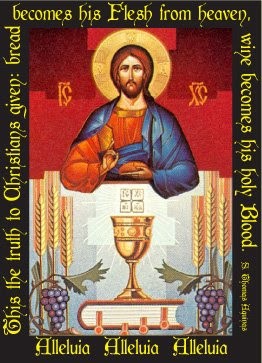
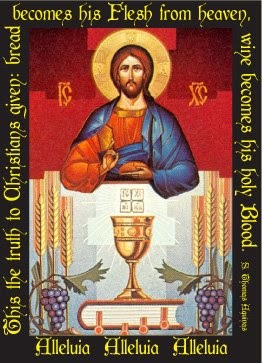
On this 2nd Sunday of Pentecost, we commemorate Corpus Christi-the solemnity of the most Holy Body and Blood of our Lord Jesus Christ. It may seem odd to have a day set aside for that which we celebrate at each and every Eucharist, but it is important to remind us of the gift which we have been given. We call to mind His promises, “I tell you truly that if two of you on the earth agree about anything you ask for, it will be done for you by My Father in heaven. For where two or three gather together in My name, there am I with them” (Matthew 18:20) and “be sure of this: I am with you always, even to the end of the age” (Matthew 28:20). Jesus is with us always, our constant companion, our guide and protector; we carry Him inside us, in our hearts and minds for He is part of who we are as Christians. Each Sunday we relive these promises in the sacrament of His Body and Blood, we hold Him in our hands, we see Him in the Bread and His blood in the Wine and we taste His presence on our tongues; and then, all too quickly, the reality of His presence fades and the Mass ends. Unlike the saints, and the moments of our past, there are no relics of our Lord to cling to, no concrete evidence of Him once walking among us; He ascended into the sacred realm and, though still with us spiritually, we long for a physical presence. Today, we bring to the forefront the reality of God’s covenant, the promise of the real presence of the Son of Man in the ritual of the Eucharist, the living presence of God in the flowing of our blood and His life giving spirit breathing life into us. Today we do more than just eat the bread of life and drink from the cup of the new covenant, we stop, gaze upon, contemplate, adore and most importantly we remember the good news he brought us and gift we have been given in breaking of His body, the surrender of His blood, the redemption in His sacrifice and the hope in His resurrection: Our Lord is with us here, now and always!


You must be logged in to post a comment.