Looking for Jesus ~ Feast of the Holy Family ~ Br. John Carson, Postulant

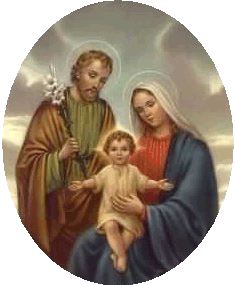
holy family

The Gospel for today:

Each year Jesus’ parents went up to Jerusalem for the feast of Passover, and when he was twelve years old, they went up according to festival custom. After they had completed its days, as they were returning, the boy Jesus remained behind in Jerusalem, but his parents did not know it. Thinking that he was in the caravan, they journeyed for a day and looking for him among their relatives and acquaintances, but not finding him, they returned to Jerusalem to look for him. After three days they found him in the temple, sitting in the midst of the teachers, listening to them and asking them questions, and all who heard him were astounded at his understanding and his answers. When his parents saw him, they were astonished, and his mother said to him, “Son, why have you done this to us? Your father and I have been looking for you with great anxiety”. And he said to them, “Why where you looking for me? Did you not know that I must be in my Father’s house?” But they did not understand what he said to them. He went down with them and came to Nazareth, and he was obedient to them; and his mother kept all these things in her heart. And Jesus advanced in wisdom and age and favour before God and man. Amen.

Today we read in the Gospel the familiar story about the Holy family going to Jerusalem for the Passover.  The Gospel tells us that after the Passover, the Holy Family were on their way back to Nazareth, but the Child Jesus stayed behind without his parents knowing, when his parents found that Jesus was not with their relatives or acquaintances, they looked everywhere for him and they found him in the Temple three days later. Mary said to Jesus that they have been looking for him and Jesus replies, “Did you not know that I was must in my Father’s house,”

How do we fit this story into our daily lives?

We are on a journey where our Jesus is to celebrate the Passover in heaven with the whole company of heaven, with the Holy Family at the right hand of God.

We are also sometimes nowhere to be found when Jesus looks for us and sometimes we close the door so Jesus can’t get through. We are sometimes the ones searching for something and sometimes it is Jesus himself that we are look for.

We find Jesus everywhere, but especially in the Father House, the Church. And also in the Sacraments.

Are we going to be found in our Father’s house or as some Bibles say “dealing with my Father’s affairs?”  are we like Jesus, are we dealing with our Father’s affairs, we as Dominican’s are dealing with our Father’s affairs every time we are doing our ministry, every time we say Mass, preaching, helping the poor, visiting the sick and also praying for the needs of the world.

Our Father’s house is everywhere we do our ministry.

At the end of the Gospel we read that Jesus went back to Nazareth, and was obedient to them.

And that is what we are called to do, be obedient unto death.

Finally, let us pray for each other in the world that we live in, and by the example of the Holy Family and the Child Jesus, be obedient to the teaching of the Church and the our Dominican Rule and our Superiors. Amen.

St. Stephen the Martyr

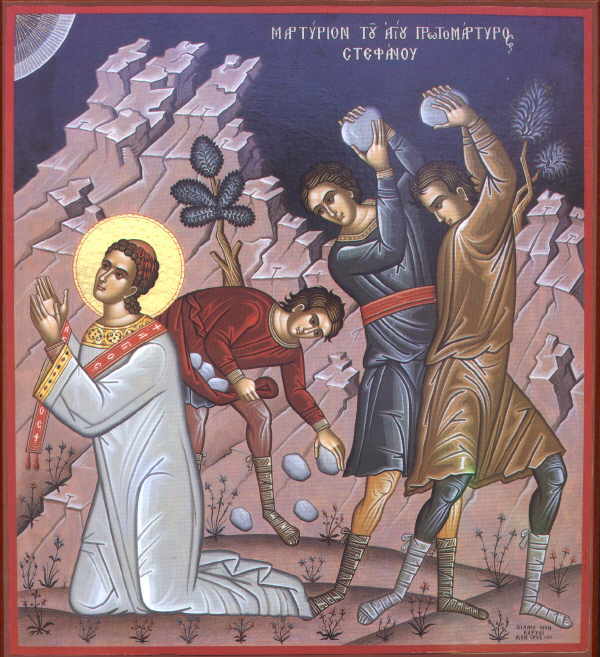
St_Stephen_Martyrdom

Stephen traditionally venerated as the Protomartyr (first martyr) of Christianity and according to the Acts of the Apostles, he was one of the first seven deacons in the early church at Jerusalem and it is stated that he had the face of an angel. Stephen aroused the enmity of members at various synagogues because of his teachings. He was accused of blasphemy and was tried. At his trial, Stephen made a long speech denouncing the Jewish authoritie who were sat in judgement of him and he was sentenced and stoned to death. His martyrdom was witnessed by Saul of Tarus who was a Pharisee who himself would later become a follower of Jesus Christ.

The only primary source of information about St. Stephen is to be found in the New Testament book of Acts of the Apostles and in Acts 6, he is mentioned as one of the Greek=speaking Hellenistic Jews who was chosen to fairly distribute welfare to the Greek=speaking widows.

Stephen is stated to have been full of both faith and the Holy Spirit and to have also performed miracles among the people (Acts 6:58).

Stephen’s name means crown and he was the first of Jesus’s disciples to receive the martyrs crown.

St.Stephen the Martyr has feast day on December 26th.

Let us pray:

O Great St. Stephen, the scriptures tell us that your face was like angel’s as you witnessed to the truth of Christ

Please ask the Most Holy Trinity to  fill my soul and the souls of all my brothers and sisters throughout the world with a deep hunger for the truth that comes from the heart of Jesus, and also with the loving courage to embrace and profess the truth even amid difficulties, confusion and persecution.

May the serenity and peace which were yours at the hour of your stoning be ours as well as we wait in hope for the coming of the Lord Jesus Christ who lives and reigns for ever and ever. Amen.


Unto Us a Child is Born

Christian-Christmas-Eve-Wallpaper-13

The Gospel According to St. Luke

And it came to pass in those days, that there went out a decree from Caesar Augustus that all the world should be taxed.  (And this taxing was first made when Cyrenius was governor of Syria.)  And all went to be taxed, every one into his own city.  And Joseph also went up from Galilee, out of the city of Nazareth, into Judaea, unto the city of David, which is called Bethlehem; (because he was of the house and lineage of David:) To be taxed with Mary his espoused wife, being great with child.

And so it was, that, while they were there, the days were accomplished that she should be delivered.  And she brought forth her firstborn son, and wrapped him in swaddling clothes, and laid him in a manger; because there was no room for them in the inn.  And there were in the same country shepherds abiding in the field, keeping watch over their flock by night. 

And, lo, the angel of the Lord came upon them, and the glory of the Lord shone round about them: and they were sore afraid.  10 And the angel said unto them, Fear not: for, behold, I bring you good tidings of great joy, which shall be to all people.  11 For unto you is born this day in the city of David a Saviour, which is Christ the Lord.

12 And this shall be a sign unto you; Ye shall find the babe wrapped in swaddling clothes, lying in a manger.

13 And suddenly there was with the angel a multitude of the heavenly host praising God, and saying, 14 Glory to God in the highest, and on earth peace, good will toward men.  15 And it came to pass, as the angels were gone away from them into heaven, the shepherds said one to another, Let us now go even unto Bethlehem, and see this thing which is come to pass, which the Lord hath made known unto us.

16 And they came with haste, and found Mary, and Joseph, and the babe lying in a manger.  17 And when they had seen it, they made known abroad the saying which was told them concerning this child.  18 And all they that heard it wondered at those things which were told them by the shepherds.  19 But Mary kept all these things, and pondered them in her heart.  20 And the shepherds returned, glorifying and praising God for all the things that they had heard and seen, as it was told unto them.

The Order of Preachers, Independent, wishes you a most blessed Christmas.

Peace, Peace ~ Br. Chip Noon, Novice

nativity11SMALL

“In the tender compassion of our God
the dawn from on high shall break upon us,
to shine on those who dwell in darkness and the shadow of death,
and to guide our feet into the way of peace.”

Years ago, I was sitting with my mother in her assisted living apartment, reading the Liturgy of the Hours. My mother, who was the most spiritual and “faithful” person I’ve ever known, wanted to hear what I was reading. So I read Zecharaiah’s canticle, “Blessed be the Lord, the God of Israel…”

When I finished she said, “That is beautiful.”

I had never thought of it like that. Leave it to mothers to show us the way!

In my memory, Christmas Eve is a calm, comfortable, warm…perfect night. From the time I was a young child, quivering in anticipation, through my youth, until now in my old age, Christmas Eve has always…well, almost always…had this aura for me. Cozy, some would call it.

O Holy Night! The stars are brightly shining,
It is the night of the dear Saviour’s birth.
Long lay the world in sin and error pining.
Till He appeared and the soul felt its worth.
A thrill of hope the weary world rejoices,
For yonder breaks a new and glorious morn.
Fall on your knees! Oh, hear the angel voices!
O night divine, o night when Christ was born;
O night, O Holy Night, O night divine!

Except for one Christmas Eve.

That was not cozy…nor anything comforting.

I remember vividly, to this day, banging on the dining room window with a wooden block, the kind that had letters and numbers on it, banging so hard my mother was afraid I’d break the glass. I can see my father’s car pulling out of the driveway and going up the street, off to the bar, or the liquor store, or wherever he shouted that he was going. My mother, brother, sister, and I were alone on Christmas Eve. I was crying and bereft. And my mother was comforting us.

My father came back from the infantry in World War II a full-blown alcoholic, as my mother told it. And to tell the truth, Christmas Eve was not always calm, comfortable, warm, nor perfect. But as a child, I fell back on the blessings of the season and willed myself into a Currier and Ives depiction of what I wanted in my life.

I made it comfortable. Today I believe that the Holy Spirit helped us through those difficult times, those Christmas holidays that were so fraught with terror for little kids. Because my mother could see what was beautiful in the world around her.  She made it comfortable for all of us.

What’s past is past. And as my wife recently said to me of difficult people, “One way to look at them is that they are just doing the best they can.”

As an aside here, it’s unnerving to think that you have married a woman just like your mother!

There’s a faith that can bring us peace. A faith in God, as with my mother, and a faith in humanity, as with my wife. Faith. We know that on Christmas Eve, the baby Jesus will be born again in all our minds. And that the promise we have heard will be fulfilled. And we know that our children, family, and friends will either be with us or thinking of us this night. And we know the thrill of hope in the new and glorious morn.

So we fall on our knees. We rejoice in the peace of God, which passeth all understanding. And we find comfort in the dark night, the sounds of the carols, the anticipation of friends, family, and the coming of the infant in the manger.

For no matter what we are facing, we can take comfort in the knowledge that God has said to us that we will have no burden that we cannot bear, that there is a calm in our souls, and that tomorrow will bring a new dawn of love and peace.

Merry Christmas!

Lord, thank you for coming to our help in our times of happiness and our times of sorrow. Thank you for giving us the splendor of your presence in the form of a little child. Thank you for the peace which passeth all understanding. Amen.

Blessed Margaret of Savoy

Маргарита_Савойская_блаженная

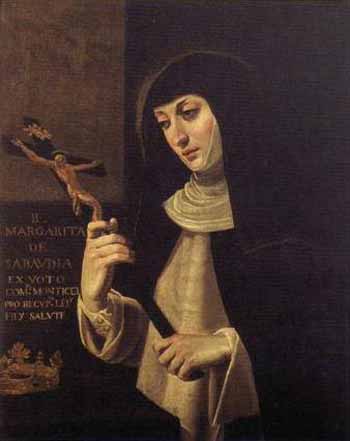
Margaret of Savoy, daughter of Duke Amadeo II, is one of three royal princesses who wore the Dominican habit and were beatified. In the 15th century, she was the glory of a family that has given several beati to the Church.

Born into the royal house of Savoy, Margaret grew up in a household in which piety and wealth were ordinary. Her own parents died when she was small, and she was educated by an uncle, who arranged an early marriage for her to the Marquis of Montferrat, Theodore Paleologus.

As queen of her fairly large domain, Margaret was the model of Christian rulers. She felt that it was her duty to exceed in charity and humility in the proportion that she was wealthier than those around her, and she devoted all of her time to God and to her neighbors. Her husband was a widower with two children, to whom she gave the greatest care. The hundreds of dependents on the large estates came to her for charity and instruction.

Disaster stuck Savoy several times in the years when she was wife and mother. Famine and plague came, making great demands on her time and her courage. Unhesitatingly, she went out to nurse the plague-stricken with her own hands, and she sent out food and clothing from her husband’s stores until it was doubtful if anything would be left. After this crisis passed, war hovered over the kingdom, and she prayed earnestly that they would be delivered from the horrors of invasion.

In 1418, the marquis died. His young widow was one of the most eligible women in Europe. Margaret sorrowed for her husband, but she made it clear to her relatives that they need not plan another marriage for her, as she was going to enter a convent. In order to live a life of complete renunciation, she decided to found a convent of her own at Alba in Liguria that would follow the ancient rule of Saint Dominic. Accordingly, she took over a cloister which had fallen into ruin, having only a few poor inhabitants, and rebuilt it for Dominican use. She dedicated the house to St. Mary Magdalen.

There is one very delightful story told of her sojourn in the convent. When she had been there many years, she one day had a young visitor; he was the son of one of her step-children. Hunting nearby, he had killed a doe, and he brought her the motherless fawn to tend. It was a pretty little animal, and it soon grew to be a pet. One legend was that the fawn was able to go and find any sister she would name, and, for several years, the animal had free rein of the halls and cells of the sisters. Perhaps it was true, though, since the house confessor told her that the deer must go. She took it to the gate and told it to go. It fled into the forest, and returned only when Margaret was about to die.

Margaret attained a high degree of contemplative prayer. One time Our Lord appeared to her and asked her whether she would rather suffer calumny, sickness, or persecution. Margaret generously accepted all three. Her offer was taken, and for the remaining years of her life she suffered intensely from all three sorrows (Dorcy). It should be noted that Saint Vincent Ferrer influenced Margaret to join the Dominican tertiaries (Benedictines).

Rejoice! Rejoice! ~ The Rev. Lady Sherwood, OPI

Good-Christian-Friends-Rejoice-654x300

Rejoice! Rejoice! Our Gift from God is Born! 

The Christmas tree stands proudly and ladened with beautiful decorations. Christmas gifts of all shapes and sizes surround the tree, all prettily wrapped in fancy paper, tied with an array of colourful ribbons and bows.

The faces of happy children all aglow with excitement as they tear open these gifts on Christmas morning. Oh what Joy! 

But the true gift which came from God Our Father, to every single one of us didn’t come wrapped in fancy paper, this precious gift was not fastened with ribbons and bows.

This true gift of pure love and salvation was born in a lowly stable in Bethlehem and his bed was a feeding trough for animals.

This perfect, wondrous and precious gift came down to us from the heavens to free us from the damnation of sin and to be our salvation.

All this he did for us because of the love Our heavenly Father has for us. Our dear Lord! Who left his throne on high to be born lowly on earth amongst us and who would love us to teach us the ways of righteousness. He loves us to the extent that this lowly yet heavenly babe would later give himself willingly up to death upon the cross to atone for our sins, he did this to save us!

Oh such a truly wonderful gift to us from Our Father, even though we are unworthy sinners! A Holy gift of such perfect love!

This is the true gift of Christmas! The gift of God to you, to me, to everyone.

Let us rejoice! Rejoice! Let us offer the Lord praise and thanksgiving! 

Let us accept anew  in our hearts and in our lives this wonderful and incomprehensible gift of pure love and let us with all the heavenly hosts-Rejoice!!

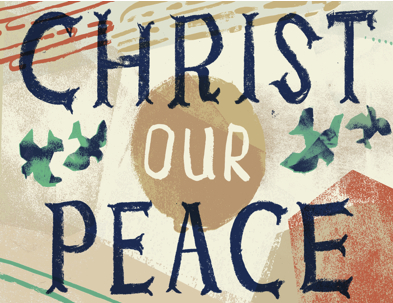
Christ is Our Peace! ~ Br. Michael Marshall, Novice

Christ-Our-Peace-Postcard-2012

Reading 1: Micah 5:1-4a

Thus says the LORD:  You, Bethlehem-Ephrathah too small to be among the clans of Judah, from you shall come forth for me one who is to be ruler in Israel;
whose origin is from of old, from ancient times.  Therefore the Lord will give them up, until the time when she who is to give birth has borne,
and the rest of his kindred shall return to the children of Israel.  He shall stand firm and shepherd his flock by the strength of the LORD,
in the majestic name of the LORD, his God; and they shall remain, for now his greatness shall reach to the ends of the earth; he shall be peace.

Responsorial Psalm: Psalm 80:2-3, 15-16, 18-19

R. (4) Lord, make us turn to you; let us see your face and we shall be saved.
O shepherd of Israel, hearken, from your throne upon the cherubim, shine forth.  Rouse your power, and come to save us.
R. Lord, make us turn to you; let us see your face and we shall be saved.
Once again, O LORD of hosts, look down from heaven, and see; take care of this vine, and protect what your right hand has planted
the son of man whom you yourself made strong.
R. Lord, make us turn to you; let us see your face and we shall be saved.
May your help be with the man of your right hand, with the son of man whom you yourself made strong.  Then we will no more withdraw from you;
give us new life, and we will call upon your name.
R. Lord, make us turn to you; let us see your face and we shall be saved.

Reading 2: Hebrews 10:5-10

Brothers and sisters:  When Christ came into the world, he said:  “Sacrifice and offering you did not desire,
but a body you prepared for me; in holocausts and sin offerings you took no delight.  Then I said, ‘As is written of me in the scroll,
behold, I come to do your will, O God.’“First he says, “Sacrifices and offerings, holocausts and sin offerings, you neither desired nor delighted in.”
These are offered according to the law.  Then he says, “Behold, I come to do your will.”  He takes away the first to establish the second.
By this “will,” we have been consecrated through the offering of the body of Jesus Christ once for all.

Gospel: Luke 1:39-45

Mary set out and traveled to the hill country in haste to a town of Judah, where she entered the house of Zechariah and greeted Elizabeth.
When Elizabeth heard Mary’s greeting, the infant leaped in her womb, and Elizabeth, filled with the Holy Spirit, cried out in a loud voice and said,
“Blessed are you among women, and blessed is the fruit of your womb.  And how does this happen to me, that the mother of my Lord should come to me?
For at the moment the sound of your greeting reached my ears, the infant in my womb leaped for joy.  Blessed are you who believed that what was spoken to you by the Lord
would be fulfilled.”

***************************************************************

 We sometimes use the term coincidence when trying to explain events which turn out a certain way. For example, my mother and I were shopping the other day. A co-worker of my mother bumps into her while we were in the store shopping for the same item, and the co-worker says, “What a coincidence!” Yet, not all things are mere coincidence; they are events set in motion by God. Scripture is full of incidents being foretold by prophets; and these events being foretold are not coincidences by any means. It has been said that the prophet Micah lived 700 years before Christ, and Micah predicted that the Messiah would be born in Bethlehem. Then it turns out that Mary and Joseph were required to go to Bethlehem for the Roman census at the very time that Mary is to give birth… Coincidence??? No, not at all! It was all part of God’s plan, which we refer to as Providence. One of the many lessons God teaches us through the great event of Christmas is the power of his Providence.

God’s Providence is a course of history, wisely and gently, but powerfully and securely without violating free will. Even though people make their own choices, God still is at work in this world, slowly setting things right; guiding a way to peace. Christmas was not THE beginning, but a NEW beginning for the relationship between God and humanity; so this is why the prophet Micah tells us in today’s First Reading that the Messiah, the Christ, will “be our peace.” I PERSONALLY would say that peace is synonymous with love and joy, which are two other aspects of the Advent season. I use the word aspect very loosely because peace is not just an aspect but also an action and emotion conveyed toward another person. We love somebody, and we spread joy among our neighbors.

Because Christ is “our peace”, we have to strive to spread that peace no matter how hard it may be, especially during this time of terrorist attacks. It is easy to pass judgment and display hate toward people of one religion based upon a small number of radical individuals, but that is not what peace is about. But since we are preparing for Christmas, I want to use another example related to the time before Christmas. The “commercialism” of Christmas can be crazy, and peace is often forgotten at the shopping mall. We often take merchandise off the shelf and replace it with the peace we are supposed to share with others as we await Christmas. The “hot ticket item of the year” gets fought over, and sometimes stolen out of cars after being purchased because there were no more in the store. People get into fights over parking spaces or places in line at checkout. But putting peace on the shelf in place of the item to be purchased is not what Advent is about!

OK, SO WHAT IS PEACE ALL ABOUT? WHAT IS ADVENT ALL ABOUT? HOW ARE WE TO ‘SPREAD PEACE?’ HOW ARE WE TO PREPARE FOR ADVENT? ANSWER THESE QUESTIONS…..

How are you going to finish out this Advent Season as you prepare for Christmas? Are you going to react negatively to the terrorist? Are you going to get upset because what you wanted to buy is gone off the shelf? Or are you going to spread peace by helping others, smiling, or even wish someone an early “Merry Christmas”?

What’s in a Name? ~ Br. Chip Noon, Novice

A-name-is-just-a-name-right-3

Is his name Jesus or Emmanuel?

I always had this question growing up, and it fueled many other contradictory statements that I found in the Bible and the Gospels I heard at Mass.

Jesus? Emmanuel? And why is it sometimes spelled Immanuel? And why also is he Jesus Christ or Jesus or, as in Paul’s writings, Christ Jesus?

For a young child, and even for some of us adults, these name switches can be unnerving. (And for now, we’ll leave out all that bit about not having Joseph as his real father…some things are a little too much for kids.)

But wait. Now that I think of it, isn’t that the whole point of the differences between then and now, between good catechesis and the stuff some of us were served up in Sunday school and in homilies? These differences, and sometimes contradictions, confuse us if we are interpreting them from our present lives and experiences…and if we are not taught from an early age that the original language of the Bible was not English, or French, or even Latin.

Let me give an example for a minute: do you remember the exercise where there is a room full of people and one person is told a story. Then she must pass that story, in secret, to the next person, who in turn passes it on, until everyone is filled in. Then the last person tells the whole room the story out loud, and then the first does the same. Usually, there are two very different stories related, to much laughter and some embarrassment.

Now let’s go back to Jesus and Emmanuel.

First of all, his name was Yehoshua, which became Yeshua, which became Yesous in Greek, which became Jesus in English. And of course, there were many variations from the time of his birth to modern English. It means “God saves.” And the angel of the Lord said he should be named this “because he will save them from their sins.”

And then—Emmanuel. This means “God is with us” according to the Gospel for today. This is the same kind of name that we read in Isaiah: “And he will be called Wonderful, Counselor, Mighty God, Everlasting Father, Prince of Peace.

So what are we to do? Unlike in the example of the different stories I just mentioned, we have written records, translated and interpreted as they have been for two thousand years. What we call our Savior is not the issue, though, is it?

Just like children waiting for Christmas and the presents under the tree, the man’s name, the name of the holiday, the narrative, the celebration just gives us some touchstone to refer to when we really mean God will save us from our sins. And when we really mean on this day God came to live among us to show that he is with us.

As we hear in today’s Responsorial Psalm, this is the story we are being told, no matter how many translations there are:

For he shall rescue the poor when he cries out,

and the afflicted when he has no one to help him.

He shall have pity for the lowly and the poor;

the lives of the poor he shall save.

Much of our daily lives are taken up with the surface things. We skim over the underlying meanings because we have context through which to understand them. And sometimes it seems at this time of year we just skim over the “true meaning of Christmas.”

But isn’t this quite natural, since we grow up knowing that Christmas means presents and lots of food and wonderful music.  Truly a magical time…for most of us, that is.

So while today is just a week away from Christmas Day, and while if we were kids we’d be looking forward to school recess and all those presents, let’s just take a moment to dig deeper. To think of the name the angel gave: God will save us from our sins. To think of the name Isaiah prophesied: God is with us.

Think of these names for a moment. Here are presents and celebrations enough to give us thought every day of our lives. Saved from our sins by God who is right here. The heavens don’t have to open for us to be in the company of angels and in the bosom of our Lord. We are already with them and he is in us and we are in him.

As the Lord lives, we have arrived and we know him as he is. It just takes the heart of a child.

Today Lord, help us in our anticipation to know that the wait is over and the fire is lit, the feast is on the table, and the candle is in the window.

Blessed Sebastian Maggi

Bl Sebastian Maggi

Sebastian Maggi lived in a colorful and troubled age, the time of Savonarola; he was, in fact, a friend of the friar of Ferrara and always staunchly defended him.

Sebastian entered the Dominican Order as Brescia as soon as he was old enough. His early years were remarkable only for his devotion to the rule, for the purity of his life, and the zeal with which he enforced religious observance. He was superior of several houses of the order, and finally was made vicar of the reformed congregation of Lombardy, which made him the superior of Jerome Savonarola, the dynamic reformer around whom such a tragic storm was brewing.

Perhaps, if Sebastian Maggi had lived, he might have saved Savonarola from the political entanglements that sent him to his death. Sebastian was his confessor for a long time, and always testified in his favor when anyone attacked the reformer’s personal life. It is hard to say just where he stood politically in the long and complex series of events concerning the separation of Lombard province from the province of Italy. But all that has been written of him conveys the same impression: he was a kind and just superior, who kept the rule with rigid care, but was prudent in exacting it of others.

Several times Sebastian Maggi was sent on missions of reform, and he died on one of these. On his way to a convent for visitation, he became ill at Genoa and died there in 1496. His body is incorrupt at the present time (1963) (Benedictines, Dorcy).

Born: 1414 at Brescia, Italy

Died: 1496 at Genoa, Italy of natural causes; body was still incorrupt in 1963

Beatified: April 15,1760 by Pope Clement XIII (cultus confirmed)

Gifts ~ The Rt. Rev. Michael R. Beckett, OPI

Christmas-Gifts

What you are is God’s gift to you.

What you become is your gift to God.

During this time of the year, many of our thoughts turn to gifts: giving and receiving, what we want to give, what we want to receive, what will please those we love, the shopping, the ordering, the wrapping, the general hustle and bustle of the Christmas season centering around gifts ad infinitum, donating to the people with the red kettles and bells so the less fortunate can have gifts…..

And then there’s the practice of ‘re-gifting,’  passing along that unwanted or unusable gift that we were given, to someone else, so that they will have SOMETHING, and so that they too, can possibly pass that pink and orange and green plaid scarf along, re-gifting it themselves to someone else who won’t use it either….and sometimes by some freak chance that unwanted item comes back to us several years later….and not much too worse for the wear….  And is re-gifting, as amusing (and cheap) as it may seem, necessarily a bad thing?

Why all this focus on gift-giving and gift-receiving at this time of year?  The union of Christmas and gift giving was a gradual one; actually, the full story of the bright packages beneath the tree, like most of our Christmas customs, begins in the days before the birth of Christ.  In ancient Rome, gifts were exchanged during the New Year’s celebrations. At first these gifts were simple, such as a few twigs from a sacred grove and small items of food. Many gifts were in the form of vegetables in honor of the fertility goddess Strenia. During the Northern European Yule, (yep, the yuletide season is a pagan thing) fertility was celebrated with gifts made of wheat products, such as bread and alcohol.

Like many of the old and pagan customs, exchanging gifts was difficult to get rid of even as Christianity spread and gained official status. Early church leaders tried to outlaw the custom, but the people cherished it too much to let it go.  St. John Chrysostom urged no compromise with heathen abominations, but he, too, failed in this tenacity of hanging on to the tradition of gift giving.  Since there was no general agreement about the exact date of the birth of Jesus, it must have seemed helpful to have it supersede the Saturnalia, so the rebirth of the sun became instead the birth of the Son of God, and the church leaders looked for a Christian justification for the practice of all this gift giving. This justification was found in the Magi’s act of bearing gifts to the infant Jesus, and in the concept that Christ was a gift from God to the world, bringing in turn the gift of redemption and everlasting life.

What you are is God’s gift to you.

What you become is your gift to God.

Wikipedia defines a gift as the transfer of something without the expectation of receiving something in return. Although gift-giving might involve an expectation of reciprocity, a gift is meant to be free. By extension the term “gift” can refer to anything that makes the other happier or less sad, especially as a favor, including forgiveness and kindness.

God’s gifts to us are free and clear.  He has given us the gift of His Son, Our Lord and Savior Jesus Christ.       He has given us the gift of eternal life:  “For the wages of sin is death, but the gift of God is eternal life in Christ Jesus our Lord.” Romans 6:23 (NIV);  The gift of salvation:  “For it is by grace you have been saved, through faith—and this is not from yourselves, it is the gift of God.” Ephesians 2:8 (NIV);  And the gifts that are unique to each of us:   “We each of us have our own individual gifts:  But each of you has your own gift from God; one has this gift, another has that.” 1Corinthians 7:7 (NIV)

Besides the obvious gift of His Son, and the forgiveness that we receive through Him whom we receive by faith, what other gifts has God given specifically to you?  What talents have you received?  What blessings have been given to you?

We learn about the 7 Gifts of the Spirit in Isaiah 11:2-3:  “2 The Spirit of the LORD will rest on him— the Spirit of wisdom and of understanding, the Spirit of counsel and of might, the Spirit of the knowledge and fear of the LORD— 3 and he will delight in the fear of the LORD. He will not judge by what he sees with his eyes, or decide by what he hears with his ears;” (NIV)

And more importantly, what are you doing with those gifts?  What are you giving back to God?  What are you “becoming” as you use your gifts and talents?  Which of the gifts that you have been given are you “regifting?”  In other words, when we’ve received a gift from God, do we share that gift with others?  Do we “regift?”  We are told in 1 Peter 4:10, “Each one should use whatever gift he has received to serve others, faithfully administering God’s grace in its various forms.” (NIV)  Jesus himself addresses this very thing in the parable of the talents in Matthew 25:14-30.  By using our gifts, they multiply and we bring others to know God, and by recognizing what we have been given and using them for God’s glory, we are giving back to God.

What is the most precious thing we can give to God?  The most precious gift we can give is what God wants the most. God wants us to make the fervent attempt to repent, get right with Him, and not lead a double life, trying to follow two contradictory paths, but living our lives according to His will.  God simply wants us to give ourselves to Him.  This is the best gift we can give!   Our gift to Him is how we respond to the gifts He has given us which are the gifts of life and of grace. We can best do this when we are headed in His direction, following His precepts with a grateful, willing heart and mindset, and by striving to be the best that we can be by becoming what it is that He wants us to be.

Barbara Streisand sings in “The Best Gift:”

The best gift
That I ever got
Didn’t really weigh a lot
It didn’t have a ribbon ’round
And it sometimes made a terrible sound
The best of all it seems to me
It wasn’t ‘neath the Christmas tree
And yet, I guess I’d have to say
That it made all the other presents twice as gay
The best gift that I’ve ever known
I’d always wanted most to own
Yet in my dreams of sugar and spice
I never thought it could be so nice
The best gift that I ever get
Was sometimes dry and sometimes wet
Was usually pink but oftentimes red
As it lay so innocently in it’s bed
The best gift of the year to me
The one I hold most dear to me
A gift that simply drove me wild
Was a tiny new born child…

As we celebrate the birth of THE tiny newborn Child, God’s greatest and best Gift to us, let us strive to make ourselves the best gift we can give to others, and to God.  Amen.