Follow Me ~ The Rev. Deacon Jay Van Lieshout, OPI

Gaudete, praeparari faceret quem tu praedicas. 

follow me

Be prepared, the Lord is coming.  This is the recurrent cry heard in the readings in this advent season.  Be prepared, make the  mountains low, raise up the valleys and make the paths straight for the coming of the Lord.  What a poetic image these words create on the importance of being prepared.  And today, the 3rd Sunday of advent we hear the introit exclaiming “Gaudete in Domino semper: iterum dico, gaudete!  (Rejoice in the Lord always; again I say, rejoice)!”  The King of Israel is near and it is time to celebrate the arrival of a mighty savior.  Yes, the Messiah is at hand, just 12 more shopping days until Christmas:  are you ready for the festivities?  Is your tree up?  Are all the lights lit?  Do you have the fixings for the feast, the stuffing, the peas and the roast beast?  Are your gifts wrapped, and stockings hung and have you made that pudding with the plums?  Have you readied all for this big affair, surely this is how to be prepared.  Or is it?

We all grasp what it means to be ready for the holiday festivities, yet this has little to do with the being prepared for the joy, the gladness and ecstasy found in this most humble of nativities.  How does one prepare for the coming of the messiah, the King of Kings, the Lord and Savior, the one who brings the peace, the joy and the love of the Creator to all of humanity?  How does one shop and cook for the alpha and omega; do you get Him a tie, make Him cookies and milk?  What do we DO to prepare ourselves for this auspicious arrival of the most Sacred and Holy One?

It’s a very good question, and one asked by the people to whom John the Baptist preached.  And the answer John gave was simple: Practice what you Preach and do the good your faith would have you do.  The good news John brought to the people ahead of Jesus was not novel or revolutionary; it is the message found in the sacred texts, proclaimed by the prophets and promised  to man by the Creator from the dawn of time.  John proclaimed the coming of the Word made Flesh, the manifestation of the truth in their faith here on earth.  John told the crowds that the Christ is the living expression of this truth, the light of creation, the living example of God’s truth. To be prepared to meet the word made flesh, one must live the word; share what you have with those who do not have, take no more than you are due, do not be greedy, do not steal cheat or lie;  practice your faith  in all aspects of your life and you will be prepared.

We all should be practicing our faith in everything we do and say.   Practice your faith, it probably sounds strange to your ears; we think of practice as something one does in sports, like throwing a ball, or in the arts like singing or playing the piano, and faith is like the thoughts we have in our heart or mind.  When I was in college, I had a theology professor who said “faith is something you DO, not something you have”. Those words have stuck with me these many years and they are the key to being prepared.  We must practice,( ie apply, perform, do over and over) our faith (the things God has told us He wants us to do).  Jesus was the living embodiment of the word: He walked, talked and acted according to how God wants each of us to live and act.  He lived out His obligation, His part, OUR part of the covenant with the Creator.  God promises that by living, breathing and acting according to His commands we would always be prepared, and in being prepared the Lord will always be at hand, we will be known for all the good we do, our hearts will for ever rejoice in the Lord and our prayers will be answered.  When we walk the walk, and talk the talk, we will have no fear; no anxiety, for the Lord God will rejoice over us and, as St Paul so adeptly said, “The peace of God that surpasses all understanding will guard our hearts and minds in Christ Jesus.”  Today, Gaudete Sunday, let us be prepared to practice our faith in our home, our work, our places of worship, out on the streets and in the alleys and throughout all aspects of our life.  As you go forth remember, the spirit of the Lord is upon each of you and  you have been anointed to bring glad tidings to the poor, the needy, the outcast and the suffering; live the word, practice your faith, be the good news and you will always be prepared.  Amen.

Leap of Faith – Feast of Our Lady of Guadalupe ~ Br. Michael Marshall, Novice

leap-of-faith

Our Lady of Guadalupe is known as the Patroness of the Americas. In December of 1531, the Blessed Virgin appeared to an Aztec Indian Man by the name of Juan Diego on Tepeyac Hill outside of what is now known as Mexico City. This was a very significant event in the history of religion in Latin America because the Aztec culture and religion was centered on the gods, while the Conquistadors brought Catholicism; and there was a clash between the two for a number of years, eventually the Indian religions disappeared. Many Indian folks converted to Catholicism due to missionary presence in Latin America.

Our Lady of Guadalupe appeared to Juan Diego, as an indigenous woman, asking that a church be built at that location. She told Juan Diego to go to his bishop to tell of this request, only his story to be believed after the fourth apparition. Castilian roses were on the hill which do not grow in that region, or in December for that matter. To prove that the Virgin had appeared again, he cut the roses and put them in his cloak to show the bishop. When Juan Diego addressed the bishop, the image of Our Lady of Guadalupe appeared in the cloak after the roses fell on the ground. The fifth and last apparition was to Juan Diego’s uncle who was ill. Juan Diego was worried about his uncle and the Virgin told him that his ill uncle who was on his deathbed would return to good health.

Images of Our Lady of Guadalupe show her wearing a dress with jasmine flowers and a mantle which has stars. These have reference to the Aztec culture and the Winter Solstice, as she appeared to Juan Diego as an indigenous woman. The impact on her apparition was huge because this was a turning point in which the people connected with Catholicism, instead of through the influence from the Europeans.

The tradition which happens on the Feast of Our Lady of Guadalupe is the Mexican people wake up very early and go to church, and they serenade Mary and pray. Boys dress up as Juan Diego. This tradition is referred to as Las Manañitas. It lasts for several hours. This Feast is a time for the Mexican people, and immigrants to connect with Mary from their own context.

First Reading: Revelation 11:19a; 12:1-6a, 10ab

God’s temple in heaven was opened,
and the ark of his covenant could be seen in the temple.

A great sign appeared in the sky, a woman clothed with the sun,
with the moon under her feet,
and on her head a crown of twelve stars.
She was with child and wailed aloud in pain as she labored to give birth.
Then another sign appeared in the sky;
it was a huge red dragon, with seven heads and ten horns,
and on its heads were seven diadems.
Its tail swept away a third of the stars in the sky
and hurled them down to the earth.
Then the dragon stood before the woman about to give birth,
to devour her child when she gave birth.
She gave birth to a son, a male child,
destined to rule all the nations with an iron rod.
Her child was caught up to God and his throne.
The woman herself fled into the desert
where she had a place prepared by God.

Then I heard a loud voice in heaven say:
“Now have salvation and power come,
and the Kingdom of our God
and the authority of his Anointed.”

Responsorial Psalm: Judith 13:18bcde, 19

  1. (15:9d) You are the highest honor of our race.
    Blessed are you, daughter, by the Most High God,
    above all the women on earth;
    and blessed be the LORD God,
    the creator of heaven and earth.
    R. You are the highest honor of our race.
    Your deed of hope will never be forgotten
    by those who tell of the might of God.
    R. You are the highest honor of our race.

Gospel: Luke 1:26-38

The angel Gabriel was sent from God
to a town of Galilee called Nazareth,
to a virgin betrothed to a man named Joseph,
of the house of David,
and the virgin’s name was Mary.
And coming to her, he said,
“Hail, full of grace! The Lord is with you.”
But she was greatly troubled at what was said
and pondered what sort of greeting this might be.
Then the angel said to her,
“Do not be afraid, Mary,
for you have found favor with God.
Behold, you will conceive in your womb and bear a son,
and you shall name him Jesus.
He will be great and will be called Son of the Most High,
and the Lord God will give him the throne of David his father,
and he will rule over the house of Jacob forever,
and of his Kingdom there will be no end.”
But Mary said to the angel,
“How can this be,
since I have no relations with a man?”
And the angel said to her in reply,
“The Holy Spirit will come upon you,
and the power of the Most High will overshadow you.
Therefore the child to be born
will be called holy, the Son of God.
And behold, Elizabeth, your relative,
has also conceived a son in her old age,
and this is the sixth month for her who was called barren;
for nothing will be impossible for God.”
Mary said, “Behold, I am the handmaid of the Lord.
May it be done to me according to your word.”
Then the angel departed from her.

In the Gospel we find Mary confused as to why she would be chosen to be the mother of the Son of God, but she recognized it was her calling from the Lord. She embraced what the Lord asked of her instead of refusing. Let’s use the saying, “You tell God your plans, and He laughs.” It is often very true because we have hopes and ambitions for ourselves, and what you desire does not always jive with what God desires for you, and sometimes it does jive. Although when your plans do not match God’s, it can be very hard to submit to His will. Yet it takes faith and trust in the Lord that He knows what is best.

I know a fellow who felt called to be a priest, and he entered seminary with the local diocese. Everything felt right during his first year of seminary, and then when he was home for vacation during the summer, he met a gal who he was very attracted to more than being friends. He knew he was in formation so did not act upon those feelings. He returned to seminary in the Fall, and through spiritual direction and prayer, he realized he had to leave formation. The fellow was very confused and torn because he felt called to the priesthood; or at least thought God called him. But he put trust in God because he knew he had to. When returning home, he started to really have a hard time comprehending what happened despite putting trust in God. The gal found out that he had left seminary, so took a shot at asking him out. They dated for some time, and finally got married. As much as leaving seminary was hard for the fellow, he his trust led him to his true calling in life; the calling to be a husband and a father. He is happier in those capacities more than when he was pursuing the priesthood.

When God presents you with something, or asks you to do something, are you going to say no because you have your own desires, or will you trust that God knows what is best? Are you going to accept the task, as Mary did? Are you going to be willing to change directions if God desires it, just as the fellow did? It is not easy to take such a leap of faith… But take that leap because good will come out of it.

The Innkeeper’s Daughter – A Poem for Christmastime ~ Br. Chip Noon, Novice

Nativity_Woman

The Innkeeper’s Daughter

The donkey’s bray resounded cross the yard,
And Sarah looked to see who stopped so late.
A man and wife, with patience, turned to wait
Upon the owner of the inn, on guard,
As if again they would be shown the door
And told to move along, “no shelter here!”
She saw the girl was near her time, so near,
The man looked awkward, beaten, and so poor.
Then Sarah pitied them and said to stay,
Her father owned the inn, she’d talk to him.
The place was full, but would they mind the shed?
The girl looked down, and then began to sway
And sank upon the ground, her face all grim.
Her husband nodded yes, and stroked her head.

Br. Chip Noon, OPI (postulant)

A Joy-Filled Prayer ~ Sister Dollie Wilkinson, OPI

cropped-teach-us-to-pray

     Just a few shorts days ago, we celebrated Thanksgiving. It is a time to reflect on every thing we have to be thankful for: family, good friends, yummy foods, and all the other things that we take for granted throughout the year, We may also turn our thoughts to those less fortunate, and resolve to donate to a worthy cause, volunteer at a soup kitchen, or drop some coins in those Salvation Army red kettles. Now we are in the season of Advent. It is a time for quiet reflection. A time to clear out the mental clutter, so that we may have a deeper relationship with God, the Father.

     As I was reading over the scripture for today, the letter from Paul, to the Philippians, really hit home. Now remember, Paul wrote to the Philippians from prison in Rome in approximately A.D. 61 or 62, about ten years after Paul, Silas, Timothy, and Luke first arrived in Philippi with the gospel message. At the end of Acts, we read about Paul being in prison in Rome awaiting trial. Philippians seems to have been written after the close of Acts but before Paul’s release from his first Roman imprisonment. As Paul writes, he is hopeful of being released soon. Certain statements in Philippians hint that Paul’s trial may have already concluded and that he was only awaiting the verdict of life or death at the time he wrote this scripture. Although the verdict could call for him to be executed, Paul was hopeful, expecting to be released from prison soon.

In Philippians 1:3-11, Paul describes his love for the people of Phillipi, and especially his congregation.

        “I thank my God every time I remember you, constantly praying with joy in every one of my prayers for all of you, because of your sharing in the gospel from the first day until now. I am confident of this, that the one who began a good work among you will bring it to completion by the day of Jesus Christ. It is right for me to think this way about all of you, because you hold me in your heart, for all of you share in God’s grace with me, both in my imprisonment and in the defense and confirmation of the gospel. For God is my witness, how I long for all of you with the compassion of Christ Jesus. And this is my prayer, that your love may overflow more and more with knowledge and full insight to help you to determine what is best, so that in the day of Christ you may be pure and blameless, having produced the harvest of righteousness that comes through Jesus Christ for the glory and praise of God.”

      During his imprisonment, Paul frequently remembered the church and always offered up prayers with joy. Here is a man, in prison, but his thoughts are not about himself, nor whether he will live another day. Besides his love of the heavenly Father, his thoughts, love, and prayers are always for his people. The prayer life that Paul exemplifies puts most of us to shame. You may wish you could pray like he does. Surprisingly, it may not be as hard as you might think. Paul cultivates the discipline of “remembering” (1:3). He consciously and continually trains his mind to reflect on God’s people. This is a discipline, just like working out or eating healthy. But it works wonders in prayer. Here are a couple examples. When you see a little boy on a bike, instead of just thinking, “What a cute kid,” let this boy remind you to pray for the children in your church, or school. When you see a young couple in the mall or in a restaurant, don’t just think: “I wish my marriage was like theirs”, or “I wish I was married”. Or a popular one I hear some days, “I wish I wasn’t married.” Instead, pray for this family, or pray for your own family members.

      When you see someone with gray hair, instead of thinking, “I hope I don’t turn gray or get old.” Instead pray for the seniors citizens in your neighborhood who may live alone. Pray for widows and widowers, who are lonely and in need, to experience God’s provisions. When you hear a different dialect, instead of thinking to yourself, “Hmm, that’s odd sounding”. Or especially with the current events in the world, mumble under your breath, “Oh, its one of those people, the ones who are causing the immigrant crisis”. Instead pray for them and the persecuted church in other countries. Pray that God would strengthen these brothers and sisters as they courageously live for Christ and His gospel. When we practice the discipline of remembering, we can be effective in our prayers.

     How we pray for one another will sometimes determine how we treat one another. If we only pray when the person we are praying for is having problems, how will we view that person when we see them? We will think they always have problems, and they become a burden and not a blessing to us. However, if we are frequently praying prayers of thanksgiving and faith, then we will have a positive view of other people. As Christians, especially for those of us who work in ministry, its may be easy to become cynical or burned out because we deal with so many problems. People come to us when their marriage is in crisis, their child has run away, or they have an illness like cancer. They secretly hope that we can solve their problems. Instead of being pessimistic and irritated, we should thank the Lord for the person’s character, spiritual gifts, their uniqueness. If we can do this, we will then be able to view others the way the apostle Paul does. His joyful prayer to the Philippians, his outpouring of love and concern, should serve as an example, and reminder, that everyone you meet is your congregation, your Church. How will you minister to them? How will you pray for them? We hope with a thankful and joy-filled heart!


Memorial of St. Francis Xavier ~ Mother Lady Sherwood, OPI

sfxSt. Francis Xavier (1506=1552)

Francis was born in Navarre, Spain in the Castle of Xavier. In 1525, he travelled to Paris and it was there that he met St. Ignatius of Loyola and it was he with whom Francis received Holy Orders in Venice in 1537.

In 1540, Francis was sent to evangelize in India. He laboured in Western India, as well as the island of Ceylon, Malacca, Molucca islands and the island of Mindanao in the Philippines as well as in Japan. Francis started a voyage to China in 1552 but died on Sanclan Island.

St. Francis was one of the church’s most illustrious missionaries and he came from a noble Basque family in Spain. He did his studies at the university of Paris where he then taught Philosophy after first obtaining his degree as Master of Arts. It was whilst at this university that he met Ignatius of Loyola and he was enrolled as one of the first seven Jesuits.

Francis and Ignatius decided to travel to the Holy land, but were prevented from doing so due to a war between the Turks and Venice, so for a time Francis laboured at Padua, Bologna, and in Rome.

In 1540, Ignatius chose Francis as the first missionary serving the Portuguese East Indies.Francis sailed from Lisbon, in the company of four papal briefs which made him nuncio with full powers and they recommended him to the Eastern Princes. 

Francis landed at Goa and his vast apostolate which lasted over ten years in duration began there. There Francis instructed the adults, gathered the children by the ringing of a bell in the streets, he catechized them, and he he also served by visiting the hospitals and prisons. After this, Francis turned to teaching the native Indians, doing so by fitting the verses to the tunes of popular songs.

Francis then travelled to Cape Comorin and there he began the conversion of paravas, and it was here that on some days he baptised so many people that at nights through fatigue, he was unable to lift his arm.

From here he travelled to Travencore where in various villages he founded forty=five churches.

Next he travelled to Malacca in Malaya where he spent the next eighteen months going from island to island, preaching, instructing and baptising.

When Francis arrived back in Goa, he heard of vast numbers of souls that were awaiting them in Japan, so he took along some companions and set sail arriving in Kagoshima in 1549, where he learned the language, preached and taught with huge success.

In 1551, Francis returned to Malacca to revisit his converts there and it was whilst on this visit that the new goal of Pagan China loomed up, but he was not to reach it.

Francis arrived on the Island of Sancian at the mouth of the Canton river and here became ill with a fever and would’ve died on the sands of the shore but a poor man named Alvarez found him and took him to his hut. Here Francis lingered for two weeks, praying in between his bouts of delirium and he finally died with his eyes tenderly fixed upon his crucifix.

Francis was buried in a shallow grave and his body was covered with quicklime and when his body was exhumed three months later, it was found to be fresh and incorrupt. His body was taken to Goa where it is still enshrined.

St. Francis Xavier was proclaimed Patron of foreign Missions and of all Missionary works by Pope St. Pius X.


Blessed John of Vercelli

BlessedJohnVercelli150

John Garbella was born early in the 13th century, somewhere near Vercelli. He studied at Paris and was ordained priest before 1229. He taught canon law at the University of Paris. While he was professor there, Jordan of Saxony (who was a friend of Saint Albert the Great) came to Paris, and John saw one after another of his best pupils desert their careers to join the Dominicans. He seems to have considered them quite objectively, without reference to himself, until one day he had an interior voice that spoke to him that it was God’s will for him to join the Dominicans. No one can say that John did not respond with alacrity; he dropped everything and ran down the street. (“Let me go; I am on my way to God!”) Jordan received him happily and gave him the habit.

In 1232, John was sent to Vercelli to establish a convent there. He built this and several other convents in Lombardy as houses of regular observance. While provincial of Lombardy, he also became inquisitor. It was a particularly difficult moment. His brother in religion, Peter of Verona, had just been killed by the heretics in Como. The entire countryside was in a state of war, with roving bands of heretics and robbers. It was the task of the new inquisitor to try to bring order out of this chaos, and what John did was remarkable, considering the situation. In spite of his heavy labors, which included the supervision of 600 friars in 28 different cities (he reached them only by walking), John of Vercelli established the ideals of study and regular observance in all of his houses.

It was the good fortune of John of Vercelli to live in an age that was well peopled by saints. He formed a close friendship with Saint Louis, the king of France. Several of his tasks in the order, particularly the Commission on the Program of Studies, he shared with Saint Albert the Great, Saint Thomas Aquinas, and Peter of Tarentaise (the future Pope Innocent V). In such company one would need to have a superior set of talents; John did.

In 1264 the chapter of the order met at Paris. Blessed Humbert had resigned as master general of the order. John went to the chapter hoping that he could resign as provincial of Lombardy. Instead of escaping one office, he fell heir to a still more difficult one. He was elected master general in 1264 and served in that capacity until 1283. John was then a man in his sixties and was, moreover, handicapped by a crippled leg. However, he accepted the office which would require him to walk, not only all over Lombardy, but all over Europe. It took a brand of courage and obedience that was little short of heroic.

During the generalate of John of Vercelli, the relics of Saint Dominic were transferred to the new tomb that had been prepared for it by Nicholas of Pisa. When the transfer was made, John of Vercelli fixed his seal on the tomb; the seals were still intact on their examination in 1946. During the translation of the relics, according to the account in the Vitae Fratrum, when the body of Saint Dominic was exposed to view, the head was seen to turn towards John of Vercelli. John, embarrassed, moved to another part of the church and gave his place to a cardinal. Whereupon, the head of Saint Dominic was seen by all to turn again in John’s direction.

On the death of Clement IV, John of Vercelli was very nearly elected pope. Being warned of the possibility, he fled in fright. However, his good friend Cardinal Visconti, was elected and took the name Gregory X. He appointed John as legate on several different missions.

He was commissioned by the pope to draw up the Schema for the second ecumenical council of Lyons in 1274–that council to which Saint Thomas Aquinas was hurrying when death found him on the road. At the council John distinguished himself for his assistance by offering to the council the talents of his best men. At the council, he accepted for the Dominican Order the special commission of promoting reverence for the Holy Name of Jesus and fighting blasphemy, which was, in that day as in ours, a prevalent vice. He can thus be considered the founder of the Holy Name Society, even though the Confraternity was not formed until 1432.

Several precious relics were suitably enshrined by John of Vercelli. These included several thorns from the Crown of Our Lord, which had been given him by Saint Louis of France. The cord of Saint Thomas, with which he had been guided by the angels and which he had worn until death, was given into the care of the master general, who gave it to the convent of Vercelli for safe keeping.

John’s career was rapidly reaching its end. In 1279, he presided over the famous chapter of Paris at which the order made the doctrine of Saint Thomas officially its own. The following year he laid the foundations of the Church of Santa Maria Sopra Minerva. One of his last official acts was to provide for a work on the instruction of novices (Benedictines, Dorcy).

Born: 1205 at Mosso Santa Maria, Italy as John Garbella

Died: September 1283 at Montpelier, France of natural causes; buried at the Dominican convent at Montpelier; his tomb was desecrated by Calvinists in 1562, and his body disappeared.

Beatified: 1903 by Pope Pius X (cultus confirmed), 1909 elevated him to the honors of the altar

St Andrew the Apostle ~ The Rev. Mthr Lady Sherwood, OPI

yhst-47912705652979_2267_77054906

The New Testament tells us that Andrew was the brother of Simon Peter. He was born in the village of Bethsaida on the sea of Galilee. Both Andrew and his brother were fishermen by trade, hence the tradition that Jesus called them to be his disciples by saying that he would make them “fishers of men”.

In the Gospel of Matthew (Matt 4:18=22) and in the Gospel of Mark (Mark 1:16=20), Simon Peter and Andrew were both called together to become disciples of Jesus and “fishers of men”. These narratives record for us that Jesus was walking along the shore of the sea of Galilee, saw Simon Peter and Andrew fishing, and called them to discipleship.

However, in parallel in this incident in the Gospel of Luke (Luke 5:1=11) Andrew is actually not named, and nor is there any mention of Simon Peter having a brother. In this, Jesus used a boat described as belonging to Simon, as a preaching platform for preaching to the multitudes on the shore, and then after as a way of achieving a huge catch of fish on a night which had hitherto proved to be fruitless. There is an indication that Simon was not the only fisherman present (they signalled to their partners in the other boat (Luke 5:7) but it is not until the next chapter that Andrew is named as Simon’s brother (Luke 6:14). Although it is generally understood that both Andrew and Simon were fishing on that night.

In contrast however, the Gospel of John (John 1:35=42) states that Andrew was original a disciple of John the Baptist before being led to follow Jesus.

Andrew is referred to in the Gospels as being present on some important occasions as one of the closest of Jesus’s disciples. Andrew told Jesus about the boy with the loaves and fishes (John 6:8), and when Philip wanted to tell Jesus about certain Greeks that were seeking him, he informed Andrew first (John 12:20=22). Andrew was also present at the last supper.

Andrew is said to have been martyred by crucifixion at the city of Patras in Achaea, on the northern coast of the Peloponnese. Early texts such as the Acts of Andrew known to Gregory of Tours, tell us Andrew was tied not nailed to a cross of the type on which Jesus is said to have been crucified, yet a tradition emerged that Andrew was crucified on a Crux decussata (an x=shaped cross), now commonly known as a St. Andrew’s cross. They say this was at his own request, as he deemed himself to be unworthy to be crucified on the same type as on which Jesus died.

Andrew is the patron saint of several countries and cities including : Barbados, Romania, Russia, Scotland, Ukraine, Amalfi in Italy, Esgueira in Portugal, Luga in Malta, Paranaque in the Philippines, and Patras in Greece. He was also the patron saint of Prussia and of the Order of the Golden Fleece.

The feast of Andrew is observed on the 30th November in Eastern and Western churches, and it is also the national day of Scotland.

In the traditional liturgical books of the Catholic Church, the feast of St. Andrew is the first feast day in the Proper of Saints.

Be Prepared!!! ~ Br. John Carson, Postulant

advent

Today we celebrate the first Sunday of Advent, a new Church year and a period of preparation for the event of Christ Jesus’s birth.

I wonder how many of us will be caught up with the usual Christmas preparation, getting decorations and buying presents and buying food that lasts for weeks afterwards, and baking cakes and mince pies and other things, to share with family and friends.

But I think we have lost the real meaning of Christmas because Jesus was born in the humble place, a stable with no door – just a cloak to keep the warmth in, a plain and simple place, among all the animals,  He was wrapped in cloth, and laid in a manger, the most humble of beginnings.

There were no fancy lights – just the lights of the stars, no decorations or Christmas trees, and no feast that would feed all of Bethlehem.

We must also think of those people in our own countries who are living in poverty, people who have no warm bed to sleep in, and families that can’t buy presents for their children, let alone have a fancy meal. And yet I look to those people at this time of year, because they are like Christ, they may be poor, material wise, but they are rich in the Holy Spirit, they have nothing to give, and yet they give everything they have.

Also we need to prepare our hearts and souls to welcome Christ into our lives; the image of the Light of the Word comes to mind, Jesus knocking at the door – all we have to do is open it.

Don’t be afraid to open wide the door to Christ, and give him complete control of your life.   I know from my own life that it is easy to say, “Come, Lord Jesus take control of my life… but I don’t want to do this or that.”  When you open the door to Christ, give him complete control because he knows what to do with us, what we can deal with, he knows everything. I know how difficult it can be to let someone have control of your life, not knowing what is round the corner and how to cope with the challenges of life. But what we sometimes forget is that Jesus went through everything that we go through, temptation, heartache, sorrows and joyful times too. And he got through it because God was leading him and helped him also.

Advent is a time of preparation, so spend some time in prayer, in church, or at home.  At this time of year, I like to sit in silence in front of the Nativity scene and see the infant Jesus laying there in the manger.  Perhaps you might, too.  Don’t say anything, sit in silence and let your heart do the praying and say “Yes” to Christ and let him into yours lives and let him guide you in your true vocation as Christians.  Amen.

Let us pray

Lord Jesus, come and show us how to live and be like you in humility, and service to our fellow brothers and sisters in our world. Help us to prepare for your coming in our hearts and souls. Let us think of all those in need and those Christians living in the Holy Lands and let there be an end to war and let peace reign in our world and our hearts. Come Lord Jesus. Amen.

The Season the America Forgot ~ Advent ~ The Rt. Rev. Michael Beckett, OPI

2014-Advent-Blog

Within the calendar year, there is another year:  the  great cycle of the liturgical year, revolving around the life and ministry Christ.  Each season of the liturgical year has its own particular focus, feasts, words, and colors, giving us an opportunity to reflect on the meaning of the coming of Jesus, his life, and his commission to His people to be a light to the world. Since the 900s, Advent has marked the beginning of the church year, and is a season of great anticipation, preparation, and excitement, traditionally focusing on the Nativity of the Christ Child, when Jesus came as our Savior.  During Advent, we as Christians also direct our thoughts to His second coming as judge.

The word Advent is from the Latin adventus, meaning “coming,” and is celebrated during the four weeks of preparation for Christmas. Advent always contains four Sundays, beginning on the Sunday nearest the feast of St. Andrew the Apostle, (November 30) and continuing until December 24. It blends together a penitential spirit, very similar to Lent, a liturgical theme of preparation for the Second and Final Coming of the Lord, called the Parousia, and a joyful theme of getting ready for the Bethlehem event.  Thus, Advent is far more than simply marking a 2,000 year old event in history. It is celebrating a truth about God, the revelation of God in Christ whereby all of creation might be reconciled to God. That is a process in which we  participate, and the consummation of which we anticipate. Scripture readings for Advent  reflect this emphasis on the Second Advent, including themes of accountability for faithfulness at His coming, judgment of sin, and the hope of eternal life.

In this double focus on past and future, Advent also symbolizes the spiritual journey of individuals and a congregation, as they affirm that Christ has come, that He is present in the world today, and that He will come again in power. That acknowledgment provides a basis for holy living, arising from a profound sense that we live “between the times” and are called to be faithful stewards of what is entrusted to us as God’s    people.     As the church celebrates God’s  Incarnation in the physical presence of Jesus Christ, and anticipates a future consummation to that history for which “all creation is groaning , awaiting its redemption,” it also confesses its own responsibility as a people commissioned to “love the Lord your God with all your heart” and to “love your neighbor as yourself.”

We celebrate with gladness the great promise of Advent, yet knowing that there is also a somber tone as the theme of final judgment is added to the theme of promise. This is reflected in some of the Scripture readings for Advent, in which there is a strong prophetic tone of accountability and judgment of sin. This is also faithful to the role of the Coming King who comes to rule, save, and judge, the world.

Because of the dual themes of judgment and promise, Advent is a time of preparation that is marked by prayer. While Lent is characterized by fasting and a spirit of penitence, Advent’s   prayers are prayers of humble devotion and commitment, prayers of submission, prayers for deliverance, prayers from those walking in darkness who are awaiting and anticipating a great light (Isaiah 9).

Historically, the primary color of Advent is Purple. This is the color of penitence and fasting as well as the color of royalty to welcome the Advent of the King. The purple of Advent is also the color of suffering used during Lent and Holy Week. This points to an important connection between Jesus’ birth and death. The nativity, the Incarnation, cannot be separated from the crucifixion. The purpose of Jesus’ coming into the world, of the “Word made flesh” and dwelling among us, is to reveal God and His grace to the world through Jesus’ life and teaching, but also through his suffering, death, and resurrection. To reflect this emphasis, originally Advent was a time of penitence and fasting, much as the Season of Lent, and so shared the color of Lent.

In the four weeks of Advent ,the third Sunday came to be a time of rejoicing that the fasting was almost over (in some traditions it is called Gaudete Sunday, from the Latin word for “rejoice”). The shift from the purple of the Season to pink or rose for the third Sunday reflected this lessening emphasis on penitence as attention turned more to celebration of the season.

In recent times, however, Advent has undergone a shift in emphasis, reflected in a change of colors used in many  churches. The penitential aspect of the Season has been almost totally replaced by an emphasis on hope and anticipation.  Many churches now use blue to distinguish the Season of Advent from Lent. Royal Blue is sometimes used as a symbol of royalty. Some churches use Bright Blue to symbolize the night sky, the anticipation of the impending announcement of the King’s coming, or to symbolize the waters of Genesis 1, the beginning of a new creation. Some churches, including some Catholic churches, use bluish violet to preserve the traditional use of purple while providing a visual distinction between the purple or red violet of Lent.

The Advent wreath is a popular symbol of the beginning of the Church year in many churches. It is a circular evergreen wreath with five candles, four around the wreath and one in the center. The circle of the wreath itself reminds us of God, His eternal being and endless mercy, which has no beginning or end. The green of the wreath speaks of the hope that we have in God, the hope of newness, of renewal, of eternal life.

The four outer candles represent the period of waiting during the four Sundays of Advent, which themselves symbolize the four centuries of waiting between the prophet Malachi and the birth of Christ.   The center candle is white and is called the Christ Candle. It is traditionally lighted on Christmas Eve or Christmas Day. The central location of the Christ Candle reminds us that the incarnation is the heart of the season, giving light to the world.

The light of the candles becomes an important symbol of the season. The light reminds us that Jesus is the light of the world that comes into the darkness of our lives to bring newness, life, and hope. It also reminds us that we are called to be a light to the world as we reflect the light of God’s grace to others (Isa 42:6). The progression in the lighting of the candles symbolizes the various aspects of our waiting experience. As the candles are lighted over the four week period, it also symbolizes the darkness of fear and hopelessness receding and the shadows of sin falling away as more and more light is shed into the world. The flame of each new candle reminds the worshippers that something is happening, and that more is yet to come. Finally, the light that has come into the world is plainly visible as the Christ candle is lighted at Christmas, and worshippers rejoice over the fact that the promise of long ago has been realized.

As we enter this holy time of the year, we ask you to join with us in preparing for the coming  of the Christ with joy, with anticipation, with prayer, and with love for all mankind.  Amen.

We wish you a blessed and holy Advent.

The Order of Preachers, Independent


Merry Xmas, Happy Holidays, Merry Christmas…or What??? ~ The Rt. Rev. Michael R. Beckett, OPI

images (1)

It’s that time of year again, especially starting today.   As we go about the hustle and bustle of our Black Friday shopping,  we will begin to hear that dreaded phrase, “Happy Holidays!”  Hence begins time for all and sundry to argue the finer points of holiday greetings:  Merry Christmas versus Happy Holidays, and God forbid someone writes “Xmas.”  How unChristian!  There’s a war on Christmas!!!  Keep Christ in Christmas, for Christ’s sake!!!  (Literally???)  At the risk of being seen as a non-Christian priest, or a politically correct one, and abandoning or at least not defending my faith and my Lord, I feel compelled for some odd reason, to offer a treatise on the use of Happy Holidays.  So here goes….

“Happy Holidays.”  Now really, what’s wrong with that?  It’s a pleasant wish that encompasses good wishes for an entire month and a half long season.  Granted, that “season” is usually meant to be the period between Thanksgiving and New Year’s Day, and is usually understood to include only Christmas and New Year’s Day.   However, in that time period, what other holidays are there?  “Happy Holidays” is a collective and inclusive wish for the period encompassing Thanksgiving, Kwanzaa, Hanukkah, the Immaculate Conception of the Blessed Virgin Mary, the Feast of Our Lady of Guadalupe, the Winter solstice, Christmas Day (The Nativity of the Lord), Boxing Day and St. Stephen’s Day, St. John’s Day, the New Year and Epiphany, and it would take me forever to get through the list, if I could remember the list at all, just to give a pleasant hello to someone!  “Happy Holidays” is just easier!  Most of the aforementioned holidays ARE Christian holidays, though, so what’s wrong with “Happy Holidays?”

Leaving those “Happy Holidays” that are in the Christian calendar for a few minutes; let’s look at the ones that aren’t Christian holidays.  Granted, I don’t really consider the Winter solstice a holiday and don’t think I know any Wiccans personally, so I can omit that one altogether and not feel too bad about it.  Kwanzaa is celebrated by our African American brothers and sisters and is not a substitute for Christmas, nor is it a religious holiday.  Wishing someone a happy Kwanzaa does nothing to deny Christianity, but it’s a holiday that I personally don’t celebrate, since I’m not African American.  I DO have many African American friends, however, and most certainly wish them all a happy and joyous Kwanzaa, as well as Merry Christmas!

Hanukkah is a Jewish festival, celebrating a miracle that occurred way back in the 2nd century BCE.  Also known as the Festival of Lights, it is an eight-day Jewish holiday commemorating the rededication of the Holy Temple (the Second Temple) in Jerusalem at the time of the Maccabean Revolt.  The story of Hanukkah is alluded to in the book of 1 Maccabees and 2 Maccabees, but Hanukkah is not specially mentioned; rather, a story similar in character, and obviously older in date, is the one alluded to in 2 Maccabees 1:18,  according to which the relighting of the altar fire by Nehemiah was due to a miracle which occurred on the 25th of Kislev, and which appears to be given as the reason for the selection of the same date for the rededication of the altar by Judah Maccabee.  Now, 1 and 2 Maccabees are not considered canonical books by most Protestants, but are included in the Apocrypha, which IS in Catholic and Orthodox Bibles.  So while Hanukkah is not a Christian holiday, per se, it can be considered Biblical.  And since it celebrates the lighting of the rededication of the Temple and is celebrated with lights, and Christ is “the Light of the World,” and the fact that Christianity has its roots in Judaism, Happy Hanukkah to my Jewish friends!

The day after Christmas is Boxing Day, which is celebrated in the Commonwealth countries.  The tradition of Boxing Day has long included giving money and other gifts to those who are needy and in service positions, and this European tradition has been dated to the Middle Ages.  Shouldn’t we, as Christians, do this year round, and not just during the “holidays”?

New Years Day:  Now, there’s a pagan holiday for you!  The Romans dedicated this day to Janus, the god of gates, doors, and beginnings. The month of January was named after Janus, who had two faces, one looking forward and the other looking backward.  It is from this Roman custom that we get the making of New Year’s resolutions:  looking backward, we resolve to not do something or other, and looking forward, we resolve TO do something or other.  Among the 7th century pagans of Flanders and the Netherlands, it was the custom to exchange gifts at the New Year.  So, I guess I’m asking, should we as Christians NOT celebrate the new year and not wish everyone a “Happy New Year”?  If this is the case, then we should certainly avoid making New Year’s resolutions, too. (Especially those that include diets and exercise!)

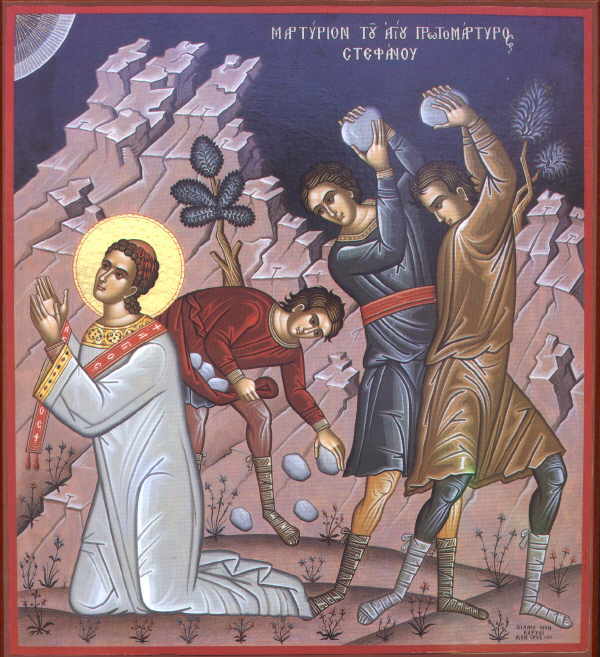
And then, there are the religious holidays that most Christians don’t really celebrate, and some don’t even know about.  The Feast of Saint Stephen, who was the first Christian martyr on 26 December, the Feast of St. John who was the “Beloved Disciple” on 27 December, the Immaculate Conception of the Blessed Virgin Mary on 8 December, and the Feast of Our Lady of Guadalupe on 12 December have already been mentioned.

Finally, there is Epiphany, which is perhaps one of the most important holidays of the liturgical or church year.  It is the last day of the Twelve Days of Christmas of which we sing in the (often-denigrated) Christmas carol, and which is overlooked by most non-liturgical churches.  Epiphany, which falls on January 6, is a Christian feast day that celebrates the revelation of God the Son as a human being in Jesus Christ.  Western Christians commemorate principally (but not solely) the visitation of the Biblical Magi to the Baby Jesus, and thus Jesus’ physical manifestation to the Gentiles.  The early Christian Fathers fixed the date of the feast on January 6.  Ancient liturgies noted Illuminatio, Manifestatio, Declaratio (Illumination, Manifestation, Declaration) taken from  Matthew 3:13–17; Luke 3:22; and John 2:1–11; where the Baptism and the Marriage at Cana were dwelt upon. Western Christians have traditionally emphasized the “Revelation to the Gentiles” mentioned in Luke, where the term Gentile means all non-Jewish peoples. The Biblical Magi, who represented the non-Jewish peoples of the world, paid homage to the infant Jesus in stark contrast to Herod the Great (King of Judea), who sought to kill him.  In this event, Christian writers also inferred a revelation to the Children of Israel. Saint John Chrysostom identified the significance of the meeting between the Magi and Herod’s court: “The star had been hidden from them so that, on finding themselves without their guide, they would have no alternative but to consult the Jews. In this way, the birth of Jesus would be made known to all.”  The earliest reference to Epiphany as a Christian feast was in A.D. 361, by Ammianus Marcellinus.   St. Epiphanius says that January 6 is hemera genethlion toutestin epiphanion (Christ’s “Birthday; that is, His Epiphany”).  He also asserts that the Miracle at Cana occurred on the same calendar day, and it was on this day, too, that John the Baptist baptized Jesus in the Jordan River.  So on 6 January, after all the Christmas trimmings have been put away, the gifts exchanged, New Years resolutions have been made (and some broken already), and the kids are back in school, we can still say, with all feeling, “Happy Holidays.”

Honestly, don’t you think “Happy Holidays” is so much easier?  And besides, I really like Bing Crosby’s Christmas carol, “Happy Holidays!”

Now, What about that pesky “Xmas” that annoys so many people?

To begin:  Look around in your churches, my friends, especially those of you from a liturgical background, and see how many X’s you can find.

“Xmas” is a common abbreviation of the word “Christmas”.  The “-mas” part is from the Latin-derived Old English word for “Mass”, while the “X” comes from the Greek letter Chi, which is the first letter of the Greek word Χριστός, translated as “Christ”.  There is a common misconception that the word Xmas is a secular attempt to remove the religious tradition from Christmas by taking the “Christ” out of “Christmas”.  While “Xmas” is considered to be an informal abbreviation, and should never be used in formal writing, it is historically correct.

The word “Christ” and its compounds, including “Christmas”, have been abbreviated in English for at least the past 1,000 years, long before the modern “Xmas” was commonly used. “Christ” was often written as “XP” or “Xt”; there are references in the Anglo-Saxon Chronicle as far back as AD 1021. This X and P arose as the uppercase forms of the Greek letters χ and ρ used in ancient abbreviations for Χριστος (Greek for “Christ”), and are still widely seen in many Eastern Orthodox icons depicting Jesus Christ. The labarum, an amalgamation of the two Greek letters rendered as ☧, is a symbol often used to represent Christ in Catholic, Protestant, and Orthodox Christian Churches.

The Oxford English Dictionary (OED) and the OED Supplement have cited usages of “X-” or “Xp-” for “Christ-” as early as 1485. The terms “Xpian” and “Xtian” have also been used for “Christian”. The dictionary further cites usage of “Xtianity” for “Christianity” from 1634. According to Merriam-Webster’s Dictionary of English Usage, most of the evidence for these words comes from “educated Englishmen who knew their Greek”.

In ancient Christian art, χ and χρ are abbreviations for Christ’s name. In many manuscripts of the New Testament and icons, Χ is an abbreviation for Χριστος, as is XC (the first and last letters in Greek, using the lunate sigma); compare IC for Jesus in Greek.

Thus, really and truly, the use of the “X” isn’t taking Christ out of Christmas at all.  And instead of protesting the use of “X” during the  Christmas season, wouldn’t we ALL be better people, the world be a better place, and Christ be better served,  if we kept that “X” in our words and deeds every day of the year?  Should we not celebrate Him always, 24/7/365?

So, having said all of the above, Happy Holidays (all of them) to all of you, and may you keep Christ, not only in Christmas, but also in your hearts and minds and lives, every day and always.  Amen.