Our Lady of Sorrows~Blessed Mother Mary ~ The Rev. Dcn. Dollie Wilkinson, OPI
The title, Our Lady of Sorrows, given to our Blessed Mother, focuses on her intense suffering and grief during the passion and death of our Lord. Traditionally, this suffering was not limited to the passion and death event; rather, it comprised the seven dolors or seven sorrows of Mary, which were foretold by the Priest Simeon who proclaimed to Mary, “This child [Jesus] is destined to be the downfall and the rise of many in Israel, a sign that will be opposed and you yourself shall be pierced with a sword so that the thoughts of many hearts may be laid bare.” (Luke 2:34-35).

Devotion to the Seven Sorrows of Our Lady has its roots in Sacred Scripture and in Christian piety, which always associates the Blessed Mother with her suffering Son. Today’s feast was introduced by the Servites in order to intensify devotion to Our Lady’s Sorrows. In 1817 Pius VII — suffering grievously in exile but finally liberated by Mary’s intercession — extended the feast to the universal Church.

This feast dates back to the 12th century. It was especially promoted by the Cistercians and the Servites, so much so that in the 14th and 15th centuries it was widely celebrated throughout the Catholic Church. In 1482 the feast was added to the Missal under the title of “Our Lady of Compassion.” Pope Benedict XIII added it to the Roman Calendar in 1727 on the Friday before Palm Sunday. In 1913, Pope Pius X fixed the date on September 15. The title “Our Lady of Sorrows” focuses on Mary’s intense suffering during the passion and death of Christ. “The Seven Dolors,” the title by which it was celebrated in the 17th century, referred to the seven swords that pierced the Heart of Mary. It is dedicated to the spiritual martyrdom of Mary, Mother of God, and her compassion with the sufferings of her Divine Son, Jesus. In her suffering as co-redeemer, she reminds us of the tremendous evil of sin and shows us the way of true repentance. As Mary stood at the foot of the Cross on which Jesus hung, the sword of sorrow Simeon had foretold pierced her soul.

Below are the seven sorrows of Mary:

1. The prophecy of Simeon: “And Simeon blessed them, and said to Mary his mother: Behold this child is set for the fall and for the resurrection of many in Israel, and for a sign which shall be contradicted; And thy own soul a sword shall pierce, that out of many hearts thoughts may be revealed.” – Luke II, 34-35.

2. The flight into Egypt: “And after they (the wise men) were departed, behold an angel of the Lord appeared in sleep to Joseph, saying: Arise and take the child and His mother and fly into Egypt: and be there until I shall tell thee. For it will come to pass that Herod will seek the child to destroy Him. Who arose and took the child and His mother by night, and retired into Egypt: and He was there until the death of Herod.” – Matt. II, 13-14.

3. The loss of the Child Jesus in the temple: “And having fulfilled the days, when they returned, the Child Jesus remained in Jerusalem; and His parents knew it not. And thinking that he was in the company, they came a day’s journey, and sought him among their kinsfolk and acquaintance. And not finding Him, they returned into Jerusalem, seeking Him.” Luke II, 43-45.

4. The meeting of Jesus and Mary on the Way of the Cross: “And there followed Him a great multitude of people, and of women, who bewailed and lamented Him.” – Luke XXIII, 27.

5. The Crucifixion: “They crucified Him. Now there stood by the cross of Jesus, His Mother. When Jesus therefore had seen His Mother and the disciple standing whom he loved, He saith to His Mother: Woman: behold thy son. After that he saith to the disciple: Behold thy Mother.” – John XIX, l8-25-27.

6. The taking down of the Body of Jesus from the Cross: “Joseph of Arimathea, a noble counselor, came and went in boldly to Pilate, and begged the body of Jesus. And Joseph buying fine linen, and taking Him down, wrapped Him up in the fine linen.” – Mark XV, 43-46.

7. The burial of Jesus: “Now there was in the place where He was crucified, a garden; and in the garden a new sepulcher, wherein no man yet had been laid. There, therefore, because of the parasceve of the Jews, they laid Jesus, because the sepulcher was nigh at hand.” John XIX, 41-42.

The Angelic Salutation (Hail Mary)
Hail Mary, full of grace, the Lord is with thee; Blessed art thou amongst women, and blessed is the fruit of thy womb, Jesus. Holy Mary, Mother of God, pray for us sinners, now and at the hour of our death. Amen.

Prior to the Second Vatican Council, there were two feasts devoted to the sorrows of Mary. The first feast was insitituted in Cologne in 1413 as an expiation for the sins of the iconoclast Hussites. The second is attributed to the Servite order whose principal devotion are the Seven Sorrows. It was instituted in 1668, though the devotion had been in existence since 1239 – five years after the founding of the order.

Symbols: heart pierced with a sword; heart pierced by seven swords; winged heart pierced with a sword; flowers: red rose, iris (meaning: “sword-lily”), cyclamen.


Prayer to our Sorrowful Mother for a particular grace:

O, mother most holy and sorrowful, Queen of Martyrs, you who stood by your Son as He agonized on the cross; by the sufferings of your life, by that sword of pain that pierced your heart, by your perfect joy in heaven, look down on me kindly as I kneel before you, sympathizing with your sorrows and offering you my petition with childlike trust.

Dear Mother, since your Son refuses you nothing, ask of His Sacred Heart to mercifully grant what I ask, through the merits of His sacred passion, along with those of your sufferings at the foot of the cross.

Mother most merciful, to whom shall I go in my misery if not to you who pities us poor sinful exiles in this valley of tears? In our name, offer Jesus but one drop of His most precious blood, but one pang of His loving heart. Remind Him that you are our sweetness, our life and our hope, and your prayer will be heard.

Amen


Here are seven graces the Blessed Virgin Mary grants to souls who honor Her daily by saying seven Hail Marys and meditating on Her tears and Dolors. The devotion was passed to us by Saint Bridget.

  1. I will grant peace to their families.

  2. They will be enlightened about the divine mysteries.

  3. I will console them in their pains and I will accompany them in their work.

  4. I will give them as much as they ask for as long as it does not oppose the Adorable Will of my Divine Son or the sanctification of their souls.

  5. I will defend them in their spiritual battles with the infernal enemy and I will protect them at every instant of their lives.

  6. I will visibly help them at the moment of their death, they will see the face of their mother.

  7. I have obtained (this grace) from my Divine Son, that those who propagate this devotion to my tears and sorrows, will be taken directly from this earthly life to eternal happiness since all their sins will be forgiven and my Son will be their eternal consolation and joy.


Get to Work! ~ Br. Chip Noon, Novice

Doesn’t it always seem to happen that when we sit at Mass and listen to the readings, it is as if they are directed straight from the Lectionary to our hearts? Psalms, readings, the Gospel for the day, stories and words we have read or heard many, many times are sharpened, aimed, and strike us as if we had never encountered these messages before.

Today’s Alleluia verse:

God was reconciling the world to himself in Christ

And entrusting to us the message of reconciliation.

Let’s say I read this a year ago, which I probably did…OK, glad to be informed of this…all part of the ongoing message of the Bible…tuck it away with the other interesting things I’ve read.

But today, when it’s coupled with the readings from Ezekiel and Romans, the 95th Psalm, and the Gospel of Matthew, it takes on a new and definitely hortatory message: “Get up, get out, and get cracking!”

So much for sitting in the pew, listening to the Mass, relaxing on a Sunday morning!

I’m reminded of a discussion I had with my mother many years ago. I must have been around 12 years old. (Yes, before electricity was discovered…and the wheel…) She told me that we don’t go to Mass and just sit there. We don’t “attend” Mass. We don’t listen to the Mass. She told me and my siblings that we “assist” at the Mass, an active verb, indicating that we are as much a part of the action as the priest and the altar boys. We were not an audience, but players in a sacred rite of worship and praise.

And every so often, from that time on, she would ask us if we had assisted at Mass that Sunday. I wish you all could have met her. She was something else!

So what are we being asked to do on this Twenty third Sunday of Kingdomtide? I think there’s not much gray area here. It’s pretty black and white. And we really don’t have much choice in the matter.

Ezekiel says it right off: “You, son of man, I have appointed watchman for the house of Israel.” And although this was written about 2,500 years ago, do you really think it does not apply to you, or to me, right now, today?

Now let me ask, are today’s readings just orders for us to get our kit together and hit the road, like Saint Dominic? We are assisting the priest as she performs the rites in memory of Jesus. So in one way, we are told this isn’t just an hour long-show we’re attending. No, today of all days, we are reminded that if we love our neighbor as ourselves we really have to do more than just wish him or her well. Love is an active verb.

Now Martin Luther, and those who ascribed to his new revelations, came up with the realization that to be saved, to be justified, all we had to do is accept Jesus Christ as our lord and savior and believe that he came to earth to save us. “That is why faith alone makes someone just and fulfills the law…. Faith is that which brings the Holy Spirit through the merits of Christ.”

Luther was reacting to the corrupt practices of the Medieval Church which was selling indulgences and, he thought, preaching false doctrine in order to keep control over all Christians.

His preaching and writings on what has been called “sola fide”, by faith alone, is the theological doctrine that distinguishes most Protestant denominations from the Catholic and Eastern Orthodox churches, and led to the variety of “Christian” beliefs that we find today all over the world. Discord, anger, rebellion, and bloodshed, all over two Latin words.

And so, we can find today discussions that say, from one extreme, that even the worst kind of sinner, as long as he or she “believes”, is forgiven and justified, to the other extreme that only those who commit their whole lives to good works are saved.

And so we can interpret today’s readings from one extreme to the other. And many have. But there is at play here just the age-old quest for power, for a desire to control others…to be the one in charge. “Do it this way, or you’re fired!” And to what end? What do we get if we rule the roost?

Now let’s go back and consider again the Alleluia from today:

God was reconciling the world to himself in Christ

And entrusting to us the message of reconciliation.

Entrusting.

Once again, we see that God is not the terrifying presence from some concepts in the Old Testament. God is within us. And part of us. And that still, small voice within.

We are partners with God in the ageless quest to bring us all to peace and love. And yes, though we recognize that we are “children of God” we also know that we are, by our intelligence, our compassion, and our calling to the Order of Preachers, that we are entrusted with the message of reconciliation.

So for me, and perhaps for you, today’s readings are like what sales organizations schedule for their sales crew: a quarterly motivational conference that gets us back on track and gives us a boost for the serious work of preaching the good news of salvation to all the world. Let’s go out and close some deals!

Lord, help us in our efforts to show the world your love and compassion. Let your good spirit flow over us and help us to bring solace to our troubled times.

Amen.

If Your Brother Offends You ~ The Rev. Dcn. Brenden Humberdross, OPI

23rd Sunday in Ordinary Time (10/09/17)


Open our ears, O Lord, to hear your word and know your voice. Speak to our hearts and strengthen our wills that we may serve you now and always. Amen.

When I read the Gospel reading for today in preparing for this homily I was struck with how pertinent it is to some events that have taken place in my life recently and I am sure that when you heard it many of you may have been struck with similar feelings.

Throughout our lives I’m sure that all of us have been confronted with situations where we have felt wronged by others, or where we feel others have sinned against us. From observation, when hurt it seems to be human nature to let it be known to the multitudes that we’re not happy. I’ve seen many a person spread their discontent amongst others and attempt to turn them down the path that they are treading. However, in the reading we have just heard, the righteous Christian needs to curb the natural desire for sympathy from others and support for our position. Christ gives His followers a totally different path to follow that consists of three straight forward steps.

Firstly, if we’re offended we need to go to the person who offended us and talk to them about it. No mention is made of talking to others first, no mention of gossiping or spreading your hurt, instead just a simple civil conversation. It should be the hope of every Christian that through our filial bonds any ill feeling can be resolved in this way; that hearts can be open enough to love to both give an apology and to accept it.

In my mind a key component of this step is to invite God into the conversation; before you go to talk with someone whom you feel has wronged you time should be spent in prayer. We should approach God and ask Him to not only soften the offender’s heart, but to soften our own so that we may be aware of our own role in this process and be ready to listen with a Christlike ear to what’s said. However, as I’m sure you’re aware these things aren’t always so easily solved and so Christ gives a path to follow is this conversation does not bring the satisfaction we think is needed.

The second step in the process of healing the wounds of wrongs or injustices once private civil conversation has been exhausted is to go to one or two friends, tell them of the situation and ask if they will come with you when you talk to the one who has offended you. Again, Christ doesn’t say to talk far and wide or to convince others of the righteousness of our cause; He simply states that we need to take one or two people with us. If the people we take aren’t to support us and “back us up” what are they for? The Gospel today is clear, they are there to listen, to hear both sides, and to bear witness to what was said if further steps to resolution need to be taken. As the scripture says the truth of things need to be established through two or three witnesses, not on the word of one individual against another.

Something that I think is essential to point out about this step is that its purpose is further conversation between the one who feels offended and the supposed offender; it isn’t an opportunity for the witnesses to pass judgement or force an apology. Like the first step this second is based on filial love and affection, on Christian virtue. Love and the Spirit should always be our guide.

If there is no resolution through this conversation with witnesses then the Gospel tells us that we need to take our complaint to the Church. I wonder, does this mean that when we go to Mass we need to tell everyone that person X has hurt us and that they’re a bad person? I would certainly hope that no one reads this scripture this way! Correction of sin and wrongdoing is always a very private matter. Instead to “take it to the Church” means going to talk with our Parish Priest or another official in the Church and seek their assistance in this matter. This of course should be a final step after all other options have been exhausted. Why is it so essential that every effort has been made to reconcile before bringing the Church into the difficulty?

The clue to this answer is in the phrase that follows Christ’s advice to involve the Church; He says:

“If he refuses to listen even to the Church, then treat him as you would a Gentile or a tax collector.”

This may seem like a very innocuous phrase to you and I but for the first century Jews that Christ was talking to this was a heavy sentence. If you were a Jew living at the time one of your many concerns was with purity, both ritual purity and moral purity. It was essential for you that you not be contaminated by the sin and wrongdoing of others; as a faithful Jew you would not want to be associated too closely with the Gentiles (non-Jews) or those Jews in league with Gentiles, such as the Jews employed by Rome to collect their taxes. So Christ is telling us that if our cause is judged righteous by the Church and an offender is not willing to accept their wrong and reconcile then they are to be treated as outsiders; in other words, that we should put them out of our mind and move on.

Wow, what a sentence! But, does this mean that we to stop loving the person or hoping that repentance and reconciliation may occur at another time? Of course it doesn’t; if I know anything about God it is that He is full of love and mercy and always wants us to be likewise. What Christ is asking us to do is not to dwell on the issue. Instead He wants us to move on and get on with life and not to spread hate or draw others away or down into what could turn into our own pits of despair and discontent.

It’s my prayer brothers and sisters, that as followers of Christ, we can keep ourselves from spreading rumours, even if they are true. Christ has given us a righteous process for dealing with the wrongs of others done towards us and it does not include drawing others into the situation.

Please join me as we pray:

Father in Heaven, we ask that you may always be with us to heal our hurts and open our hearts to your righteous process of justice. May our tongues not lead us into sin and offense against you or our brethren and sisters. May our hearts always be open to your love and may we extend the love that you show us to every one of your children. We ask this of you in and through the name of your beloved Son our Saviour Jesus Christ. Amen.

The Feast of the Nativity of Mary ~ The Rev. Dcn. Brenden Humberdross


May the words of my mouth and the meditations of our hearts be always acceptable to you O Lord, our God and our Creator. Amen.

Today, I want to start by expressing a special gratitude that I feel towards our Blessed Mother. She stands as a special example to me of the life that I should lead as a Christian; a life of total willing submission to the will of God. Something that I pray that I, and all of us, may live up to in some small way.

Today is a very unique day in the Church calendar, not only because it is a day that we celebrate the life and work of the Blessed Mother but also because it is one of only three birthdays celebrated on the Church year. The other two births that we celebrate are those of John the Baptist and our Saviour Jesus Christ. It should be evident immediately as to why we celebrate Christ’s birth, that event that heralded to opening of salvation to mankind. However, why do we celebrate the birth of both the Blessed Mother and John the Baptist?

The traditions of the Church hold that all three of these individuals, The Saviour, The Blessed Mother and John the Baptist were both born without the mark of original sin. Jesus Christ, being God himself in human form could not sin and so was obviously free from the sin of our first parents in Eden goes without question. Which leaves us to ask why are our Blessed Mother and John the Baptist also considered to be have saved from original sin? Consider the mission of these two individuals. Of all of those found within the Bible these two figures stand as central to the saving mission of Christ, John the Baptist as the herald of the coming Saviour and the Blessed Mother as the willing vessel of the God-Man Christ, the very Mother of God. I like to think that God looked upon these two great individuals and the mission that they would have to undertake and knew that he could strengthen them by removing the mark of original sin from their births.

At this point I am sure that some of you are sitting there thinking, “If today is about the Blessed Mothers birth, then why was the Gospel about the birth of Christ?”

I am sure that the answers for this are many and varied; however in my mind I take the view that the Scriptures are silent on the life of Mary before her betrothal to Joseph. For information surrounding the early life of the Blessed Mother we need to look to works outside the scriptures such as the Gospel of the Nativity of Mary (translated from the Hebrew by St. Jerome, A.D. 340-420), the Protevangelium of St. James (dated to ca. A.D. 125) or the writings and visions of various mystics throughout the life of the Church. While these works may be of benefit to the faithful they are not works sanctioned by the Church and so are not appropriate for reading here within our sacred rites. For this reason, the Church chooses to offer us a portion of scripture that brings to our minds the significance of the Blessed Virgin in the economy of salvation and just why it is important for us to celebrate and venerate her whenever we can and by doing so, give glory and honour to God in His great works.

I imagine that throughout her entire life the Blessed Mother was being prepared by God to accept the call that he would give to her through the Archangel Gabriel. Can you imagine being a young, engaged woman having an angel of God come to them and announce that they would bear the Son of God? What an awesome and overwhelming experience! I’m not sure how I would react, but I get the feeling I would be brought to my knees and made a quivering mess…is this what happened to Mary though? It certainly wasn’t she boldy accepted the will of the Lord for her life and prepared to receive the Son of God within her sacred womb.

Can you imagine being St Joseph her betrothed? He gets told that his fiancée is pregnant and that the child is God’s! I know that I would have found it hard to believe; I would have doubted and suspected my fiancée of being unfaithful. Is this what Joseph did? Today’s Gospel reminds us that it sure was! The reading indicates that Joseph thought that the Blessed Mother was guilty of a grave crime and was prepared to cancel their engagement by divorce; it was only the intervention of an Angle that changed his mind.

Can you see the difference in St Joseph and the Blessed Mother’s responses to God’s message? Mary’s was a willing and unwavering yes while St Joseph’s was one of doubt and fear. There is something supernatural about Mary’s response. And it is this response that indicates to me the unique place that Mary holds in the economy of salvation, it points us to the truth of her freedom from Original Sin and the extra strength that she had from a life of preparation by and devotion to God. It is for this reason that I look to Mary as my Mother, why I pray for her counsel and her intercession, why I ask for her blessings on my endeavours, and why I strive to live a life lead by the example of her life. I want to be able to stand before the judgement seat and be able to see that I was guided by the most holy mortal person to ever walk upon the earth, that I strove to not only honour them but to emulate their life as best I could.

It is my prayer that we may all look to the Most Holy Blessed Virgin Mary as our guide and example. As Catholics we should be able to boldly proclaim that we hold the ancient faith of the early Church concerning Mary, we should boldly proclaim her as not just a woman but as the very Theotokos, the Mother God!

Let us pray a prayer written by St Anselm in honour of the Nativity of the Blessed Mother:

Vouchsafe that I may praise thee, O sacred Virgin; give me strength against thine enemies, and against the enemy of the whole human race. Give me strength humbly to pray to thee. Give me strength to praise thee in prayer with all my powers, through the merits of thy most sacred nativity, which for the entire Christian world was a birth of joy, the hope and solace of its life.

When thou wast born, O most holy Virgin, then was the world made light.

Happy is thy stock, holy thy root, and blessed thy fruit, for thou alone as a virgin, filled with the Holy Spirit, didst merit to conceive thy God, as a virgin to bear Thy God, as a virgin to bring Him forth, and after His birth to remain a virgin.

Have mercy therefore upon me a sinner, and give me aid, O Lady, so that just as thy nativity, glorious from the seed of Abraham, sprung from the tribe of Juda, illustrious from the stock of David, didst announce joy to the entire world, so may it fill me with true joy and cleanse me from every sin.

Pray for me, O Virgin most prudent, that the gladsome joys of thy most helpful nativity may put a cloak over all my sins.

O holy Mother of God, flowering as the lily, pray to thy sweet Son for me, a wretched sinner. Amen


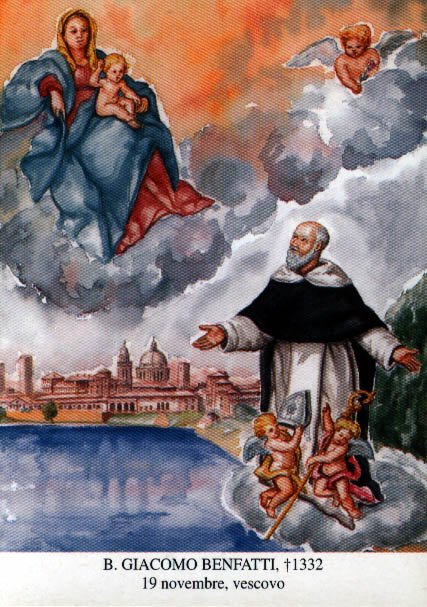
Blessed Bertrand of Garrique

Bertrand was a secular priest under the Cistercians, missioner, and ardent opponent of Albigensianism when he first met Saint Dominic in the party of Bishop Diego. Bertrand may have been the one to recruit Dominic in the battle against the French heretics because they worked closely together in this mission for the rest of their lives.

Bertrand joined the first Dominican friars by receiving the habit at Toulouse in 1216. Dominic left him in charge of the community when he traveled to Rome to seek papal approval of the order. Bertrand’s zeal and experience played an important role in the founding of the Friar Preachers. When the brothers were sent out in little groups on missions, Bertrand was left in Paris with Matthew of France, where he helped to form the Dominican tradition of learning and governed the first foundation at Paris.

While Bertrand’s advice and prayers helped to establish the order, he is best remembered as the closest friend and traveling companion of Saint Dominic, until he was appointed as provincial of Provence. He witnessed the miracles and heavenly favors bestowed upon his friend and provided us with insightful testimony about the heart and mind of the founder.

Bertrand himself was credited with many miracles, both during his life and after his death. Others considered him a “second Dominic” in austerity and holiness, but he humbly overlooked his own claims to sanctity in his loving insistence on those of his friend.

Bertrand was preaching a mission to the Cistercian sisters of Saint Mary of the Woods near Garrigue, when he fell sick and died. He was buried in the sisters’ cemetery until the frequency of miracles suggested that he should be given a more suitable shrine. His relics were lost and shrine destroyed during the religious wars, but pilgrimages were still made to “Saint Bertrand’s Cemetery” until the time of the French Revolution.

Born: at Garrigue, diocese of Nîmes, France, c. 1195

Died: In 1230 he died in Le Bouchet

Beatified: cultus confirmed by Pope Leo XIII in 1881

Blessed Catherine of Racconigi

Catherine was born into poverty and hunger following the devastation of war. Her father, an unemployed locksmith, became despondent and quarrelsome as so many do when they lose their livelihood. Her mother supported the family by weaving coarse cloth at home. Catherine and her brother grew up in an atmosphere that was absent the peace of Christ.

Surprisingly, God reached the heart of little Catherine when she was only five. It was then that her mystical experiences began. Our Lady appeared to her while the tiny child was praying alone in her tiny room and told Catherine that Jesus wished to make her His spouse. Then as a child her own age, Jesus himself appeared, accompanied by many other saints including Catherine of Siena and Peter Martyr, and the Blessed Mother place the ring of espousal on her finger. Like the ring of Saint Catherine of Siena, it was visible to today’s saint but could not be seen by others.

Thereafter Catherine had frequent ecstasies and visions. Jesus always appeared to her as a man her own age. He talked with her, taught her how to pray, and several times took her heart away to cleanse it. When He appeared with His Cross, he offered to help Him. He let it rest on her should a moment, and it left a wound for the rest of her life. She also received the stigmata, though it too remained invisible to others and, at her request, it was only revealed by her confessor after her death.

And, of course, Jesus worked many miracles on behalf of His friend: made a broken dish whole again, and provided money and food when the family’s poverty was extreme. In times of trial, the heavenly hosts came to comfort the girl who received great consolation from the aspiration, “Jesus, my hope!”

Because her family opposed her becoming a Dominican, she took the habit of a tertiary. Her mystical experiences roused a storm of gossip among her neighbors, who were terrified at the lights and sounds that came from her home. The devil stirred up more trouble to mitigate her influence over other souls. Even the Dominican fathers ostracized her and eventually she was forced out of town and settled in Racconigi.

There rich and poor sought out Catherine for her wise counsel, prayers, and material assistance. She was almost continually in ecstasy. The particular object of Catherine’s prayers was the salvation of soldiers dying in battle. Numerous miracles occurred before and after her death, and a cult arose at her tomb almost immediately. Even her persecutors were aware of her sanctity and retracted their bitter words.

Born: in the diocese of Cuneo in the Piedmont, Italy, 1487

Died: 1574

Beatified: Pope Pius VII confirmed her holiness and cult in 1810


Take Up Your Cross ~ The Rev. Dcn. Scott Brown, OPI

MT 16:21-27   

Jesus began to show his disciples
that he must go to Jerusalem and suffer greatly
from the elders, the chief priests, and the scribes,
and be killed and on the third day be raised.
Then Peter took Jesus aside and began to rebuke him,
“God forbid, Lord! No such thing shall ever happen to you.”
He turned and said to Peter,
“Get behind me, Satan! You are an obstacle to me.
You are thinking not as God does, but as human beings do.”

Then Jesus said to his disciples,
“Whoever wishes to come after me must deny himself,
take up his cross, and follow me.
For whoever wishes to save his life will lose it,
but whoever loses his life for my sake will find it.
What profit would there be for one to gain the whole world
and forfeit his life?
Or what can one give in exchange for his life?
For the Son of Man will come with his angels in his Father’s glory,
and then he will repay all according to his conduct.”


In Matthew 16:21-27 we hear Jesus tell his disciples that he must go to Jerusalem to complete his God-given mission to save the world by dying on the cross. This naturally comes as a shock to his disciples. After all, why would God send someone to something as ungodly as dying. Could there be another way for God to accomplish his goal, rather than having his only son suffer a gruesome fate? If dying was necessary, couldn’t it be done on the battlefield instead of a cross? Quick and easy, not long, drawn out, and filled with suffering. It is no wonder that Peter rebukes Jesus, since Peter was a fisherman who believed Jesus but could not comprehend the true purpose of Jesus’ mission here on earth.

Peter thought that the Messiah would be a military ruler who would drive out the Romans and restore Israel to the glory days of the reign of King David.  Peter rebuked Jesus because he took seriously his new role as the rock on which the church was built. He took this role so seriously that he thought he had a responsibility to make sure that Jesus’ ministry would eventually be successful, and thought it was his duty to rebuke Jesus, but Jesus puts him in his place . His place was behind Jesus as a follower, a role we too have to play.

Peter like Satan tried to deflect Jesus from the way of god just as Satan tries to deflect us from God’s way today. Satan likes to put traps in our path, and because he is smart he knows that the best time to trap us is right after some great victory when our guard is down.  In Peter’s case it was just after Jesus told him that he was going to be the rock that the church would be built on.  Just as in our lives, when we experience a victory, whether it is financial, emotional, or physical, there sometimes is an obstacle that follows. Satan wants us to follow the wide smooth road that leads to worldly things and sin. Jesus followed (as should we) the narrow rough road of life serving the Father.

Jesus wasted no time in dealing with Satan and neither should we. Peter had fallen for Satan’s temptations of allowing his thoughts to turn inward to himself and his worldly desires. So Jesus moved quickly to stop Peter’s wrong way of thinking. As an example, we should never allow thoughts of pride or sin to linger, we must stay focused on the path of righteousness and ask God to reveal His perfect will to us. When these thoughts do enter our heads we should do as Jesus did and say “Get the behind me Satan”

Jesus knew that the road he would have to travel would lead to self-denial and the cross, and he urged his followers then just as he urges us today to be prepared to pay the price and suffer the consequences if we want to follow the same path in life. One example is how Jesus repeatedly told his disciples of the suffering that awaited him in Jerusalem, but they really didn’t fully understand until after the resurrection. However after they saw the resurrected Christ, they knew He was the Savior.

We take up the cross of Jesus any time we suffer in some way for identifying with Him and His cause. “Cross bearing” does not always include affliction or persecution in general. It may mean denying what we deeply desire in order to do the will of God. When we obey Him, we position ourselves for great blessing and when we disobey him we open ourselves to the bidding of Satan.

When Jesus said that those who want to save their lives will lose them and vice versa, he was right. Our world is full of examples of people who have sold their souls by using sex, drugs, money, careers, possessions or alcohol to find happiness in life, only to be disappointed. Whatever a person is or becomes in his outward life, the particular quality of his or her soul will be the deciding factor in how he or she lives and how others experience him or her.

Jesus saves us by his death, by overcoming once and for all the power of sin. Sin no longer has a death grip over us. Christ makes it clear that God will forgive the sin that we confess and from which we repent in the sincere desire to renew our lives. Christ makes us realize that we are the most precious creatures in creation-creatures worth dying for.

As Jesus said, death lurks in the darkness of life. Whatever we hope to find outside of God’s plan proves elusive and temporary. Only by walking with Christ on the path of goodness will we find security and contentment we are seeking. If our lives are more important to us than our faith, our lives will be over.  If our faith is more important to us than our lives, we will be rewarded with eternal life. Our Christian life involves sacrifice because Jesus must come first in our lives. We are to be like Jesus-selfless and obedient, even to the point of death to self and life in Christ.

Heavenly Father, give us the strength to take up our crosses and follow you, give us the wisdom to drive around Satan and all his temptations while cruising down the rough and narrow road of life, guide us onto the path toward salvation and righteousness. Amen


Guala was one of the first disciples of Saint Dominic, attracted by the Dominican ideal in 1219, when he heard the founder preach. He received the habit from Dominic at the time the friary opened in Bergamo. After a short novitiate, he was appointed prior there.

Guala proved to be an able superior and a practical administrator and builder. He was on the committee that planed the convent of Saint Agnes in Bologna. During a delay in the construction of the convent because of the opposition of the family of Blessed Diana d’Andalò, who was financing the project, Guala was sent to Brescia to assume the position of its first prior.

During this period Guala had the revelation of Saint Dominic’s greatness that became the subject of many early legends. Although they were good friends, Guala did not know that Dominic was dying on their return from a chapter. Guala had fallen asleep with his head leaning against the belltower of the conventual church at Brescia when he had a vision of two ladders coming down from heaven. Our Lord was visible at the top of one ladder, and Our Lady at the top of the other. Angels were ascending and descending on them. As Guala watched, a friar, who sat at the foot of one ladder with his face covered was drawn up to heaven and great glory surrounded him. Guala awoke, deeply affected by the vision, and went immediately to Bologna, where he found that Saint Dominic had died at the time of his vision.

In 1226, Guala was named the prior of Bologna’s Saint Nicholas abbey, famous for its regularity and fervor. While there, Pope Honorius III appointed him arbiter between Bologna and Modena. Guala worked hard to forge a treaty that lasted 10 years. The following year Pope Gregory IX asked him to negotiate between Emperor Frederick II and the Lombard confederacy–an even more daunting diplomatic task. Guala was also commissioned to convince Frederick to keep his vow to lead a crusade. He was unable to resolve matters between the parties, but at least they maintained the status quo of an uneasy peace.

In 1228, Guala was consecrated bishop of Brescia. As such, he negotiated a number of treaties between warring cities. Frederick broke all the promises he had made and attacked the cities that had remained loyal to the pope. In 1238, Frederick’s army besieged Brescia, but the attackers had to withdraw within three months, which is credited to Guala.

Guala’s contemporaries described him as “a man of great prudence, well acquainted with the world, and of accomplished manners,” and said that “he governed the diocese entrusted to his care with such holiness that, both during his life and after his death, he wrought many wonders through God.”

The years of labor and civil strife wore him down. He resigned his see in 1242 in order to enter complete seclusion and pray without interruption in preparation for death. Therefore, he retired to the Vallumbrosan monastery of San Sepolcro d’Astino, where he lived as a hermit until his death. He was buried in the Benedictine church, and after many miracles at his tomb, his cause was promoted.

Born: in Bergamo, Italy

Died: in San Sepolcro d’Astino, Italy, in 1244

Beatified: cultus approved in 1868 by Pope Pius IX.

Continue reading

The Beheading of John the Baptist ~ Dcn. James Dominic

The Herod who ordered the beheading of John the Baptist is Herod Antipas, one of the sons of Herod the Great. His first wife was from the neighboring Arabian kingdom of the Nabateans. I am sure you can visualize its capital city Petra cut into the cliff face in modern day Jordan because Indiana Jones went there to rescue the Holy Grail. While married to his first wife, Herod met Herodias, and they lived adulterously at first and then they both divorced their spouses so they could marry. Sin often brings its own punishment and it did in this case. The Nabateans were enraged with Herod for slighting his first wife, one of their own, and in 39 AD there was open conflict between them which resulted in the exile of Herod.

John the Baptist, following in the footsteps of the prophets of old who confronted the kings over immorality, confronted Herod the tetrarch. John the Baptist preached the truth about fidelity in marriage to Herod Antipas. Obviously John’s preaching to Herod was not successful; Herod and Herodias remained together. On this occasion, John the Baptist was like the prophets of old who enjoyed little success. Jeremiah, the prophet, despite all his pleadings would eventually see Jerusalem in the hands of the Babylonians because the people would not listen to his pleas to repent and return to living a life under the Covenant with God. The prophets were not called to be successful; rather they were called to preach the word of God whether welcome or not. John the Baptist preached to Herod without success, but John fulfilled his calling; he preached the word of God welcome or unwelcome. The hostility to his preaching on marriage means that just as he preceded Christ in his birth he would also precede Christ in his passion and death.

St. Augustine in one of his sermons sees John the Baptist taking the role of a priest (Sermon 293:1-3). Augustine reflects on John the Evangelist’s describing of Jesus as the Word in the Fourth Gospel. John is the voice preceding the Word. The Vox before the Verbum. The role of the priest is to be like John, a voice for the Word. Through the voice the Word enters the heart of another. This is done without the speaker, the priest, having lost any of the Word himself. The voice is a mediator, helping the Word to enter the heart of another. Commenting on St. Augustine’s sermon, Cardinal Ratzinger in Pilgrim Fellowship of Faith: The Church as Communion (p164) wrote,

Ultimately, the task of the priest is quite simply to be a voice for the word: “He must increase, but I must decrease”—the voice has no other purpose than to pass on the word…On this basis the stature and the humbleness of priestly service are both equally clear: the priest is, like John the Baptist, purely a forerunner, a servant of the Word. It is not he who matters, but the other.

Blessings vs. Woes ~ Dcn James Dominic, Novice


As Jesus’ passion and death draw near, his teaching becomes more intense. According to the chronology of St. Matthew, the Lord’s triumphal entry into Jerusalem is a prelude to the dramatic cleaning of the Temple. There follows a series of parables that emphasize the theme of judgment and repentance. In the Gospel of today’s Mass (Matthew 23:13-22), Jesus rebukes the Scribes and Pharisees for their hypocrisy.

As we have seen, Jesus gives great importance to the virtue of sincerity. To be sincere is to live in the truth, and the source of all truth is God. To be sincere involves living as God would have us do, so that our desires, words, and actions are authentic and all spring from the same source.

The hypocrisy of some of the scribes and Pharisees stands in stark contrast to this ideal. Jesus doesn’t criticize these religious leaders simply for being sinners; no one can escape that condition. Nor does he rebuke them for being unrepentant; he must still have hope for them in that regard. They are criticized, however, for manipulating the precepts of their religion, and for failing to share the riches of their faith with others.

“Woe to you, scribes and Pharisees, you hypocrites. You lock the Kingdom of heaven before men. You do not enter yourselves, nor do you allow entrance to those trying to enter” (Matthew 23:13).

This is the first in a series of seven “woes” in the Gospel of St. Matthew. In a way, they are the “reverse side of the coin” to the eight Beatitudes (Matthew 5:3-12). Whereas the Beatitudes proclaim the pattern of blessedness for the Christian, these “woes” reveal the barrenness that is the rotten fruit produced by the rejection of Christ and his Gospel.

Blessedness versus barrenness. This is the contrast presented by Christ. If we want to find blessing, grace and peace in our lives, we will strive, with God’s help, to live the virtues described in the beatitudes. On the other hand, the interior blindness that fuels the “woes” will only lead to corruption, cynicism, and unhappiness.

Particularly offensive to the Lord is the twisting of religious practice into something that resembles superstition.

“You say, ‘If one swears by the altar, it means nothing, but if one swears by the gift on the altar, one is obligated.’ You blind ones, which is greater, the gift, or the altar that makes the gift sacred?” (Matthew 23:18-19).

Where did the Pharisees get all of this? Their approach to religious duties seems to be little more than a series of well-choreographed rituals, far removed from the intentions of the heart.  It is almost as if religion has been reduced to a game of chance. “To attribute the efficacy of prayers. to their mere external performance, apart from the interior dispositions that they demand, is to fall into superstition” (Catechism of the Catholic Church, no. 2111).

We recognize, of course, that Jesus directs this warning not only to the Pharisees, but to us as well.  We never want to regard the outward practice of the faith as a kind of “good luck charm” with the power to manipulate circumstances to our benefit. Rather, the visible forms of the faith serve to cultivate and reinforce an interior disposition of belief, conversion, and worship.

Indeed, in the sacramental life of the Church, outward ritual is transformed by the power of Christ into a living and dynamic communion with God. The sacraments possess a power all their own, because it is Christ himself who is at work. When our faith is firmly rooted in the sacraments, it will not only be preserved, but it will grow in vigor and intensity.


Today, in the life of the Church, is the Memorial of St. Augustine.
A Saint, a sinner, a poet, a philosopher, an author, a father, a bishop, a doctor of the Church, a father of the Church – there are so many ways to look at the saint for today. Yet above all, he is Christ’s.  He is a disciple, or perhaps he, like St John the beloved, would describe himself as the disciple whom Jesus loved.

For a sinner the greatest thing about the Lord Jesus is that He identified Himself and revealed Himself to the lost. For St Augustine of Hippo, this was the greatest thing about Jesus Christ, which came through almost on every page of his writings. He never got over the fact that God called him out of darkness into his marvelous light.  However great and noble, lofty and poetic his writings may be – he never stopped rejoicing in the very simple truth that he is loved by God.

“You called, shouted, broke through my deafness; you flared, blazed, banished my blindness; you lavished your fragrance, I gasped; and now I pant for you; I tasted you, and now I hunger and thirst;  you touched me, and I burned for your peace.”

The world today needs people who are in love with God, or rather witnesses who reveal themselves as disciples whom Jesus loves. The only thing that can break through the complexity and the confusion of the people of our time is the simple and holy Love of God.

Ever try teaching chastity to a teen, correcting a person who is hurting many, or consoling a person who is suffering in the wake of immeasurable loss?  Without the love of God, these things are impossible or perhaps even futile.  It is only the Spirit of the living God, that lives and sings in the hearts of disciples that can ignite this fire in others.

This is the fire of St Augustine, his song, his instruction, his beautiful Latin poetic praise of God, his mystagogy and catechesis, his heart and soul – the Love of God. This is why he has such appeal to disciples of every age and every land.  He is a man of sincerity.  A man who’s love is sincere.  There is no faking true love. He is a man on fire with God’s mercy.

There is great need for apostles of our age to be on fire with this love, to first burn brightly with it and then share it like fire that catches others.

May the prayers of St Augustine help us to be on fire with the Love of God and to share it with all.