Hell, Vigils, and Lullabys ~ Br. Chip Noon, Novice

Holy Saturday. Sabbatum Sanctum. The day after Good Friday and the day before Easter.

As children, we were taught that on this day, Jesus went down to Hell. It is in the Creed as “He descended into Hell.” As a child myself, this day was one of sadness, fear, and anticipation.

In Sunday School (where we who did not attend a parochial school were forced to go), the nuns depicted this day to us as the time during which Jesus freed all the righteous people who had lived before his time from bondage in darkness and distance from God. We were told that everyone from Adam and Eve was unable to enter heaven because Jesus had not opened it for them.

You can imagine what went through my mind thinking about this day. The nuns in my parish did not always do a good job of explaining what was going on this day and how it affected people in hell. So we kids made up lots of interesting stories. I always thought back to the hymns that sang about our longing for Christ to save us from our sins and the “sins of the world.”

Still, what were those people doing in hell before Jesus came to free them? We were assured that they did not suffer the same fate as sinners, who were tormented by the devil and the fires of hell. Eternal hellfire. That was a pretty scary concept.

It was only later as a youth that I found out about the “harrowing of hell.” Growing up in rural Maryland, I knew what a harrow was. To me, it was always a disc harrow, a bunch of metal discs in a row used to break up clods of dirt after ploughing. And so Jesus used this instrument to open up the soil of hell to let the dead ascend, finally, into heaven. Of course, this was always done in a dark, murky atmosphere suitable to that part of hell that wasn’t on fire.

Holy Saturday…that was quite a fearsome day!

Back then, in the 1950’s, we either didn’t have Easter Vigil as we do today, or my parents never took us to it. Easter Sunday was always THE day for us and Mass was always THE most important ceremony of the year. So from Good Friday to Easter Sunday was a time of agitation.

Of course, the agitation and anticipation was all about the Easter Baskets with colored hard-boiled eggs, candy, and especially jelly beans. And the fact that the solemnity of Lent was at last gone, and maybe the nuns would let up on us…

What must have been going through the minds of the Apostles and the women disciples? I never heard this discussed growing up, but in my adult life, it became one of the things I thought about on Holy Saturday. We know it as anticipation. They experienced it as the utter destruction of their whole world.

Their Teacher was tortured and died a horrible death on a cross. Now what?

For all of the Apostles but John, there must have been intense shame. They had all deserted their Teacher and his mother and had gone into hiding. Imagine their feelings on this day.

What we know today was all taught to them, so there should have been no surprise. But we can say that from the distance of two millennia and the evidence of the empty tomb. This group of grieving souls had none of that.

“But these are written that you may believe that Jesus is the Messiah, the Son of God, and that by believing you may have life in his name.” John 20:31

Written many years after Holy Saturday.

Now what?

Although all of this was presented to them by Jesus, they really didn’t know what was happening.

They weren’t anticipating Easter eggs, baskets, jelly beans, the solemn joy of the Easter Sunday Mass.

They were deserted, bereft, scared, ashamed, and deeply sorrowful.

We get some or all of these feelings at times of crisis in our own lives. I’ve had them during and after a crisis, and believe me, the sinking feeling in my stomach is quite real and quite frightening.

But wait. We were told the Gospel stories so that we might believe that Jesus is the Messiah, the Christ, the Son of God. The disciples thought they had nothing. We have the Word. They had despair. We have triumphant anticipation.

It’s probably a good thing we were never taken to the Vigil. I can’t imagine I’d have done well sitting through all those readings.  Seven readings, six psalms, an Epistle, the Gospel…it just goes on forever, doesn’t it?

“When I was a child, I spoke and thought and reasoned as a child.”

Now I know that the Vigil is actually the most calming lullaby God could ever sing to me. It tells our whole story, from the beginning of time to the Resurrection. Everyone is created, everyone goes through bad times, everyone sees glimmers of hope, everyone in some way gets through the troubles, everyone can pray these words from one of those psalms:

O LORD, my God, you are great indeed!

You are clothed with majesty and glory,

robed in light as with a cloak.

Because we know that while now we may shed tears, dawn will bring incomparable gladness.

We have Holy Saturday to teach us how to live through all our times of despair and fear. We have salvation history in all those readings, we have the stories of a small group of terrified disciples who on Sunday will experience that incomparable gladness. We have the anticipation we remember as children and the delight we see in our own children’s eyes on Sunday. And we have the words of John, the disciple who stayed with his Teacher through all the horror and who was told to care for the Blessed Mother:

“But the Advocate, the Holy Spirit, whom the Father will send in my name, will teach you all things and will remind you of everything I have said to you. Peace I leave with you; my peace I give you. I do not give to you as the world gives. Do not let your hearts be troubled and do not be afraid.”

We have come through the dark nights of our souls and we will be able, finally to say Alleluia.

Lord, help us to remember that your son suffered, died, and was buried for our sakes. Help us to remember that even as we face crisis and trouble, the next day will bring incomparable gladness if we trust in you. Help us to remember that Easter comes after Holy Saturday.

Amen.


He Died! The Great Redeemer Died ~ Br. Brenden Humberdross

Good Friday of the Lord’s Passion 2017 Reading: John 18:1 – 19:42

The Great Redeemer Died!

He died; the great Redeemer died,
And Israel’s daughters wept around;
A solemn darkness veiled the sky,
A sudden trembling shook the ground.

 Come, saints, and drop a tear or two
For him who groaned beneath your load;
He shed a thousand drops for you,
A thousand drops of precious blood.

 Here’s love and grief beyond degree,
The Lord of glory died for men:

                                                                                (Isaac Watts)

Today, we stand at the centre of the holiest week in the Christian calendar, and of the most important event in human history. Today we remember not only the death of the man Jesus, not only humankind’s rejection of God, but of the opening of the way for all of humanity to a full relationship with God.

In less than 24 hours we have seen Jesus betrayed by one of his closest followers, interrogated, beaten and humiliated, and finally brutally murdered upon the cross of Calvary. At this point, the disciples would have been despairing; their master, who had seemed to promise so much, was gone. What were they to think of his message? Was he really the messiah or were they wrong? I’m sure that doubt and fear would have been at the forefront of their minds as they grieved for their spiritual leader. However, for us, with the hindsight that distance brings these events take on a different meaning. We should be able to see in the events of Good Friday a different message, not one of despair and fear, but one of hope.

On Thursday night, Jesus left the relative security of the Upper Room where the Eucharist had been instituted and went to the Garden of Gethsemane. The gospel reading today makes it clear to us that Judas, the betrayer, was well aware that this was a place that Jesus and His followers frequented, so why go there? This action is the start of a number of signs in today’s reading that point out for the keen observer that Jesus was totally in control of the events surrounding His passion.

Jesus knew very well that Judas would be able to find him and yet still went to the Garden. When the betrayer and the soldiers appeared Jesus didn’t run, He stood his ground. When approached He asked the mob who they were looking for, to which they responded “Jesus the Nazarene”; and it’s here that we see the first miracle of the Passion. Jesus responded with the words “I AM”. These words were so powerful that they caused the mob to turn away and fall to the ground; but why? Jesus was revealing to the mob, to His disciples and to us his true identity; I AM is the very name of God! When God appeared in the Burning Bush to talk to Moses what name did he give? I AM…Jesus was revealing through the power of His name that he was the Lord God and that no matter what was to follow we shouldn’t fear, but have confidence that all was in His control.

When the mob had recovered Jesus handed himself over to them and it was at this point that Peter leapt to his aide and cut off the ear of the servant; was Peter arrested with Jesus? Surely he should have been for such a violent crime? However, we know that he wasn’t; why? The answer is simple, the Lord of the Passion didn’t allow it. Before handing himself over Jesus said to the soldiers, “…so if you are looking for me, let these men go”; and instead of ignoring the “Nazarene criminal” the soldiers obeyed; the Lord of the Passion exerted His will to control the events.

If the Apostles and Disciples were able to see these events through our eyes their attitude towards what followed may have been totally different. Instead of seeing the acts of brutality performed against their friend, their Master, and their Messiah degrading Him and diminishing Him they may have been able to rest in the knowledge that Jesus has revealed himself as the Great I Am. They may have been able to stand firm knowing that He was in control of events and was truly Lord of all that was happening. They may have even had the foresight that in some way, the Messiah would overcome whatever seemingly earth shattering events were overtaking them.

And thus it should be for us; we should mourn, we should feel grief at the rejection of the Saviour of the whole human family however, we should also rest firm in the knowledge that Jesus is the Lord of the Passion and it is all part of the great plan for the redemption of humanity.


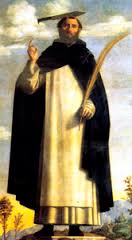
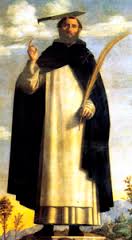
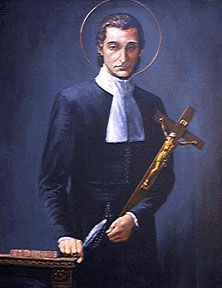
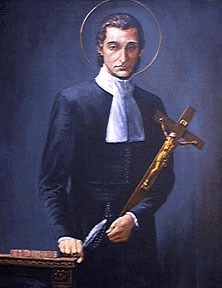
Saint Peter Gonzalez

The parents of Peter Gonzales were wealthy and apparently expected their son to become a priest so that he might in time obtain some rank. It was a period in history when this sort of thing was a trial to the Church, and Peter’s worldly youth was only one of many examples. He was educated by his uncle, the bishop of Astorga, who invested him with a canonry at Palencia and deanery when he was still quite young.

Full of pride, for a special Bull had been procured so that he might obtain the deanery while he was under age, he resolved to be installed with great pomp, and for his state entry into Astorga chose Christmas Day when the streets were likely to be crowded. He wanted to impress his flock with his fine clothes and vivid personality.

He paraded through the town on horseback, magnificently equipped, but in the noise and excitement the animal reared and threw him upon a dung heap. The Spanish people, who have a fine sense of comedy, responded with loud gusts of laughter. Picking himself up in shame, he cried: “If the world mocks me, henceforth, I will mock the world.” Covered with filth and confusion, Peter withdrew to clean up and ponder his sins.

Surprisingly enough, when his wounded feelings had healed, Peter reformed his pointless life and immediately entered the Dominican monastery at Palencia. He was never to forget to weep for his sins, and his life was spent in prayer and penance to offset the wasted years of his youth.

Peter’s friends did not allow this to happen without protest. They had been amused by his accident, but not converted by it as he was, and they did their best to talk him into leaving religious life and returning to the luxurious world he had left behind. It was probably a serious temptation to the young man, for it is not easy to reform overnight. But he did not turn back. Instead, he said to his friends, “If you love me, follow me! If you cannot follow me, forget me!” He became, by close application to the rule, one of the shining exemplars of this difficult way of life.

After his studies were completed, Peter entered into his apostolate. It was to take him into places where his worldly background would be a help rather than a hindrance, for he could well understand the temptations and troubles of worldly people. He was first of all a military chaplain with the royal army. He also began to preach in the region. He did not talk about trivia, his sermons drew large crowds. The recitation of the Psalms was his most constant prayer.

The fame of his piety and zeal spread throughout Spain and reached the ears of King Saint Ferdinand of Castile, who sent for him and attached him to his court as chaplain and as his confessor. Appalled by its licentiousness, Gonzales immediately set about reforming it, which so displeased the younger courtiers that they tried to corrupt him; but he was proof against all temptations and won the confidence of the saintly king.

Peter did much to foster the crusade against the Moors. When Ferdinand finally acted, Peter accompanied him on his expedition against the Moors. Upon the capture of Cordova and Seville, Peter used his influence and authority on the side of the vanquished and was instrumental in reducing rape and bloodshed. He also took over the Moorish mosques and converted them into Christian churches.

He was showered with favors by the king, who had the utmost confidence in him. Fearing honors, however, Peter quit the king’s service upon his return to Spain. Instead, moved by compassion, he lived among the poor peasants and sought to evangelize them. Although he was met everywhere with ignorance and brutality, his work proved efficacious. He penetrated the wildest and most inaccessible areas, seeking out the peasants in villages and the shepherds in the mountains of the Asturias. His preaching brought about reconciliation between neighbors and between men and God. He gave reassurance to the dismayed and the perplexed.

Most of the anecdotes of his life come from this period, and they have to do with miracles that he worked for these people. At his prayer, storms ceased, droughts were ended, bottles were refilled with wine, bread was found in the wilderness. The bridge that he built across the swift river Minho made his name famous throughout Spain, and it existed up until recent times. During the time he was directing work on this bridge, he used to call the fish to come and be caught; it was a way of helping to feed the workers.

He visited also the seaports of Galicia–boarding ships and preaching on their open decks. He had a great liking for sailors, and is often portrayed in the habit of his Order, holding a blue candle which symbolized Saint Elmo’s fire, the blue electrical discharge which sometimes appears in thunder storms at the mast- heads of ships, and which was supposed to be a sign that the vessel was under the saint’s protection. (The name of Saint Elmo is of earlier origin. Peter Gonzales, in the popular devotion of the sailors of the Mediterranean, has replaced the name and memory of the older saints associated with the sea, particularly the 4th century Saint Erasmus.)

He retired finally to Tuy in a state of extreme exhaustion. During Lent he preached each day in the cathedral, on Palm Sunday he foretold his death, and on the Sunday after Easter, he died at Santiago de Compostella. Bishop Luke of Tuy, his great admirer and friend, attended him to his last breath and buried him honorably in his cathedral. In his last will, the bishop gave directions for his own body to be laid near Peter’s remains, which were placed in a silver shrine and honored with many miracles.

Born: 1190 at Astorga, Spain

Died: April 15,1246 at Saintiago de Compostela, Tuy; buried in the cathedral at Tuy

Beatified: 1254 by Pope Innocent IV

Canonized: December 13, 1741 by Pope Benedict XIV (cultus confirmed)

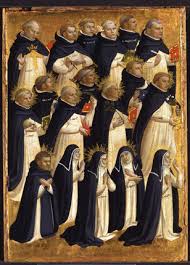
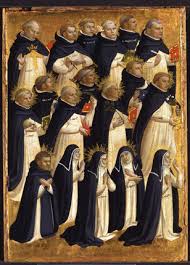
Representation: Dominican holding a blue candle or a candle with a blue flame; Dominican lying on his cloak which is spread over hot coals; Dominican holding fire in his bare hands; Dominican catching fish with his bare hands; Dominican beside the ocean, often holding or otherwise protecting a ship.

Maundy Thursday and Miracles ~ The Rev. Dcn Brett Whetstone


 I received from the Lord what I also handed on to you, that the Lord Jesus on the night when he was betrayed took a loaf of bread, and when he had given thanks, he broke it and said, “This is my body that is for you. Do this in remembrance of me.” In the same way he took the cup also, after supper, saying, “This cup is the new covenant in my blood. Do this, as often as you drink it, in remembrance of me.” For as often as you eat this bread and drink the cup, you proclaim the Lord’s death until he comes.

Maundy Thursday is perhaps the worst day in church history. In fact it is probably the worst day in the history of all humanity. Maundy Thursday is the day that the embodiment of Gods perfect  love came to us in the person of Jesus and we rejected him. It was on that last night that there was no hope left for Jesus. One of his best friends had just betrayed him for money, and another was about to deny him three times, and all the rest of his disciples would run away in fear for their lives. It was in a moment of hopelessness, that Jesus gave us a sign of hope , when he said “this is my body and I give it to you”. He was letting us know it would be ok, that he had a plan.

In the establishment of the Eucharist Jesus gave the church many things, but the most important thing he gave was the assurance that God had a plan.

I was listening to a sermon that was given by one of my favorite authors, a Roman Catholic Dominican Priest from England, and he was talking about this very moment in church history, and he asked the question: ” have you ever thought how odd it is, that every Sunday we gather to remember the moment that the community ran away, when they were dispersed?” He continued on to say that, “we gather in hope to remember the worst moment, because it is when it is darkest that God comes to us” or to rephrase that I like to say that it is when it is darkest that God comes to us and we start to see his plan.

Several years ago a friend of mine posted a cryptic post on Facebook. She and I had gone to Bible school together and had reconnected online. In her post she simply said, “If you pray I need you to pray.” So that evening I spent some time praying for her, and the next morning I woke up and checked Facebook as I do every morning and saw her post, she said that her husband’s cancer had returned and that it was going to take a miracle for him to make it. Several months later, at the age of 32 her husband had passed away.

So here is my friend, she and her husband fellow ministers doing exactly what God wants them to do and tragedy strikes. Where is God’s plan in all of this? That’s the question that I was asking, but not her. She said despite this being painful, and despite her feelings of sadness and anger, she knew that God had a plan, and she wanted everyone else to know this as well.

Time went on, as if does in these situations and I happened across another Facebook post from her several months later. This one caught me off guard. She had just announced that she was pregnant.

She had explained that they had trouble conceiving their first child and they sought out help from a fertility specialist. In doing so the specialist had fertilized several eggs, and as luck would have it the first egg was all they needed to have for a healthy pregnancy. Because they went to a Christian hospital for the procedure, the hospital froze he remaining fertilized eggs in case they needed them again in the future. Well the future arrived, and even though her husband had passed away she moved forward with getting pregnant again, because he wanted her too, and he time was right. She got pregnant and experienced a normal pregnancy.

After nine long pregnancy months, she gave birth to a beautiful baby girl. Baby and mom were healthy and sent home from the hospital and to a brother who was anxiously awaiting their arrival. But then after three shot days of being at home, the unthinkable happened. My friend’s newborn daughter spiked a high fever, and no amount of medicine was brining it down. They rushed to the emergency room, where dozens of tests were run. Then the news came. My friend’s daughter had somehow contracted meningitis. Her daughter was hooked up to breathing machines and all sorts of monitors. She was not expected to make it.

So there sat my friend who had just lost her husband a short time ago, about to lose her daughter. She was desperate and didn’t know what to do. Then faced with the decision that no parent should have to face, she made the decision to take her daughter off of the ventilator. She didn’t want to see her baby suffer any longer.

She removed her daughter from the ventilator and held her close to her, cuddling her, crying and praying.  Then the unthinkable….the unexplainable happened. Her daughter, who just moments ago was not able to breath on her own took a breath. Then another, and another and then minutes turned into hours and hours turned into days. The miracle that she had prayed for was happening right before her eyes.

Through all of this she never lost hope, she pressed on knowing that no matter what, God had a plan, and that He was going to see her through it., and He did.

I believe that God had his hand in all of this, the entire time he was there with her giving her the strength that she needed to make it through the loss of her husband, and the near loss of her daughter, and now you can see the fruits of that plan, because she travels all over the country talking to groups large and small about grief and trusting in Gods plan. She has been interviewed by people magazine and has a best selling book. So when Jesus said those words 2000 years ago this is my body and I give it to you, it was Him letting us know that he had a plan, it was Him letting us know that He has us covered and that no matter what happens he will see us through it.


Let us pray:

Almighty Father, whose dear Son, on the night before he
suffered, instituted the Sacrament of his Body and Blood:
Mercifully grant that we may receive it thankfully in
remembrance of Jesus Christ our Lord, who in these holy
mysteries gives us a pledge of eternal life; and who now lives
and reigns with you and the Holy Spirit, one God, for ever
and ever. Amen.

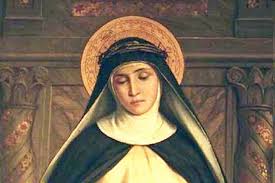
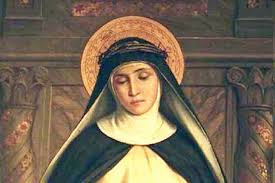
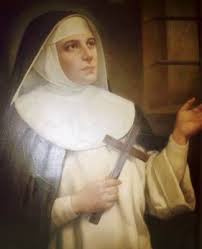
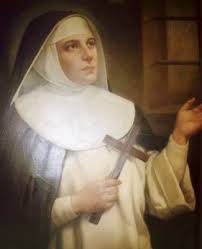
Blessed Margaret of Castello

Margaret was born blind into a poor, mountain family, who were embittered by her affliction. When she was five years old, they made a pilgrimage to the tomb of a holy Franciscan at Castello to pray for a cure. The miracle failing, they abandoned their daughter in the church of Città-di-Castello and returned to their home.

Margaret was passed from family to family until she was adopted by a kindly peasant woman named Grigia, who had a large family of her own. Margaret’s natural sweetness and goodness soon made themselves felt, and she more than repaid the family for their kindness to her. She was an influence for good in any group of children. She stopped their quarrels, heard their catechism, told them stories, taught them Psalms and prayers. Busy neighbors were soon borrowing her to soothe a sick child or to establish peace in the house.

Her reputation for holiness was so great that a community of sisters in the town asked for her to become one of them. Margaret went happily to join them, but, unfortunately, there was little fervor in the house. The little girl who was so prayerful and penitential was a reproach to their lax lives, so Margaret returned to Grigia, who gladly welcomed her home.

Later, Margaret was received as a Dominican Tertiary and clothed with the religious habit. Grigia’s home became the rendezvous site of troubled souls seeking Margaret’s prayers. She said the Office of the Blessed Virgin and the entire Psalter by heart, and her prayers had the effect of restoring peace of mind to the troubled.

Denied earthly sight, Margaret was favored with heavenly visions. “Oh, if you only knew what I have in my heart!” she often said. The mysteries of the rosary, particularly the joyful mysteries, were so vivid to her that her whole person would light up when she described the scene. She was often in ecstasy, and, despite great joys and favors in prayer, she was often called upon to suffer desolation and interior trials of frightening sorts. The devil tormented her severely at times, but she triumphed over these sufferings.

A number of miracles were performed by Blessed Margaret. On one occasion, while she was praying in an upper room, Grigia’s house caught fire, and she called to Margaret to come down. The blessed, however, called to her to throw her cloak on the flames. This she did, and the blaze died out. At another time, she cured a sister who was losing her eyesight.

Beloved by her adopted family and by her neighbors and friends, Margaret died at the early age of 33. From the time of her death, her tomb in the Dominican church was a place of pilgrimage. Her body, even to this day, is incorrupt. More than 200 miracles have been credited to her intercession after her death. She was beatified in 1609. Thus the daughter that nobody wanted is one of the glories of the Church

After her death, the fathers received permission to have her heart opened. In it were three pearls, having holy figures carved upon them. They recalled the saying so often on the lips of Margaret: “If you only knew what I have in my heart!”.

Blessed Anthony Neyrot

Blessed Anthony Neyrot occupies a unique place in Dominican history, as he is the only one among the beautified who ever renounced the faith. He expiated his sin with an act of heroism that merited heaven, washing away in his own blood the denial that might have cost him his soul.

Of the childhood of Blessed Anthony, we know nothing that he was born at Rivoli, in Italy. He was accepted into the Order by Saint Antoninus, who must have been particularly fond of the young man, since he gave him his own name. Completing his studies, Anthony was ordained and lived for a time at San Marco, the famous Dominican convent in Florence. Then, becoming restless and dissatisfied, he asked for a change of mission. He was sent to Sicily, but this did not prove to his liking either so he set out for Naples.

Brother Anthony was sailing from Sicily to Naples when pirates captured the ship. Anthony was taken to Tunis and sold as a slave. He was able to win his freedom, but fell away from the Church. He denied his faith in Jesus and abandoned his religious vocation. He accepted the Koran, the diabolical book of the Muslims. For several months, he practiced the Muslim religion. He also married.

In the meantime, his former Dominican prior, the saintly Antoninus, died. This led Anthony to have a shocking experience. It seems that one night, Anthony had something like a dream. St. Antoninus appeared to him. The conversation between the two men was to lead to a radical change in Anthony. He became truly sorry for having betrayed the Lord. He knew that in his heart he could never give up his faith in Jesus. He knew that he could only be a Catholic. And he realized that he still wanted very much to be a Dominican brother.

Blessed Anthony sent his wife back to her family. He then put on his white Dominican habit. In spite of his fear, he went to see the ruler of Tunis. A large crowd gathered and the ruler came out to the courtyard. Brother Anthony publicly admitted he had made a terrible mistake becoming a Muslim. He was a Catholic. He believed in and loved Jesus. He was a Dominican and wanted to be so for all his life. The ruler was angry. He threatened and then made promises of rewards if only Anthony would take back what he was saying. But Anthony would not. He knew this meant his death.

Anthony knelt and began to pray for the courage to give his life for Jesus. Suddenly he felt the large stones pounding him. He just kept praying for the strength to remain true to the Lord. Then he lost consciousness. Anthony died a martyr in 1460. Some merchants from Genoa, Italy, took his remains back to his own country.

Born: 1420

Died: Martyred on Holy Thursday, 1460


Salvation on a Donkey ~ The Rev. Dcn. Dollie Wilkinson, OPI

Today is Palm Sunday……but what does that really mean? Palm Sunday is the final Sunday of Lent, the beginning of Holy Week, and as told in Matthew 21:1-11, commemorates the triumphant arrival of Christ in Jerusalem, days before he was crucified.

When they had come near Jerusalem and had reached Bethphage, at the Mount of Olives, Jesus sent two disciples, saying to them, “Go into the village ahead of you, and immediately you will find a donkey tied, and a colt with her; untie them and bring them to me. If anyone says anything to you, just say this, ‘The Lord needs them.’ And he will send them immediately.” This took place to fulfill what had been spoken through the prophet, saying, “Tell the daughter of Zion, Look, your king is coming to you, humble, and mounted on a donkey, and on a colt, the foal of a donkey.” The disciples went and did as Jesus had directed them; they brought the donkey and the colt, and put their cloaks on them, and he sat on them. A very large crowd spread their cloaks on the road, and others cut branches from the trees and spread them on the road. The crowds that went ahead of him and that followed were shouting, “Hosanna to the Son of David! Blessed is the one who comes in the name of the Lord! Hosanna in the highest heaven!” When he entered Jerusalem, the whole city was in turmoil, asking, “Who is this?” The crowds were saying, “This is the prophet Jesus from Nazareth in Galilee.” “

Palm Sunday is known as such because the faithful will often receive palm fronds which they use to participate in the reenactment of Christ’s arrival in Jerusalem. In the Gospels, Jesus entered Jerusalem riding a young donkey, and to the lavish praise of the townspeople who threw clothes, or possibly palms or small branches, in front of him as a sign of homage. This was a customary practice for people of great respect. Palm branches are widely recognized symbol of peace and victory, hence their preferred use on Palm Sunday.

So here we have Jesus, basically riding to His death, not in a carriage, or on a magnificent horse, but on an humble donkey. But this serves to remind us that even though He is the Son, our Savior, He chooses to come to us where we are, as a humble servant for His people. The use of a donkey instead of a horse is also highly symbolic, it represents the humble arrival of someone in peace, as opposed to arriving on a steed in war. A week later, Christ would rise from the dead on the first Easter.

During Palm Sunday Mass, palms are distributed to parishioners who carry them in a ritual procession into church. The palms are blessed and many people will fashion them into small crosses or other items of personal devotion. These may be returned to the church, or kept for the year. Because the palms are blessed, they may not be discarded as trash. Instead, they are appropriately gathered at the church and incinerated to create the ashes that will be used in the follow year’s Ash Wednesday observance. The colors of the Mass on Palm Sunday are red and white, symbolizing the redemption in blood that Christ paid for the world.

I love the picture represented in Matthew. Everyone around are taking off their coats, and laying it in front of Jesus, as He rides in on the donkey. Even those too poor to have a fine coat, gather branches or palms off the trees, to lay at Jesus” feet. This reminds me of a fairy tale prince, who discards his cloak, covering a puddle so the dainty princess may cross without getting her feet wet. Yet in Matthew, the people are clearly showing their support, and adoration, for the Lord, Jesus Christ. I wonder how many of them knew what was to happen just a few days later. But Jesus knew, and yet He didn’t enter the city under cover of darkness. He rode in on a donkey, an humble symbol of peace.

Palm Sunday Prayer:

Almighty God,

On this day, your Son Jesus Christ entered the holy city of Jerusalem and was proclaimed King by those who spread garments and palm branches along His way. Let those branches be for us signs of His victory, and grant that we who bear them in His name may ever hail Him as our Lord, and follow Him in the way that leads to eternal life.

In Jesus’ Name We Pray,

Amen.

Blessed Anthony Pavonius

Antony grew up to diately was engaged in combatting the heresies of the Lombards. be a pious, intelligent youth. At 15, he was received into the monastery of Savigliano, was ordained in 1351.

Pope Urban V, in 1360, appointed him inquisitor-general of Lombardy and Genoa, making him one of the youngest men ever to hold that office. It was a difficult and dangerous job for a young priest of 34. Besides being practically a death sentence to any man who held the office, it carried with it the necessity of arguing with the men most learned in a twisted and subtle heresy.

Antony worked untiringly in his native city, and his apostolate lasted 14 years. During this time, he accomplished a great deal by his preaching, and even more by his example of Christian virtue. He was elected prior of Savigliano, in 1368, and given the task of building a new abbey. This he accomplished without any criticism of its luxury–a charge that heretics were always anxious to make against any Catholic builders.

The consistent poverty of Antony’s life was a reproach to the heretics, who had always been able to gain ground with the poor by pointing out the wealth of religious houses. He went among the poor and let them see that he was one of them. This so discomfited the heretics that they decided they must kill him. He was preaching in a little village near Turin when they caught him.

The martyrdom occurred in the Easter octave. On the Saturday after Easter, he asked the barber to do a good job on his tonsure because he was going to a wedding. Puzzled, the barber complied. On the Sunday after Easter, as he finished preaching a vigorous sermon against heresy at Brichera, seven heretics fell upon him with their daggers, and he hurried off to the promised “wedding.” He was buried in the Dominican church at Savigliano, where his tomb was a place of pilgrimage until 1827. At that time the relics were transferred to the Dominican church of Racconigi.

Oddly enough, this Dominican Antony takes after his Franciscan namesake. He is also invoked to find lost articles.

Born: 1326 at Savigliano, Italy

Died: Martyred in 1374 at Turino, Italy

Beatified: 1868

Patronage: Lost Articles


Saint Vincent Ferrer

Born into a noble, pious family headed by the Englishman William Ferrer and the Spanish woman Constantia Miguel, Saint Vincent’s career of miracle-working began early. Prodigies attended his birth and baptism on the same day at Valencia, and, at age 5, he cured a neighbor child of a serious illness. These gifts and his natural beauty of person and character made him the center of attention very early in life.

His parents instilled into Vincent an intense devotion to our Lord and His Mother and a great love of the poor. He fasted regularly each Wednesday and Friday on bread and water from early childhood, abstained from meat, and learned to deny himself extravagances in order to provide alms for necessities. When his parents saw that Vincent looked upon the poor as the members of Christ and that he treated them with the greatest affection and charity, they made him the dispenser of their bountiful alms. They gave him for his portion a third part of their possessions, all of which he distributed among the poor in four days.

Vincent began his classical studies at the age of 8, philosophy at 12, and his theological studies at age 14. As everyone expected, he entered the Dominican priory of Valencia and received the habit on February 5, 1367. So angelic was his appearance and so holy his actions, that no other course seemed possible to him than to dedicate his life to God.

No sooner had he made his choice of vocation than the devil attacked him with the most dreadful temptations. Even his parents, who had encouraged his vocation, pleaded with him to leave the monastery and become a secular priest. By prayer and faith, especially prayer to Our Lady and his guardian angel, Vincent triumphed over his difficulties and finished his novitiate.

He was sent to Barcelona to study and was appointed reader in philosophy at Lerida, the most famous university in Catalonia, before he was 21. While there he published two treatises (Dialectic suppositions was one) that were well received.    In 1373, he was sent to Barcelona to preach, despite the fact that he held only deacon’s orders. The city, laid low by a famine, was desperately awaiting overdue shipments of corn. Vincent foretold in a sermon that the ships would come before night, and although he was rebuked by his superior for making such a prediction, the ships arrived that day. The joyful people rushed to the priory to acclaim Vincent a prophet. The prior, however, thought it would be wise to transfer him away from such adulation.

Another story tells us that some street urchins drew his attention to one of their gang who was stretched out in the dust, pretending to be dead, near the port of Grao: “He’s dead, bring him back to life!” they cried.

“Ah,” replied Vincent, “he was playing dead but the, look, he did die.” This is how one definitely nails a lie: by regarding it as a truth. And it turned out to be true, the boy was quite dead. Everyone was gripped with fear. They implored Vincent to do something. God did. He raised him up.

In 1376, Vincent was transferred to Toulouse for a year, and continued his education. Having made a particular study of Scripture and Hebrew, Vincent was well-equipped to preach to the Jews. He was ordained a priest at Barcelona in 1379, and became a member of Pedro (Peter) Cardinal de Luna’s court–the beginning of a long friendship that was to end in grief for both of them. (Cardinal de Luna had voted for Pope Urban VI in 1378, but convinced that the election had been invalid, joined a group of cardinals who elected Robert of Geneva as Pope Clement VII later in the same year; thus, creating a schism and the line of Avignon popes.)

After being recalled to his own country, Vincent preached very successfully at the cathedral in Valencia from 1385-1390, and became famed for his eloquence and effectiveness at converting Jews–Rabbi Paul of Burgos, the future bishop of Cartagena was one of Vincent’s 30,000 Jewish and Moorish converts–and reviving the faith of those who had lapsed. His numerous miracles, the strength and beauty of his voice, the purity and clarity of his doctrine, combined to make his preaching effective, based as it was on a firm foundation of prayer.

Of course, Vincent’s success as a preacher drew the envy of others and earned him slander and calumny. His colleagues believed that they could make amends for the calumny by making him prior of their monastery in Valencia. He did withdraw for a time into obscurity. But he was recalled to preach the Lenten sermons of 1381 in Valencia, and he could not refuse to employ the gift of speech which drew to him the good and simple people as well as the captious pastors, the canons, and the skeptical savants of the Church.

Peter de Luna, a stubborn and ambitious cardinal, made Vincent part of his baggage, so to speak; because from 1390 on, Vincent preached wherever Peter de Luna happened to be, including the court of Avignon, where Vincent enjoyed the advantage of being confessor to the pope, when Peter de Luna became the antipope Benedict XIII in 1394.

Two evils cried out for remedy in Saint Vincent’s day: the moral laxity left by the great plague, and the scandal of the papal schism. In regard to the first, he preached tirelessly against the evils of the time. That he espoused the cause of the wrong man in the papal disagreement is no argument against Vincent’s sanctity; at the time, and in the midst of such confusion, it was almost impossible to tell who was right and who was wrong. The memorable thing is that he labored, with all the strength he could muster, to bring order out of chaos. Eventually, Vincent came to believe that his friend’s claims were false and urged de Luna to reconcile himself to Urban VI.

He acted as confessor to Queen Yolanda of Aragon from 1391 to 1395. He was accused to the Inquisition of heresy because he taught that Judas had performed penance, but the charge was dismissed by the antipope Benedict XIII, who burned the Inquisition’s dossier on Vincent and made him his confessor.

Benedict offered Vincent a bishopric, but refused it. Distressed by the great schism and by Benedict’s unyielding position, he advised him to confer with his Roman rival. Benedict refused. Reluctantly, Vincent was obliged to abandon de Luna in 1398. The strain of this conflict between friendship and truth caused Vincent to become dangerously ill in 1398. During his illness, he experienced a vision in which Christ and Saints Dominic and Francis instructed him to preach penance whenever and wherever he was needed, and he was miraculously cured.

After recovering, he pleaded to be allowed to devote himself to missionary work. He preached in Carpetras, Arles, Aix, and Marseilles, with huge crowds in attendance. Between 1401 and 1403, the saint was preaching in the Dauphiné, in Savoy, and in the Alpine valleys: he continued on to Lucerne, Lausanne, Tarentaise, Grenoble, and Turin. He was such an effective speaker that, although he spoke only Spanish, he was thought by many to be multilingual (the gift of tongues?). His brother Boniface was the prior of the Grande Chartreuse, and as a result of Vincent’s preaching, several notable subjects entered the monastery.

Miracles were attributed to him. In 1405, Vincent was in Genoa and preached against the fantastic head-dresses worn by the Ligurian ladies, and they were modified–“the greatest of all his marvelous deeds, reports one of his biographers. From Genoa, he caught a ship to Flanders. Later, in the Netherlands, an hour each day was scheduled for his cures. In Catalonia, his prayer restored the withered limbs of a crippled boy, deemed incurable by his physicians, named John Soler, who later became the bishop of Barcelona. In Salamanca in 1412, he raised a dead man to life. Perhaps the greatest miracle occurred in the Dauphiné, in an area called Vaupute, or Valley of Corruption. The natives there were so savage that no minister would visit them. Vincent, ever ready to suffer all things to gain souls, joyfully risked his life among these abandoned wretches, converted them all from their errors and vices. Thereafter, the name of the valley was changed to Valpure, or Valley of Purity, a name that it has retained.

He preached indefatigably, supplementing his natural gifts with the supernatural power of God, obtained through his fasting, prayers, and penance. Such was the fame of Vincent’s missions, that King Henry IV of England sent a courtier to him with a letter entreating him to preach in his dominions. The king sent one of his own ships to fetch him from the coast of France, and received him with the greatest honors. The saint having employed some time in giving the king wholesome advice both for himself and his subjects, preached in the chief towns of England, Scotland, and Ireland. Returning to France, he did the same, from Gascony to Picardy.

The preaching of Saint Vincent became a strange but marvelously effective process. He attracted to himself hundreds of people–at one time, more than 10,000–who followed him from place to place in the garb of pilgrims. The priests of the company sang Mass daily, chanted the Divine Office, and dispensed the sacraments to those converted by Vincent’s preaching. Men and women travelled in separate companies, chanting litanies and prayers as they went barefoot along the road from city to city. They taught catechism where needed, founded hospitals, and revived a faith that had all but perished in the time of the plague.

The message of his preaching was penance, the Last Judgment, and eternity. Like another John the Baptist–who was also likened to an angel, as Saint Vincent is in popular art–he went through the wilderness crying out to the people to make straight the paths of the Lord. Fearing the judgment, if for no other reason, sinners listened to his startling sermons, and the most obstinate were led by him to cast off sin and love God. He worked countless miracles, some of which are remembered today in the proverbs of Spain. Among his converts were Saint Bernardine of Siena and Margaret of Savoy.

He returned to Spain in 1407. Despite the fact that Granada was under Moorish rule, he preached successfully, and thousands of Jews and Moors were said to have been converted and requested baptism. His sermons were often held in the open air because the churches were too small for all those who wished to hear him.

In 1414 the Council of Constance attempted the end the Great Schism, which had grown since 1409 with three claimants to the papal throne. The council deposed John XXIII, and demanded the resignation of Benedict XIII and Gregory XII so that a new election could be held. Gregory was willing, but Benedict was stubborn. Again, Vincent tried to persuade Benedict to abdicate. Again, he failed. But Vincent, who acted as a judge in the Compromise of Caspe to resolve the royal succession, influenced the election of Ferdinand as king of Castile. Still a friend of Benedict (Peter de Luna), King Ferdinand, basing his actions on Vincent’s opinion on the issue, engineered Benedict’s deposition in 1416, which ended the Western Schism.

(It is interesting to note that the edicts of the Council of Constance were thrown out by the succeeding pope. The council had mandated councils every ten years and claimed that such convocations had precedence over the pope.)

His book, Treatise on the Spiritual Life is still of value to earnest souls. In it he writes: “Do you desire to study to your advantage? Let devotion accompany all your studies, and study less to make yourself learned than to become a saint. Consult God more than your books, and ask him, with humility, to make you understand what you read. Study fatigues and drains the mind and heart. Go from time to time to refresh them at the feet of Jesus Christ under his cross. Some moments of repose in his sacred wounds give fresh vigor and new lights. Interrupt your application by short, but fervent and ejaculatory prayers: never begin or end your study but by prayer. Science is a gift of the Father of lights; do not therefore consider it as barely the work of your own mind or industry.”

It seems that Vincent practiced what he preached. He always composed his sermons at the foot of a crucifix, both to beg light from Christ crucified, and to draw from that object sentiments with which to animate his listeners to penance and the love of God.

Saint Vincent also preached to Saint Colette and her nuns, and it was she who told him that he would die in France. Indeed, Vincent spent his last three years in France, mainly in Normandy and Brittany, and he died on the Wednesday of Holy Week in Vannes, Brittany, after returning from a preaching trip to Nantes. The day of his burial was a great popular feast with a procession, music, sermons, songs, miracles, and even minor brawls.

Born: 1350 at Valencia, Spain

Died: April 5th in 1419 at Vannes, Brittany , France

Canonized: 1458

Patronage: brick makers; builders; Calamonaci, Italy; construction workers; pavement workers; plumbers; tile makers

Representation: cardinal’s hat; Dominican preacher with a flame on his hand; Dominican preacher with a flame on his head; Dominican holding an open book while preaching; Dominican with a cardinal’s hat; Dominican with a crucifix; Dominican with wings; flame; pulpit; trumpet


Where’s the Proof? ~ Br. Chip Noon, Novice

Jesus wept.

He was human, after all. We can presume he laughed too, can’t we? He loved to have children around him, and they wouldn’t come to him if he were always glum. And casting out beams from our eyes to me is certainly humorous in a sardonic way.

And he “groaned within” or “groaned in the spirit” so we know he was capable of deep emotion.

But when we think of Jesus, we are guided by Isaiah—“he was a man of sorrows, and acquainted with grief.” Fasting, marathon praying, casting out evil spirits, admonishing his followers and others… we know this was a serious guy.

And we can presume he had one thing on his mind: our salvation. This man of sorrows wanted us to be joyful.

But in today’s readings and Gospel, we come up against a real stumbling block, one that dogs us even to this day. Our unbelief.

In fact, that’s a theme throughout the New Testament. Our unbelief.

“OK, you say all these things can happen. Give me some proof!” We doubt everything. We fear to trust. We cower in uncertainty, just as almost everyone in the Bible does at one time or another.

Jesus wept. He wept for his dead friend Lazarus. He wept for the unbelievers. He wept for the believers who would become backsliders. He wept for the condition of humankind then, before, and now.

“Give me proof.”

It is sad, isn’t it? We all need reassurance, proof, pats on the back.

What Jesus gave as proof was what we call miracles. He raised Lazarus from the dead. He turned water into wine. He cured lepers. He made the blind see. He cast out devils.

This is how he taught his followers and his doubters.

And in a few weeks, we will hear from the pulpit that when he showed himself to thousands after his death, they became believers too.

Why do we need these proofs? We certainly don’t get them today. We don’t see people raised from the dead. We don’t see the blind made to see. We don’t…we don’t…or do we?

What is a miracle? The Bible gives us healings, serpents, transfigurations, resurrections. But that was thousands of years ago. What do we have today?

Do you need to see your dead brother brought to life? Do you think it’s even possible? Do you need to see the cancer sufferer cured? Do you think it’s even possible? Do you need to see your life turned around? Do you think it’s even possible?

Let me tell you for a minute one of my own “miraculous” experiences. Eight years ago my son called me and told me that the sonographer could not detect a heartbeat in the baby in his wife’s womb. He was distraught. His wife was distraught. My wife and I were distraught. But Mike did tell me that the doctor wanted to wait a week and have the sonogram taken again.

That was a bad week. What did I do? Yes, I worried. Yes, I was distraught too. But then I thought, “I’ll pray to my mother in heaven and see if she can help.” Let me tell you now that I think my mother is truly a saint in heaven. And since I firmly believe in the communion of saints, I got right on the prayer train to her. Our Fathers, Hail Marys, Rosaries, lots of made up prayers and supplications.

Of course I included Jesus and Mary in the prayers, figuring I should go direct as well.

And the next week…they heard a heartbeat.

Do I know if this was a miracle? I have no idea…that is, I have no proof. But to me, that was a miracle and proof of God’s continuing presence in our lives.

Now I have quite a few friends who take all this as malarkey, and figuratively pat me on the head and say, “whatever makes you happy.” You know the comments. But even in my own doubt (Lord I believe. Help thou mine unbelief.) I figured that this was a true miracle and my mother had one in the win column. But you know it takes two miracles to make a saint, so a year later, there was a similar event that needed divine intervention. Down to the station, back on the prayer train, and more supplications to Jesus, Mary, and Doris, my mother.

Sure enough, another miracle, my sister recovered. Doris has had several more miracles over the years. Maybe I should call the Vatican…

But back to the sermon, the First and Second Readings and the Gospel are talking about life and death, and coming back to life and being alive in the spirit. These are our wishes. In fact, this is what we all hope will happen after we die. We believe there is no end, but a continuation in another realm.

However, let me call your attention back to Psalm 130 from this morning.

Out of the depths I cry to you, O Lord,
Lord, hear my voice!
O let your ears be attentive
to the voice of my pleading.

If you, O Lord, should mark our guilt,
Lord, who would survive?
But with you is found forgiveness:
for this we revere you.

My soul is waiting for the Lord,
I count on his word.
My soul is longing for the Lord
more than watchman for daybreak.
Let the watchman count on daybreak
and Israel on the Lord…

Here the psalmist is not asking for proof, miracles, signs. He knows that God will forgive us and he counts on the Lord. That’s the essence for today. We can ask for, we can rely on miracles, but if the Kingdom of Heaven is within us, do we need those signs?

I love them, actually. I firmly believe I have experienced miracles, but I also know that God speaks to us without signs and symbols. So the miracles for me are a comfort. But the daily comfort is there, if only I ask.

Amen.

Lord as you show us your miracles every day, hear us as we pray, Lord, we believe. Help thou our unbelief.