
Category: Lesson
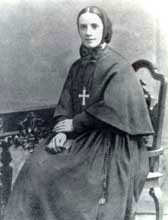
St. Frances Xavier Cabrini ~ The Rev. Lady Sherwood, OPI
 St. Frances Xavier Cabrini was born Maria Francesca Cabrini on July 15th, 1850 at Sant’Angelo Lodigiano. The young girl with was drawn to a life of religious service at an early age. She was influenced by her older sister, her uncle, a priest who captured her imagination with stories of missionary work, and also by the Daughters of the Sacred Heart, who prepared her for a normal school diploma in 1870.
Francesca who had already vowed herself to virginity at the age of 12, attempted to enter the Daughters of the Sacred Heart in 1872, but she was declined due to health reasons as had contracted smallpox whilst caring for the sick during an epidemic, and although she was healed from such, she still did not seem to be strong physically.
She found employment briefly as a teacher in Virdardo and then she was persuaded to do charity work at an orphanage at Codogno, and it was here that she took her vows in 1877.
In thissame year she was appointed to be Prioress of her new foundation, The Institute of Missionary Sisters of the Sacred Heart, which at the onset consisted of seven orphaned girls whom she had trained.
Mother Cabrini had much to do in Italy but very soon craved fulfillment ofa lifelong wish to do missionary work in China but Pope Leo XIII and Bishop Scalabrini of Piacenza instead urged her to carry her talents to Italian immigrants in the slums of the United States, and dutifully, but with reluctance, she sailed in 1889 with six sisters.
From modest beginnings in the New York City area, Mother Cabrini and her followers gradually built a national and international network of some 70 institutions.
In 1909 she became an American citizen. Her journeys on behalf of her mission, which included 30 crossings of the Atlantic, occupied much of her time and energy, although she remained frail physically throughout her life.
At the breakout of World War I in Europe, she dedicated her hospitals, and nuns in Italy to the war effort there.
On December 22nd, 1917, she after a brief illness, died of malaria in her own columbus Hospital in Chicago.
Cardinal George Mundelein of Chicago and others launched the process of her canonization in 1928. She was pronounced Venerable in 1933, was beatified in 1938, and was canonized in 1946.
Her remains originally at West Park in New York, are now enshrined in the Chapel of the Blessed Mother Cabrini High school in New York City.
St. Frances Xavier Cabrini, though declared to have effected the two miracles needed for canonization, is best remembered for her energetic labours among immigrants and the poor in the United States and for establishing and the staffing of orphanages, schools, hospitals, convents and other facilities throughout the world.
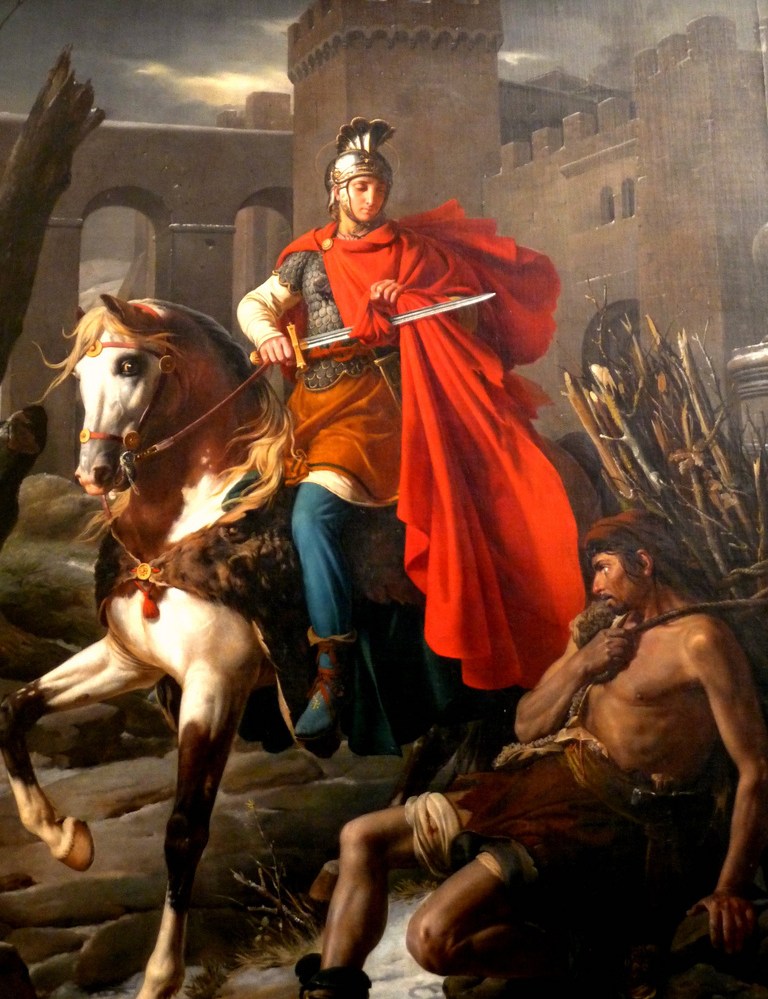
SAINT MARTIN OF TOURS ~ The Rev. Dn. Joshua Hatten, OPI
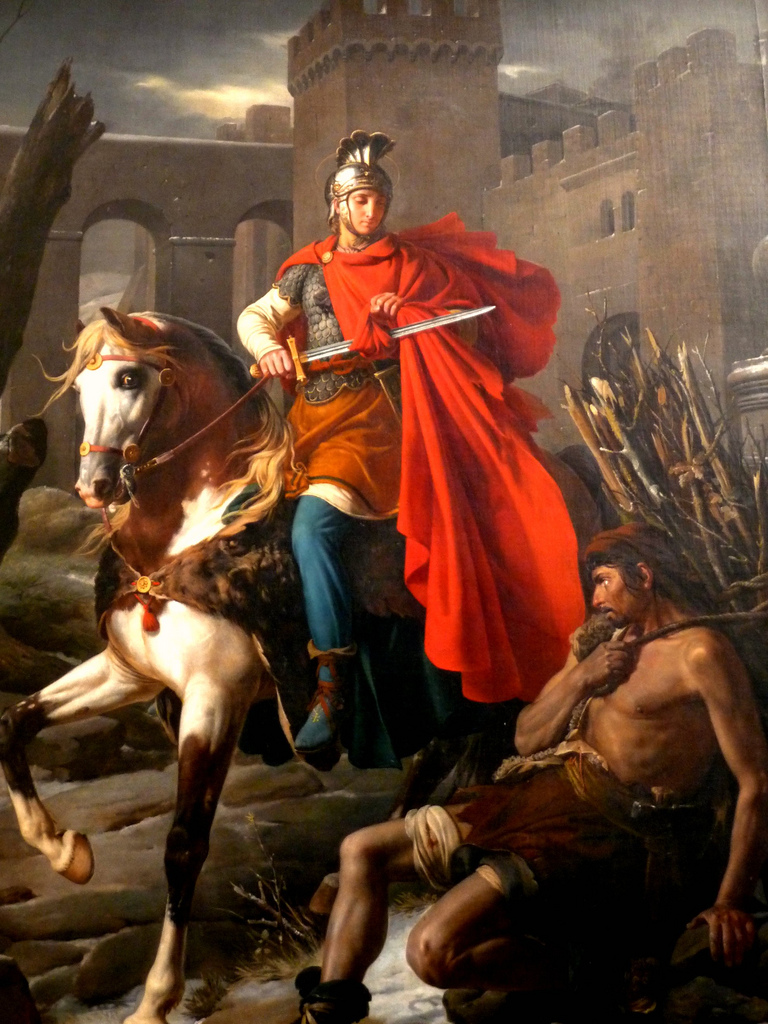
St. Martin of Tours was born in what is modern day Northern Yugoslavia and western Hungary. In about 316 A.D., when St. Martin was born, it was then known as Sabaria of Upper Pannonia. Saint Martin was born to pagan parents – his father being an officer of the Army of Rome. Due to a military transfer, Martin and his family relocated to Pavia in the north of Italy. It was here, at Pavia, that Martin first encountered Christianity. Being so drawn to the the faith, he soon became a catechumen, that is, one actively studying the faith before baptism into the Church.
During this time of study, Martin reached the age of 15 and, as his father was a Roman Officer, Martin was required to enter Roman Military service at this point. History and tradition are quick to point out that Martin never attempted to get around the requirement and did sign on as an officer, but lived “more like a monk than a soldier.”
Saint Martin was stationed to a place then called Amiens, in Gaul (modern day France). Tradition hold that it was here that Martin had an experience that changed his life forever. The story goes that one day, whilst riding toward town one cold winter day, Martin noticed a beggar at the entrance gates. The man was dressed in threadbare rags, freezing and shivering from the elements and begging for alms. Martin also noticed that EVERYONE else passed the beggar by without any notice, neverminding any charity or love toward the man.
Martin’s heart was touched and the legend continue that he removed his heavy military issued cloak, and with his sword, cut the cloak in half. Keeping half for himself and giving the other half to the poor beggar. Later the following night, Martin, while sleeping, saw Christ surrounded by throngs of angels. And in this vision, Our Lord was wearing half of the cloak that Martin had given the beggar. Martin was then asked, in the vision, whether or not he recognized the piece of the cloak – which he did. Then Christ was heard to say to the surrounding angels: “Martin, not even yet baptized, has covered ME with his cloak.” Upon waking from the vision, Martin immediately looked to be baptized into the faith fully.
Closer to the age of twenty, Martin, with a few soldier-comrades, was summoned by the Emperor Julian and given orders to go and take care of the Teutonic invasions happening in Gaul. Martin’s conversion of heart kicked in and he was compelled to tell the emperor that he must refuse the order. Saying to Emperor Julian: “Up to now, I have served you as a soldier, allow me henceforth to serve Christ. Give the bounty and orders to others who are going out to battle. I am a soldier of Christ and it is not lawful for me to fight.” You might say that Saint Martin is one of our earliest Christian examples of a “conscientious objectors.”
However, Emperor Julian, not being accustomed to being refused ANYTHING, had Martin hauled off to prison. Fortunately his incarceration ended rather quickly with truces being put into place. Martin, now free and on the go, then travailed to Poitiers, and under the Bishop and friend, Hilary, was ordained a deacon into the church.
Other travels took Martin back toward his homeleand. There he converted his mother and many others to the Christian faith. To his dismay, Martin could not convince his father to give up his pagan beliefs. Martin later felt a religious calling to a life of solitude. His friend, the Bishop Hilary, gave him a small tract of land in what is now central France. There, in this place called Liguge, Martin was joined by hermits and other holy men and then established a monastery, said to be the fist established in Gaul. It survived until the early 17th Century.
For the next 10 years of his life, Martin lived as the Prior of the monastery – directing the other brothers lives and preaching in nearby areas. Around 371, the Bishop of Tours died, and so popular was Saint Martin with the locals, it was urged that he take up the vacant post. Reluctantly, and actually with a bit of trickery from the locals, Martin did accept the post as Bishop of Tours. But, even in this high post, Martin continued to live a strict and austere and simple life. Martin soon grew tired of the rigorous life as a bishop and longed to return to a simple monastic life. He retired from his post as Bishop and went Marmoutier, where he founded another simple monastery that later became a famous abbey of the region. In fact, later Bishops of Tours were often selected from among the brothers and priests of Saint Martin’s monastery.
During his life, Saint Martin was a true soldier for Christ. He stood up to Emperors and fought heretics. He won many souls for Christ and to him are attributed many, many other legends and miracles.
Closing in on the year 400, St. Martin began to have premonitions of his death and eventually sickness fell upon him. Ton the 8th of November, in the year 400, Saint Martin fell asleep in the Lord. He was buried 3 days later, at Tours. It is said that over two-thousand monks, nuns and religious attended his funeral. Soon after his burial, a chapel, then basilica where built upon Saint Martin’s grave. Both, long since destroyed, currently a modern church is built upon the site – which, still, annually has thousands of faithful pilgrims visit it.
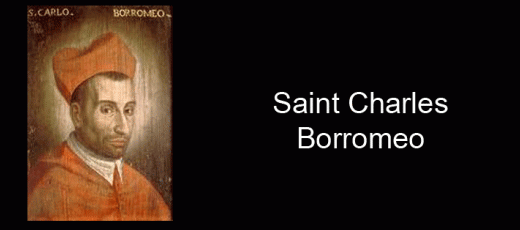
Saint Charles Borromeo ~ The Rev. Dn. Joshua Hatten, OPI
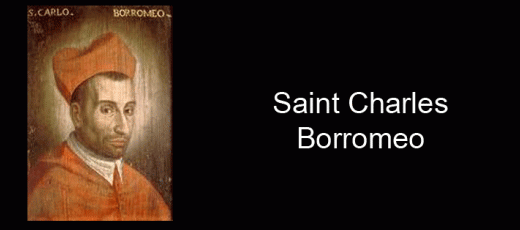
Saint Charles Borromeo was born on October 2, 1538, into a noble family of Milan and was also related to the powerful Medici family. But Charles desired to devote himself to the Church. His uncle, Cardinal de Medici, was elected pope in 1559( he took the name Pius IV). Pope Pius IV placed Charles in the office of cardinal deacon and made Charles the administrator of the Archdiocese of Milan – and all while he was still a layman and a student. But it is because of his intellectual gifts that he was entrusted with several important offices connected with the Vatican. Later in life, he was appointed secretary of state, which carries the responsibility for the papal states.
In the midst of all this, Charles’ older brother passed away. The death was untimely, but it is what brought Charles to his definite decision to become an ordained priest. His relative objected – they wished to see Charles marry and have children. But Charles was adamant about his calling, and, at the age of 25, he was ordained to the priesthood. Very soon after his ordination, he was consecrated as the Bishop of Milan.
St. Charles Borromeo lived during the tumultuous times of the Protestant Reformation and was also involved in the final years of the Council of Trent. Charles had encouraged the pope to renew the Council in 1562 after it had been suspended for 10 years. Using his mind and persuasion, much credit is due to St. Charles for keeping the Council of Trent going, when at many times it was on the verge of breaking up. For the Council, St Charles himself, took up the task of correspondence during the final phase – NOT AN EASY JOB!!
After the Council of Trent drew to a close, Saint Charles was allowed to devote his time to the Archdiocese of Milan, where religious and moral reform was needed from within. Saint Charles initiated a provincial council, made up of all the bishops under his leadership. This Council focused on every phase of Catholic life from among the laity to the clergy and the specific changes and reforms needed therein. Saint Charles new that the changes had to start with the clergy, if the laity were to change then they must first be given a good example of the desired reforms by the bishops and other clergy. The people needed a reformed Catholic example, and Saint Charles knew this.
Saint Charles took the initiative in being a Christ-like example. Most of his income went to various charities. He gave up all luxuries and imposed harsh penances on himself. He denounced honors, esteem and influence to become poor. During the plague and famine of 1576, he tried to feed 60,000 to 70,000 people DAILY!! This he accomplished by getting loans of large sums that required years to repay. Charles saw Christ in his neighbor and knew that charity done for the least of his flock was charity done for Christ. Whilst the civil authorities and powers fled during the height of the plague, Saint Charles Borromeo stayed in the city and he ministered to the sick and the dying and continued to help those in need.
By the age of 46, the overwhelming work and burdens of his office began to affect his health and Saint Charles gave up his ghost. The Church that he had worked so hard to make more human, recognized him as a saint in 1610. His feast day is celebrated on November 4th.
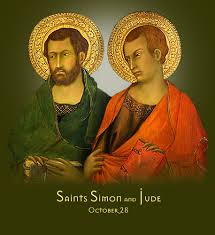
Sts Simon and Jude, Apostles ~ The Rev. Lady Sherwood, OPI

Today we as a church commemorate the joint feasts of St’s Simon and Jude. St Simon was called the Cananaen or Canaanite because he was born in the Galilean town of Cana. This is the town in which our Lord Jesus wrought his first miracle by changing water into wine as is known to us from the Gospel. Some including Nicephorous have the opinion that Simon was the bridegroom of this wedding at which Our Lord Jesus and his mother, the Blessed Virgin Mary honoured with their presence and that later with the consent of his bride, Simon left to follow Christ. This account though is disputed by others. St. Jude according to some traditions is believed to be the brother of Simon and is also named Thaddseus to distinguish him from Judas Iscariot who was the one who betrayed the Lord before his crucifixion. According to Nicephorous, Mary Cleophas was the mother to Simon and Jude and James the less was also their brother. Other writers and traditions however say that Simon and Jude were not brothers.
On the various lists of the twelve Apostles (Matthew 10:2=4, Mark 3:16=19, Luke 16:14=16, Acts 1:13), the tenth and eleventh places are occupied by St. Simon and St. Jude.
We are told in the Gospel that Our Lord Jesus chose both Simon and Jude to be his Apostles, but when and under what circumstances this took place, has not been recorded and none of the particulars of their works are known by us, however, we know for sure that like all the Apostles, they constantly followed Christ.
When the apostles separated to preach the Gospel, according to some traditions, Simon first travelled to Eygpt and St. Jude to Mesopotamia. Both also travelled to other lands preaching the Word of Christ and that after thirty years they met again in Persia. Other traditions say that both Simon and Jude went together as missionaries to Persia and were martyred there.
St. Jude is often referred to as the Patron of desperate causes, the ‘saint of last resort’, and is the one often asked for help when all else fails. Since his name reminds many of Judas of Iscariot, there is a tendency to ask for intercession from any of the other Apostles first.
Let us pray:
Father,
You revealed yourself to us through the preaching of your Apostles Simon and Jude. By their prayers, give your church continued growth and increase the number of those who believe in you. Through our Lord Jesus Christ, your Son, who lives and reigns with you and the Holy Spirit, one God, for ever and ever. Amen. Continue reading
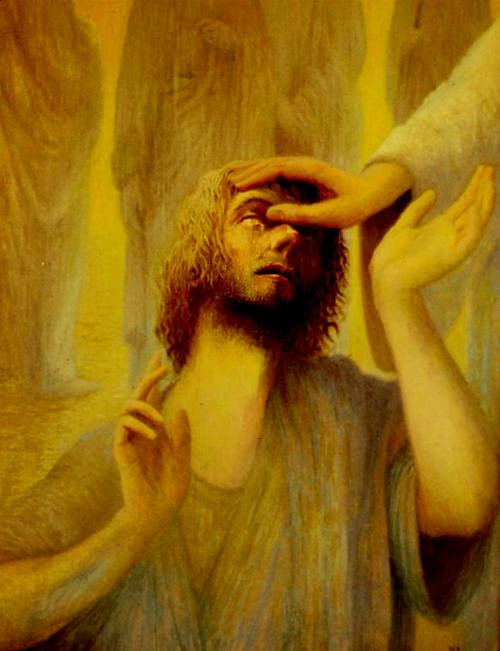
“And the Blind Shall See” ~ The Rev. Dn, Sister Dollie Wilkinson
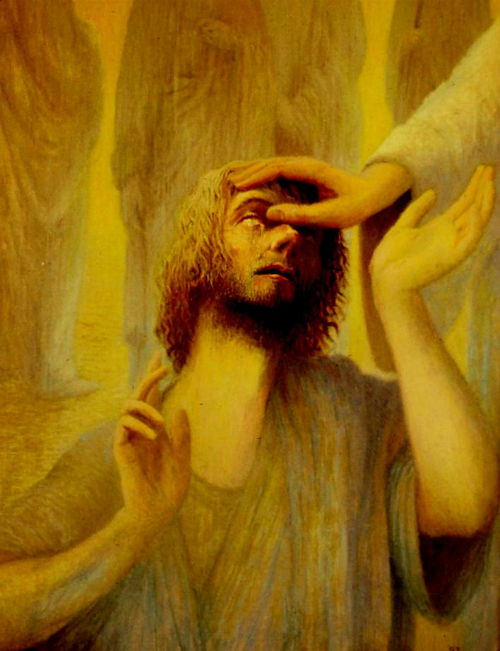
As I was going about my day, like I normally do, rushing here and there to get everything done, I happened to notice an elderly lady struggling with a walker. She was also trying to carry several bags of groceries, but because she relied on a walker to get around, she was having a very hard time. Now understand this wasn’t an isolated incident, in a rural area, but in the middle of a busy city – a local bus station. There had to be at least twenty people around her, including myself, but no one seemed to notice this lady’s struggles. As I rushed to help this poor dear, I muttered to myself, “Are so many people blind?”.
Actually, there are many, many people of the world who are very blind. Blind to what is really right in front of them. Have we became so complacent in our society, that we ignore an elderly lady struggling just to get around? Have we become so immune to violence that we would rather post a violent video we caught with our I-phone on social media, than actually step in to help when we see someone being hurt? Have we so bought in to our culture of instant-gratification, that we expect our needs be met in a heartbeat, without actually putting in any work? What does it take to have our eyes opened? In Mark 10:46-52, Bartimaeus, the blind beggar, knew exactly what, or more importantly who, could grant him the gift of sight……could open his eyes.
“They came to Jericho. As he and his disciples and a large crowd were leaving Jericho, Bartimaeus son of Timaeus, a blind beggar, was sitting by the roadside. When he heard that it was Jesus of Nazareth, he began to shout out and say, “Jesus, Son of David, have mercy on me!” Many sternly ordered him to be quiet, but he cried out even more loudly, “Son of David, have mercy on me!” Jesus stood still and said, “Call him here.” And they called the blind man, saying to him, “Take heart; get up, he is calling you.” So throwing off his cloak, he sprang up and came to Jesus. Then Jesus said to him, “What do you want me to do for you?” The blind man said to him, “My teacher, let me see again.” Jesus said to him, “Go; your faith has made you well.” Immediately he regained his sight and followed him on the way.”
How did a blind man recognize that this person, Jesus of Nazareth, could not only help him, but heal him? It took a blind man to see what was right in front of him. He recognized Jesus, and knew He was the ultimate healer. Yet, he couldn’t see. He starts by yelling very loud, much to the chagrin of those around him. They try to silence him, thinking him a fool, or not worth our blessed Savior’s time. But Jesus, in His infinite grace, calls the man over. He asks, “What do you want me to do for you?”. This is a very loaded question. If you had a magic genie that you knew could grant you any wish, what would you wish for? Wealth, fame, beauty? As we know, the blind beggar only wanted one thing…..to see again.
He could have asked for anything, but he asked for one thing. His wish was to have his sight restored. But, I think this dear soul saw more than anyone around him. He, though blind, recognized the Son, believed in Him and knew to trust that he would be healed. I’ve read a lot of commentary on this one little piece of scripture, and most focus on the miraculous healing of Bartimaeus, the fact that a blind man can finally see. But I think he saw more, though he was blind, than many folks can see now with perfect eyesight.
He recognized Jesus, knew he was the Son of David, and knew that He could heal him. He put his entire trust and faith in this person, whom he had never met. And Jesus, because He recognizes the strong faith in this young man, responds with, “Go; your faith has made you well.”. So, a blind man can see, and we can assume because of this, he no longer has to beg to live. So ask yourself this? Are you blind?
I’m not only talking about the elderly woman I saw today, struggling to carry groceries, who’s hardship appeared to go unnoticed by those around her. Would Jesus have ignored her struggles? But, I’m also talking about faith. If a blind man can recognize our blessed Savior, and know that all he had to do was ask, and his sight would be restored, can we not also put our trust in this same Savior? What does it take for you to recognize Jesus, throw off your cloak of doubt, and simply ask (through prayer), for what is your most crucial need? Must you be like this blind beggar, to really see???
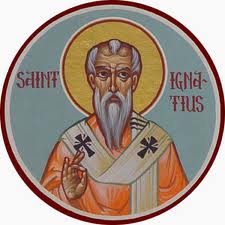
What’s Next? – St. Ignatius of Antioch ~ Br. Chip Noon, Novice

Many religions seek to answer the question of what becomes of us when we die. Many try to reconcile the inevitability of death with our fear of it. Many attempt to create a life beyond this one, at least to give us a hope that this world is not all there is.
As Christians we believe that God became man to teach us directly that there is indeed life after death and that as long as we acquit ourselves well in this life we shall attain that afterlife.
St. Ignatius of Antioch, one of the earliest church bishops, appointed by St. Peter himself, tried to teach us that the message of Jesus was much more than just saying there is life after death and that we can see God. He taught us to long for that time, to put aside all fears as not worthy of our calling after Jesus, and to eagerly seek whatever end we are destined for.
What a confusing time he lived in! Some of the twelve apostles were still alive, yet there was already dissention, schism, opportunism, false teachings. Not fifty years after the resurrection of our Savior, people abounded who used his Gospel as a means of dividing others, enriching themselves, and attaining as much power and prestige for themselves as they could achieve. Is this the real message of the early church fathers – that times will never change? Maybe. That could be one message we glean from their writings. And from the Gospels, for that matter.
But then comes St. Ignatius, a convert, a student of St. John the Apostle, and obviously a brilliant and devout Christian. What does he tell us?
There is one Physician who is possessed both of flesh and spirit; both made and not made; God existing in flesh; true life in death; both of Mary and of God; first passible and then impassible—even Jesus Christ our Lord.
He says that Jesus is God existing in the flesh. This is one of the first post apostolic writings that proclaims that Jesus is God, both man and spirit. And if this is so, then the prophets proclaiming that there is life after death must be correct. And he stressed that the Eucharist is the medicine of immortality. Therefore, we must partake of the Eucharist.
Then he says
Take care to do all things in harmony with God, with the bishop presiding in the place of God, and with the presbyters in the place of the council of the apostles, and with the deacons, who are most dear to me, entrusted with the business of Jesus Christ, who was with the Father from the beginning and is at last made manifest.
So if Jesus is God and vouchsafed his spirit and teachings upon us, we must also listen to him when he proclaims the Apostles and indicates an hierarchy within the church. So Ignatius is trying to secure those teachings and insure that the truth, the teachings of Jesus, are handed on. “Be not seduced by strange doctrines nor by antiquated fables, which are profitless.” He is trying to build up the authority of the local bishop, one bishop per city or diocese. This in order, again, to preserve correct teachings.
Then he says
I am writing to all the Churches and I enjoin all, that I am dying willingly for God’s sake, if only you do not prevent it. I beg you, do not do me an untimely kindness. Allow me to be eaten by the beasts, which are my way of reaching to God. I am God’s wheat, and I am to be ground by the teeth of wild beasts, so that I may become the pure bread of Christ.
And this all leads to a feeling of joy at death since we will see Jesus, God, the Holy Spirit and live forever. St. Ignatius not only believed this, he lived it. The hardships of his journey to face death in Rome were borne with grace…he even attempts to comfort his captors.
So in today’s reading from Romans, Paul is saying that it is not the law that will lead us to “inherit the world,” but faith, the gift from God. And in the Gospel, Jesus says, “When they take you before synagogues and before rulers and authorities, do not worry about how or what your defense will be or about what you are to say. For the Holy Spirit will teach you at that moment what you should say.” Faith.
So isn’t that all the message of St. Ignatius? That it does not matter what will happen to us, nor that we should concern ourselves with how we will comport ourselves at the end, even if it is a violent one. There is “even Jesus Christ our Lord” who will be leading us onward. St. Ignatius is showing us the direct lineage from Jesus to us, from chaos to peace, from fear to faith.
And if we listen to the Gospels and Epistles, we will have all we need to realize this lineage.
Finally, St. Ignatius was responsible for the first known use of the Greek word katholikos, meaning “universal”, “complete”, and “whole” to describe the church. And this concept permeates all his teachings and exhortations. One holy, catholic, and apostolic church. May it ever be so.
Lord, in today’s world there continues to be dissention, schism, opportunism, false teachings. Help us to hear your word and follow the teachings of your son. Let us replace fear with faith and spread that faith to all we meet. Amen.
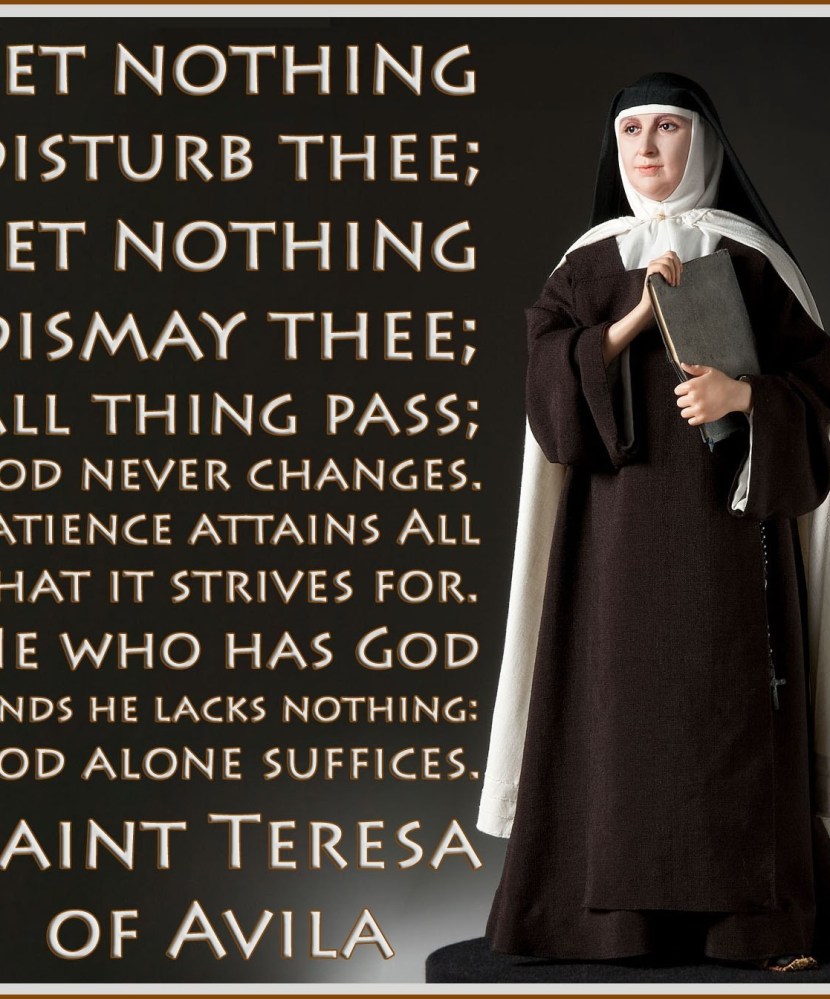
“God Alone Is Enough” St. Teresa of Avila ~ The Rev. Deacon, Sister Dollie Wilkinson, OPI

Saint Teresa of Avila (Saint Theresa of Jesus)
Born in Avila, Spain March 28, 1515; died in Alba de Tormes, October 4, 1582
Foundress of the Discalced Carmelites, 1560-62.
Canonized by Gregory XV, 1622; declared a Doctor of the Church in 1970.
Spanish mystic, writer and reformer of the Carmelite order.
St Terese of Avila was an influential and pivotal figure of her generation. St Teresa (Teresa de Cepeda y Ahumada) was born in Avila, Spain on 28th March 1515. Her parents were both pious Catholics and in some ways inspired their daughter to take up a life of prayer. As a young child Teresa showed signs of a deeply religious nature; she would often retreat into silence for prayer and would enjoy giving alms to the poor. She was very close to her Mother, who provided a warm counterbalance, to the strictness of her father. However in her teens, Teresa’s mother passed away, leaving the young Teresa distraught at the void she felt. The young St Teresa tells of her despair and how she turned instinctively to the Virgin Mary for comfort.
“I threw myself down in despair before an image of the Mother of God. With many tears, I implored the Holy Virgin to become my mother now. Uttered with the simplicity of a child, this prayer was heard. From that hour on, I never prayed to the Virgin in vain.”
During her later teen years Avila lost some of her early piety and religious zeal. She recounted how she became interested in worldly matters and enjoyed the company of a wide circle of friends. She had a natural charm and found it easy to make friends. In return she enjoyed the compliments and friendships of others. However, she was not at peace, considering herself to be a miserable sinner; later she would look back in guilt at her early life. However this sense of being a “miserable sinner” was probably the result of a harsh self-judgment, encouraged by her fathers exacting religious standards. At the age of 16, her father decided to send Teresa to a convent school to be educated.
This re-ignited in Avila an interest in following a spiritual life and after some deliberation resolved to become a nun of the Carmelite Order. At the time the convent rules were not very strict; it was probably more relaxed than living with her father. At the time the convent accepted many people into the order, often for financial reasons. The convent became overcrowded and people were often judged not on the basis of spiritual intensity but on material possessions. In this climate, Teresa struggled to find time for quiet reflection; although she did start teaching people on the virtues of mental prayer.
Shortly after becoming a nun, Avila experienced a severe illness (malaria), which left her in great pain for a long period. At one point it was feared that her illness was so severe that she would not be able to recover. However during this period of intense physical pain, she began to increasingly experience divine visions and an inner sense of peace. These inner experiences of joy and peace seemed to transcend the intense physical pain of the body.
When she was a little better she resumed her prayers with renewed vigor. However after telling others of her visions and spiritual experiences, she was dissuaded from persuading them. Certain clergy felt they were just delusions of the devil. As a result, for many years Teresa lost the confidence to pursue her prayers and her spiritual life was almost put on hold. However, when Teresa was 41, she met a Priest who convinced her to go back to her prayers and implore God to come back. Initially, she had some difficulty sitting through prayers. She wryly remarked the end of the hour’s prayer couldn’t come soon enough. However, in the course of time, she became absorbed in deep contemplation in which she felt an ever growing sense of oneness with God. At times she felt overwhelmed with divine love. The experiences were so transforming, she at times felt the illumining grace of God would wash her soul away. She was so filled with divine contemplation it is said at times her body would spontaneously levitate. Teresa, however was not keen on these public displays of “miracles”. When she felt it happening she would ask other nuns to sit on her to prevent her floating away.
Teresa was not a just a quiet, placid saint. She had an endearing, natural quality; her life energy attracted and inspired many who were close. They admired her for both her outer charm and inner serenity. But at the same time her religious ecstasies also caused jealousy and suspicion. Unfortunately she was born into the period of the Spanish inquisition, during this time any deviation from the orthodox religious experience came under the strict observation and scrutiny. On one occasion Teresa complained to God about her mistreatment from so many different people. God replied to her saying “That is how I always treat my friends” with good humor St Teresa replied “That must be why you have so few friends”. St Teresa struggled because there were few who could understand or appreciate her inner ecstasies. However on the one hand she felt these experiences to be more real than ordinary events.
At the age of 43, St Teresa decided she wanted to found a new order recommitting to the values of poverty and simplicity. She wanted to move away from her present convent which made a life of prayer more difficult. Initially her aims were greeted with widespread opposition from within the town of Avila. However, with the support of some priests, the opposition waned and she was allowed to set up her first convent. St Teresa proved to be an influential leader and founder. She guided the nuns not just through strict disciplines, but also through the power of love, and common sense. Her way was not the way of rigid asceticism and self denial. Although she underwent many tribulations herself, to others she stressed the importance of experiencing God’s love.
St Teresa devoted much of the rest of her life to traveling around Spain setting up new convents based along the ancient monastic traditions. Her travels and work were not always greeted with enthusiasm, many resented her reforms and the implied criticism of existing religious orders. She often met with criticism including the papal nuncio who used the rather descriptive phrase “a restless disobedient gadabout who has gone about teaching as though she were a professor” St Teresa also had to frequently contend with difficult living conditions and her frail health. However she never let these obstacles dissuade her from her life’s task. She eventually died on October 4 at the age of 67. In 1566 she wrote Camino de perfeccion (Way of Perfection), to tell the nuns how to reach their goal. In 1580 she wrote what is considered her greatest work; the Castillo interior/ Las moradas (Interior castle/ The mansions). This involved describing the various stages of spiritual evolution leading to full prayer; she wrote Las Fundaciones (Foundations) from 1573 to 1582, so they would remember the early history of their order.
St. Theresa’s most popularly known writing, is a brief poem, which is known as her “Bookmark”, because it was found in her prayer book after her death in 1582. It has been variously translated into English, and has been very widely circulated.
“God alone is enough.”
Let nothing disturb you,
Let nothing frighten you,
All things are passing away:
God never changes.
Patience obtains all things.
Whoever has God lacks nothing;
God alone suffices.
Teresa lived in an age of exploration as well as political, social and religious upheaval. It was the 16th century, a time of turmoil and reform. She was born before the Protestant Reformation and died almost 20 years after the closing of the Council of Trent.
The gift of God to Teresa in and through which she became holy and left her mark on the Church and the world is threefold: She was a woman; she was a contemplative; she was an active reformer.
As a woman, Teresa stood on her own two feet, even in the man’s world of her time. She was “her own woman,” entering the Carmelites despite strong opposition from her father. She is a person wrapped not so much in silence as in mystery. Beautiful, talented, outgoing, adaptable, affectionate, courageous, enthusiastic, she was totally human. Like Jesus, she was a mystery of paradoxes: wise, yet practical; intelligent, yet much in tune with her experience; a mystic, yet an energetic reformer. A holy woman, a womanly woman.
Teresa was a woman “for God,” a woman of prayer, discipline and compassion. Her heart belonged to God. Her ongoing conversion was an arduous lifelong struggle, involving ongoing purification and suffering. She was misunderstood, misjudged, opposed in her efforts at reform. Yet she struggled on, courageous and faithful; she struggled with her own mediocrity, her illness, her opposition. And in the midst of all this she clung to God in life and in prayer. Her writings on prayer and contemplation are drawn from her experience: powerful, practical and graceful. A woman of prayer; a woman for God.
Teresa was a woman “for others.” Though a contemplative, she spent much of her time and energy seeking to reform herself and the Carmelites, to lead them back to the full observance of the primitive Rule. She founded over a half-dozen new monasteries. She traveled, wrote, fought—always to renew, to reform. In her self, in her prayer, in her life, in her efforts to reform, in all the people she touched, she was a woman for others, a woman who inspired and gave life.
Her writings, especially the “Way of Perfection”and “The Interior Castle”, have helped generations of believers.
In 1970, the Church gave her the title she had long held in the popular mind: Doctor of the Church. She and St. Catherine of Siena were the first women so honored.

Riches… ~ The Rev. Deacon Scott Brown, OPI

Mark 10:17-30New International Version (NIV)
The Rich and the Kingdom of God
17 As Jesus started on his way, a man ran up to him and fell on his knees before him. “Good teacher,” he asked, “what must I do to inherit eternal life?” 18 “Why do you call me good?” Jesus answered. “No one is good—except God alone. 19 You know the commandments: ‘You shall not murder, you shall not commit adultery, you shall not steal, you shall not give false testimony, you shall not defraud, honor your father and mother.’[a]” 20 “Teacher,” he declared, “all these I have kept since I was a boy.” 21 Jesus looked at him and loved him. “One thing you lack,” he said. “Go, sell everything you have and give to the poor, and you will have treasure in heaven. Then come, follow me.” 22 At this the man’s face fell. He went away sad, because he had great wealth.
23 Jesus looked around and said to his disciples, “How hard it is for the rich to enter the kingdom of God!” 24 The disciples were amazed at his words. But Jesus said again, “Children, how hard it is[b] to enter the kingdom of God! 25 It is easier for a camel to go through the eye of a needle than for someone who is rich to enter the kingdom of God.” 26 The disciples were even more amazed, and said to each other, “Who then can be saved?” 27 Jesus looked at them and said, “With man this is impossible, but not with God; all things are possible with God.”
28 Then Peter spoke up, “We have left everything to follow you!”
29 “Truly I tell you,” Jesus replied, “no one who has left home or brothers or sisters or mother or father or children or fields for me and the gospel 30 will fail to receive a hundred times as much in this present age: homes, brothers, sisters, mothers, children and fields—along with persecutions—and in the age to come eternal life.
Jesus tells us that if we put aside our earthly possessions and follow him then we will be rewarded in the kingdom of God with 100 times as much. Now this does not mean that if we give up one car we will have 100 cars in heaven, nor does it mean that for every house we give away on earth we will get 100 houses in heaven. What He is trying to let us know is that our riches in heaven cannot be measured by dollars and cents, Mercedes or Chevy, or diamonds or emeralds. He is telling us that our rewards will be so wonderful that we cannot compare them to anything on earth. I believe that our rewards will be the eternal experience of the overwhelming love of our creator. There will be no stress there, we will have no sickness, cancer, diabetes, none of the earthly nuisances and bothers that we deal with on a daily basis here. We will walk in peace and tranquility with Jesus, without experiencing traffic jams, bosses that are irritable and cranky all the time. There will be no terrorists’ threats or school massacres. Overwhelming will be the feelings of joy and peace, to the degree that we cannot imagine here on earth. Bliss will be the norm; no stress headaches, no deadlines fast approaching, no such thing as overdrawn bank accounts and bounced checks. These things will all be but a memory. At the moment we enter into the kingdom of God we will be relieved of all sorrow and the weight of the world will be lifted off our shoulders. There will be beautiful soothing music sung by choirs of angels and happiness will abound everywhere. We will have eternal life without any worries or concerns to plague us as we have now. We will be reborn into a place where there is no stress, worries, or cares. So in essence this scripture tell us that when we enter the kingdom of heaven we will be starting our lives anew, fresh, unsoiled by the daily grinds that we experience here on earth today. It will be as if we have been showered in true love and cleansed of all our sins and transgressions. Starting over will be a joyous and wonderful experience that we all should be looking forward to. So when the traffic backs up, or the checking account is overdrawn, the neighbor is being a total jerk, or you have that desire to slap your boss and pour hot coffee down his pants, sit back and rejoice in the knowledge that soon, very soon these will be but distant memories and such things will never happen again for all eternity. One of my favorite classic gospel hymns is Beulah Land. The lyrics describe perfectly the rewards that await us on the other side.
- I’ve reached the land of corn and wine,
And all its riches freely mine;
Here shines undimmed one blissful day,
For all my night has passed away.- Refrain:
O Beulah Land, sweet Beulah Land,
As on thy highest mount I stand,
I look away across the sea,
Where mansions are prepared for me,
And view the shining glory shore,
My heaven, my home forevermore!
- Refrain:
- My Savior comes and walks with me,
And sweet communion here have we;
He gently leads me by His hand,
For this is Heaven’s borderland. - A sweet perfume upon the breeze,
Is borne from ever vernal trees,
And flow’rs that never fading grow
Where streams of life forever flow. - The zephyrs seem to float to me,
Sweet sounds of Heaven’s melody,
As angels with the white-robed throng
Join in the sweet redemption song.
Read the lyrics and be assured that these wonderful rewards are waiting for you on the other side.
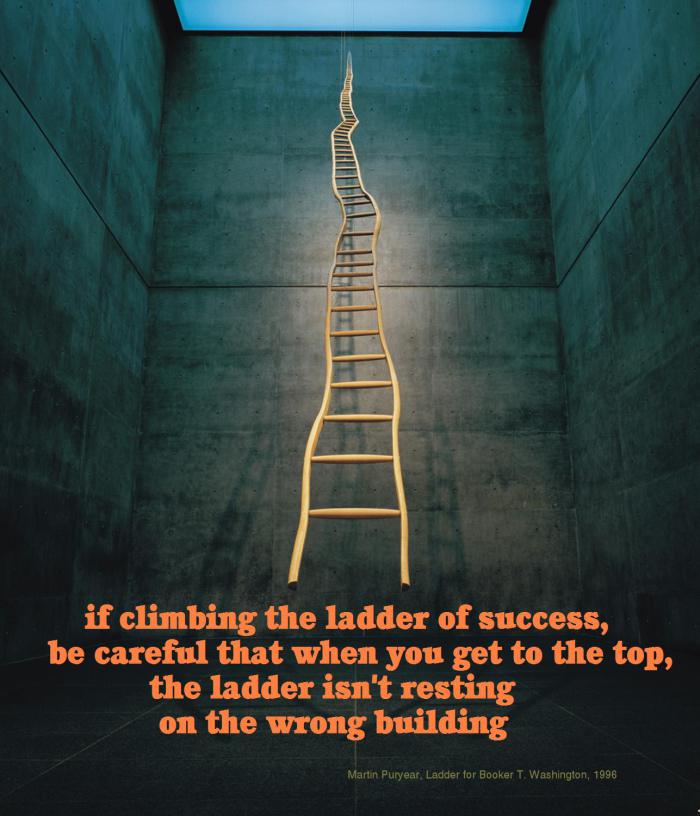
The Ladder of Success???? ~ Br. Chip Noon, Novice
POSTER_20B
How fitting that today, as the Bishop of Rome, Pope Francis, takes his leave of the richest country on earth…and in the history of the world…the second reading from today’s Mass is from James 5: 1-6:
You have lived on earth in luxury and pleasure; you have fattened your hearts for the day of slaughter.
In fact, all of this passage has at one time or another in Francis’ Papacy been addressed by him and flung out to the world as a warning and as a criticism. “It is easier for a camel to go through the eye of a needle than for someone who is rich to enter the kingdom of God.”
And the world has flocked to him – Roman Catholics and non-Catholics alike. But his message, as some think, including the young man Jesus told to sell all, is a hard one. How are we to give up all we have and still live in this world? Does Francis, like St. Francis, really mean to give away our inheritance and live in hair shirts? Are we supposed to go without shoes, even in the winter? What about when we get old, if we haven’t “saved up” how will we live?
But if we look at the first reading and at the Gospel, we see a nuanced story that is at the heart of what Jesus taught, and what Francis is proclaiming.
I think what we are seeing here is more profound than simply saying “the poor are better than the rich.” I think we are examining how Jesus viewed what we love, not what we have. In both the reading and the Gospel, the Holy Spirit is giving us the message that we are all equal, we are all children of God, and whether we are officially entitled or we are acting on our own, if what we are doing is loving God and our neighbor as ourselves, we are following the word of God…and we will enter the Kingdom.
Isn’t our life a constant sizing up? We compare ourselves with each other, with celebrities, with kings and queens – and don’t we usually find ourselves wanting? Moses asked Joshua, “Are you jealous for my sake?” And in that question, we can see the hierarchy that Joshua, and probably the whole people of the Exodus, had formed in his mind and tried to enforce: There’s Moses, then Aaron, then the 70 Elders…then maybe Joshua, then the heads of households, then the male children, etc., etc. Everyone was to know his or her place and act accordingly. And anyone who got out of line was to be censured, and of course Joshua and the other top dogs would do the censuring or meet out the punishments. The big guys vs. the little guys, or the worthy vs. the lesser beings.
Didn’t we read in Wisdom 2:11 “But let our strength be our norm of righteousness; for weakness proves itself useless.”? Again and again, God is telling us that no one is more worthy than any other. But further on in Wisdom we read: “Let us lie in wait for the righteous one, because he is annoying to us; he opposes our actions, Reproaches us for transgressions of the law and charges us with violations of our training.” This is echoed in the second reading:
You have condemned; you have murdered the righteous one;
he offers you no resistance.
And of course Jesus is the real subject here. But so also is St. Francis, and Pope Francis, both of whom have been reviled for speaking the words God has said to us in the Bible. And so have most reformers and seekers of justice for all. Reviled and condemned because they are really kicking away the ladder so many of us stand on. The higher the rung, the closer to…to what? Heaven, the giant’s castle in the clouds, the envy of our neighbors?
It’s really a simple message: there is one God and then there are the rest of us. Scrambling up the ladder of wealth and prestige will get us no closer to him.
And so should we really sign over our bank accounts and have a yard sale of all our possessions and put that money in the poor box? I suppose we should, if that would remove the beam from our eye. Still, that’s the same line of thought in reverse: the less we have, the better we are. It still precludes infatuation with hierarchy and position.
So what is the real answer? We know what it is. 1 Timothy 6:10 alludes to it. “For the love of money is the root of all evil: which while some coveted after, they have erred from the faith, and pierced themselves through with many sorrows.”
The real answer is “Love the Lord your God with all your heart and with all your soul and with all your mind and with all your strength. The second is this: Love your neighbor as yourself. There is no commandment greater than these.”
Lord, today as we contemplate these words and think on the poor and suffering, help us to remember that simply loving them and showing them the love of God is what they need most. Then, with differences of wealth and position aside, and in a spirit of your servants, we can begin to bestow what riches we may have on those who need them.
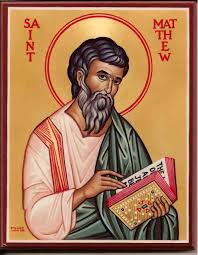
St Mathew, Apostle, Evangelist ~ The Rev. Lady Sherwood, OPI
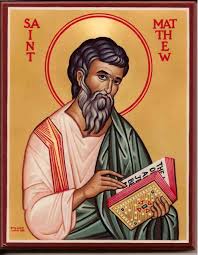
When our Lord Jesus called him to follow him, Mathew was a tax collector by profession for the Romans. His profession was hated by the devout Jews as it reminded them of their subjection and also the Pharisees saw his profession which was classed as publican, as work for the typical sinner.
St Mathew is one of the Lord Jesus’ twelve apostles and by christian tradition is also seen as one of the four Evangelists. He was the first to put down in writing as his Gospel the Lord’s teachings and the account of our Lord Jesus’ life. Mathew wrote his Gospel in Aramaic, which is the language which was spoken by Jesus himself.
No one was shunned more than a publican by the devout Jews because a publican was a Jew who worked for their enemy, the Romans and who robbed their own people making themselves large personal profits. Publicans were despised to the extent that they were not allowed to trade, eat or even to pray with other Jews.
One day when Mathew was seated at his table of books and money, Jesus looked at him and said unto him two words, “follow me”. For Mathew, these two words were all it took for him to immediately rise, leaving all his pieces of silver to follow our Lord Jesus Christ.
Mathew’s original name was ‘Levi’ which in Hebrew signified ‘Adhesion’ whilst his new name given to him by our Lord Jesus of Mathew means ‘Gift of God’.
The only other major mention of Mathew in the Gospels is regarding the dinner party for Jesus and his companions to which Mathew invited his fellow tax collectors.
The Jews showed surprise at seeing our Lord Jesus eating in the company of a publican, but Jesus explained to the Jews that he had come “not to call the just, but sinners.”
Not much else is known about the life of Mathew but according to tradition, he is reported to have preached in such places as Egypt, Ethiopia and other further Eastern areas.
Some say Mathew lived into his nineties before dying a natural death, but other Christian traditions say he died the death of a martyr.
The Gospel according to Matthew is one of the four canonical gospels, one of the three synoptic gospels, and is the first book of the New Testament. The narrative tells how Messiah, our Lord Jesus was rejected by Israel, and how he finally sends his disciples to preach his Gospel to the whole world. Most Scholars believe the Gospel of Matthew was composed between 80 and 90 CE, with the possibility of between 70110 CE. The Gospel of Matthew is a creative reinterpretation of Mark, stressing Jesus’ teachings as much as his acts, making subtle changes to reveal Jesus’ divine nature for example, Mark’s “young man” who appears at Jesus’ tomb becomes a radiant angel in the Gospel of Matthew. The Gospel of Matthew shows Jesus as the Son of God from his birth, the fulfillment of the Old Testament. The Gospel of Matthew was the favourite Gospel of St.Dominic de Guzman, who always would carry it wherever he went.
Let us pray to St Mathew to ask him to intercede on our behalf:
O Glorious St Mathew, in your Gospel you portray Jesus as the longed-for Messiah who fulfilled the prophets of the Old Covenant and as the new lawgiver who founded a church of the New Covenant. Obtain for us the grace to see Jesus living in his church and to follow his teachings in our lives on earth so that we may live forever with him in heaven. Amen.
 The Order of Preachers, Independent
You must be logged in to post a comment.