
Category: Sermon
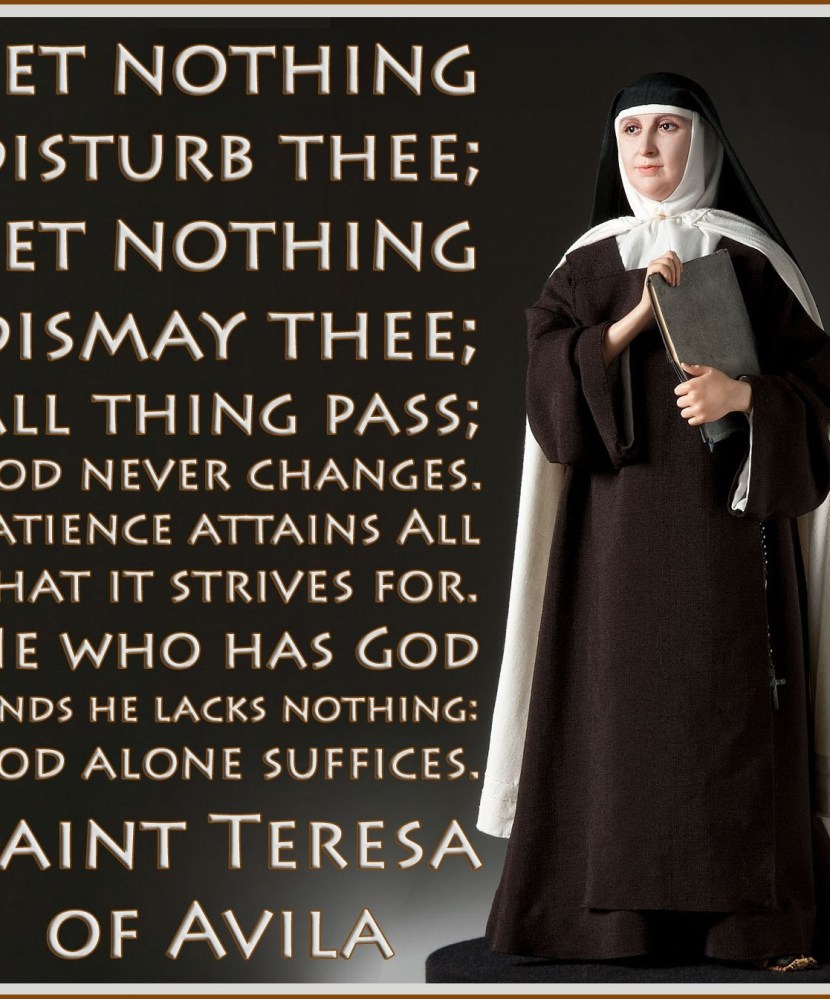
In God’s Hands: St. Teresa of Avila ~ Br. Chip Noon, Novice
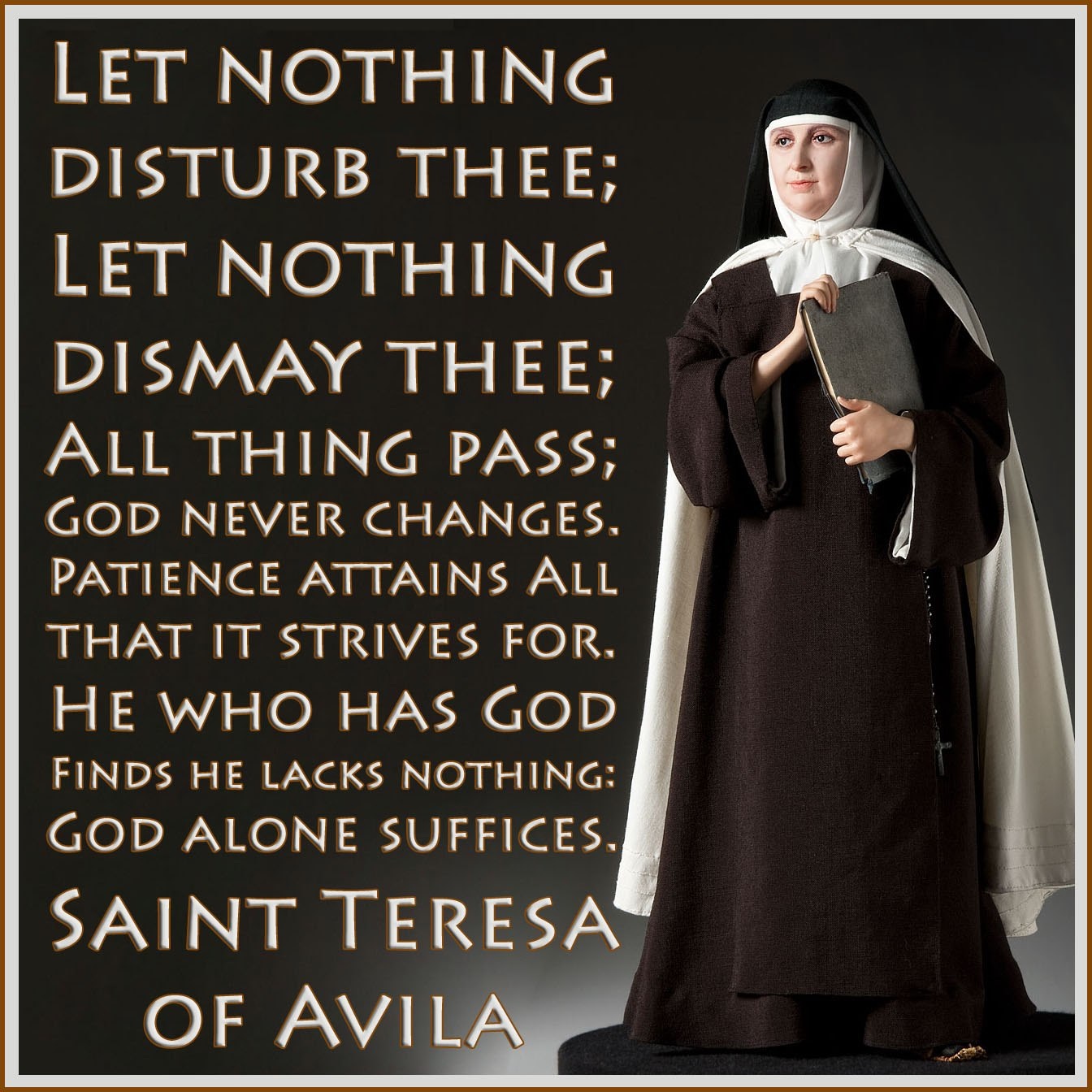
Today is the memorial of St. Teresa of Avila, also known as St. Teresa of Jesus.
Representing the mystical branch of Christianity, St. Teresa embodied and taught that the concept of divine grace is bestowed as a gift. Nothing we do can earn this gift. It is freely given by God.
But she also taught and wrote about being prepared for that gift. And it is in her preparation for God’s blessing that we see her “works”, if we may call them such.
Throughout her teachings, St. Teresa presented the ascent of the soul to God in four stages: 1. Devotion of Heart, devout concentration and contemplation. 2. Devotion of Peace, surrendering to God all our being and all our thought in quiet prayer. 3. Devotion of Union, an ecstatic state of further absorption in God, or rapture. 4. Devotion of Ecstasy, wherein all of our senses and mental faculties are completely entranced by the love of God.
While a true contemplative, St. Teresa was a tireless reformer, teacher, writer, and founder of Carmelite monasteries. So she was out and about, without shoes since she was a discalced religious, working fervently for the unification of the Order and to establish as many houses as she could. She also lived in extreme poverty, renounced property, and practiced flagellation.
In today’s first reading, St. Paul is giving thanks for his brothers and sisters in Ephesus who have shown him their faith in Jesus. And Paul prays that they will receive from God a spirit of wisdom and knowledge of him. This is essentially St. Teresa’s first stage that they are in and Paul is praying for their advancement to a higher level.
The Psalm and the Gospel may be seen as the beginnings of the second stage, the Devotion of Peace, essentially a surrendering. Jesus tells us that when faced with having to defend our beliefs, we need only surrender to the Holy Spirit who will teach us at that moment what we should say.
Let me go back to the idea of preparation.
In another of St. Teresa’s works, The Interior Castle, the saint is recording for us the path to mystical union with God. Like St. Ignatius of Loyola, she is giving us a prescription to follow, in an orderly way, so that we may receive the full majesty of God’s grace and glory. These exercises, as St. Ignatius called them, are work we must do to have the strength to move into the realm of ecstasy.
Yet, as in the readings, and as St. Teresa said time and again, we cannot “earn” God’s grace; it is always freely given. We must only be ready to receive it.
Isn’t this always the conundrum? So embedded in our minds and psyches is the notion that we must earn our daily bread, we must work hard to get ahead, we must never give up, so embedded is this that it seems that all good things come only after struggle and toil. This “valley of tears” is only something to be overcome, to be slogged through, to be endured.
Of course it is. This is real life!
But what Jesus and St. Teresa and all our spiritual teachers are telling us is that no matter how hard we struggle, we can rest easy in the knowledge that we are in God’s hands. And what they are suggesting is that we put ourselves in grace’s way. We pray, we contemplate, we study, we patiently wait, we open the eyes of our hearts that we may be enlightened, as Paul says in the Reading.
And so that is what our daily prayers are. That is what our weekly reading of The Rule does. That is why we have our daily studies and Liturgy to contemplate so that we are prepared. And as Paul says to the Thessalonians, “For you know very well that the day of the Lord will come like a thief in the night.”
Let us pray. Lord, give us the courage to prepare for your presence, give us the stamina to exercise our souls for the day of your coming, and give us the time and the peace to be ready for the manifold distribution of your gifts. We ask this in Jesus’ name.
Amen.

The Broken Ones ~ The Rev. Dcn. Scott Brown, OPI

Today’s Gospel is Luke 17, 11-19
11 On the way to Jerusalem he was passing along between Samaria and Galilee. 12 And as he entered a village, he was met by ten lepers,[a] who stood at a distance 13 and lifted up their voices, saying, “Jesus, Master, have mercy on us.” 14 When he saw them he said to them, “Go and show yourselves to the priests.” And as they went they were cleansed. 15 Then one of them, when he saw that he was healed, turned back, praising God with a loud voice; 16 and he fell on his face at Jesus’ feet, giving him thanks. Now he was a Samaritan. 17 Then Jesus answered, “Were not ten cleansed? Where are the nine? 18 Was no one found to return and give praise to God except this foreigner?” 19 And he said to him, “Rise and go your way; your faith has made you well.”
Jesus heals those who ask. He picks us up when we are down, lifts our spirits when we are depressed and takes away our scars. We are all broken in one way or another; we are all in need of healing of one kind or another; and we are all in need of love and compassion. This is what Jesus will do for you if you only ask him.
Jesus heals all of the lepers who asked him, but only one of them returned to thank him for what he had done for him. Why did the other nine not return to thank Jesus? That may be one of the mysteries we can only have answered when we actually meet Jesus. My thoughts are this: the other nine were so overjoyed to be healed and cleansed that they didn’t see the need to thank the Lord for what he had done for them, or possibly they were so overcome with glee and joy they wanted to rush to their homes and show them what had happened. Regardless of their reasons there was one who acknowledged what Jesus had done for him and felt the need to acknowledge and praise Him for his outpouring of love towards him. We need to keep this in mind and thank and praise Jesus for the blessings he shows to us every day. When your checking account is empty and you get that surprise check in the mail that will carry you through to the next payday, when you are depressed and feeling all alone in the world, an old friend calls you without warning, when your boss gives you a raise at work because you put in that little bit of extra effort on a project; these are all blessings that we need to be thankful for and praise our Lord for his bountiful love and compassion. Our healings may not be as profound as those of the lepers, but we are all blessed and healed one way or another on a daily basis. Praise him and thank him for every little blessing you receive.
Lord in your mercy hear the prayers of the sick, depressed, poor, and anyone who needs your blessings in any way. Let us truly know where our bounties come from and acknowledge those bounties and blessings as yours. In Jesus name we pray. Amen

Living the Life of Faith ~ The Rev. Lady Sherwood, OPI

Gospel reading: Luke 17:5-10
5 The apostles said to the Lord, “Increase our faith!”
6 He replied, “If you have faith as small as a mustard seed, you can say to this mulberry tree, ‘Be uprooted and planted in the sea,’ and it will obey you.
7 “Suppose one of you has a servant plowing or looking after the sheep. Will he say to the servant when he comes in from the field, ‘Come along now and sit down to eat’? 8 Won’t he rather say, ‘Prepare my supper, get yourself ready and wait on me while I eat and drink; after that you may eat and drink’? 9 Will he thank the servant because he did what he was told to do? 10 So you also, when you have done everything you were told to do, should say, ‘We are unworthy servants; we have only done our duty.’”
In today’s Gospel reading, we hear the disciples asking Jesus to increase their faith. I am sure most of us at some point in our lives have asked similarly.
If I had only more faith, we say if things are difficult in our lives. We say things such as, “if only I had more faith, maybe that person wouldn’t have got Ill, or wouldn’t have died” or “if I had more faith, I wouldn’t suffer like this or have that in my life, or I would be a better person”. I admit, there have been times when I have thought exactly as the disciples did in today’s Gospel reading.
However, living by faith is not something that comes in sizes or in measurable quantities. It is not a bargaining chip that we can use to gain favour or our own personal wants from God.
Faith is a true loving relationship that we have with Our Lord and is something which we must live fully each and every day of our lives. Living a faithful life does not mean that we will not suffer hardships and pain within our lives. The righteous are not exempt from suffering, just because a person may be ill or poor does not make them a sinner. We must not confuse wealth with approval of God or illness with sin (see Matt 9:21=22 and Jn 9:2=3).
It is living as one with God in all our daily words and deeds and doing it to our utmost with all that we are. Living a faithful life doesn’t even mean that we have to always agree with everything that our Lord tells us, but that out of love we learn to live as one to the best of our ability.
A good example is if we look at a good marriage or partnership, the two out of love for each other, live as one, they are faithful to each other in all things even if they may not always agree with each other.
Living a faithful life, is living to the best of our ability as Our Lord would live, we are all one in Christ and should strive to live this fully within our daily lives.
It is Loving each other, accepting each other and forgiving each other. It is walking with each other on this path of life and helping our brothers and sisters who stumble along the way.
We know that God will only do what is good for us as his children and that he has plans only for our good as the following scriptures clearly tell us:
And we know that in all things God works for the good of those who love him, who have been called according to his purpose (Rom 8:28).
For I know the plans I have for you” declares the LORD, “Plans to prosper you and not to harm you, plans to give you hope and a future (Jer 29:11).
A true example of living the life of faith can clearly be seen in the story of Job. The story of the life of Job is one of faith, endurance, and of patience winning out against amazing odds.
Job was subjected to three tests=the first was to accept without sinning, the loss of his possessions and offspring (Job 1:6=22). The second was to endure the destruction of his health without blaming anything on God (Job 2:1=10). The third test was to endure false accusation. Most people would respond to the trials of Job by blaming these evils on God’s inaction, but Job showed humility in the sight of God. He tore his robe, shaved his head, and fell down and worshipped God and throughout all his trials Job never resorted to sinning against God. Job’s life and his faith is an excellent example to all of us as Christians.
Thank You, Lord, for the measure of faith You have given me. I refuse to be moved by outward circumstances, but only by what Your Word says. I will trust in the Lord with all my heart and I will not lean upon my own understanding (Proverbs 3:5). Thank You for saving me! Ephesians 2:8 says, “it is by free grace (God’s unmerited favour) that you are saved (delivered from judgement and made partakers of Christ’s salvation) through [your] faith. And this [salvation] is not of yourselves [of your own doing, it came not through your own striving], but it is the gift of God…”. All of the precious gifts You have given me: salvation, healing, prosperity, etc., are connected to my faith, and it’s impossible to please You without it. I will keep Your commandments, walk in love, stay in the Word and live by faith!

Rich Man, Poor Man~ The Rev. Deacon Dollie Wilkinson, OPI

When I was younger, living in a small town in West Virginia, we were considered poor. Like most of my friends’ parents, even though my Mom and Dad worked full time, we lived paycheck to paycheck. This meant that usually the money ran out before the end of the month. Though our bills were usually paid, there were some months that maybe the electric bill wasn’t paid, or we would get a cut off notice for the water. I remember many months where we would make an impromptu visit to the Salvation Army pantry, to pick up canned goods, dried beans, and if we were lucky, a canned ham. Being a child, and because most of my closest friends’ parents, or grandparents, also did this, I never thought much of it. It was only when I got older, going to junior high school, then high school, that I realized not everyone lived this way. I just assumed everyone wore hand-me-downs, and ate left-overs more than one day a week.
Now as an adult, I realize how poor we were. Though we didn’t have much money, we had plenty of things money couldn’t buy – family, love, contentment, joy, fun, friendship. But of course being a child, I did envy those children who would come back from Christmas break, bragging about the presents they got or where they spent their holiday vacation. When my daughters were growing up, I tried to give them all the material things I lacked as a child – newest, most popular toy, latest fashion in clothes, and any food stuff or snacks they wanted. While also providing them with a loving and safe home, I wished to make sure they never felt deprived, that they never went hungry, that they never wanted for anything (within reason and budget, of course). Now that they are adults, with good paying jobs, they can provide for themselves.
But as adults, we sometimes are like children – so we still want the newest, most popular toy, latest fashion in clothes, and any food stuff or snacks we crave. There isn’t anything wrong with this, as long as we understand that there must be a limit to our material possessions. That just like a child who understands limits, what he or she can or cannot do, or can or cannot have. As adults, especially as children of God, we must recognize that material wealth does have its limits. And that the value that we put on material possessions will hinder us from leading a life of goodness and faith. This is what we are cautioned about in 1 Timothy 6:6-19:
“Of course, there is great gain in godliness combined with contentment; for we brought nothing into the world, so that we can take nothing out of it; but if we have food and clothing, we will be content with these. But those who want to be rich fall into temptation and are trapped by many senseless and harmful desires that plunge people into ruin and destruction. For the love of money is a root of all kinds of evil, and in their eagerness to be rich some have wandered away from the faith and pierced themselves with many pains. But as for you, man of God, shun all this; pursue righteousness, godliness, faith, love, endurance, gentleness. Fight the good fight of the faith; take hold of the eternal life, to which you were called and for which you made the good confession in the presence of many witnesses. In the presence of God, who gives life to all things, and of Christ Jesus, who in his testimony before Pontius Pilate made the good confession, I charge you to keep the commandment without spot or blame until the manifestation of our Lord Jesus Christ, which he will bring about at the right time–he who is the blessed and only Sovereign, the King of kings and Lord of lords. It is he alone who has immortality and dwells in unapproachable light, whom no one has ever seen or can see; to him be honor and eternal dominion. Amen. As for those who in the present age are rich, command them not to be haughty, or to set their hopes on the uncertainty of riches, but rather on God who richly provides us with everything for our enjoyment. They are to do good, to be rich in good works, generous, and ready to share, thus storing up for themselves the treasure of a good foundation for the future, so that they may take hold of the life that really is life.”
In Timothy, we are not told to always go around and be poor. Rather we are cautioned that if we have wealth, if we have a comfortable life with plenty of food on the table, clothed in the latest fashion, or surrounded by nice things, to not be boastful, To share with others as we can, to also “pursue righteousness, godliness, faith, love, endurance, gentleness”. While having nice things is not a sin, worshiping these things above God is. So we must use these material blessings from our heavenly Father to help others, to do good works. How do we do that? Volunteer your time in a soup kitchen, or animal shelter. Donate money to help orphanages overseas, or a local church charity. Offer to cut your neighbors grass, or sit with an elderly friend. Though you may not have wealth, you can still be rich. For as long as you do good works, it is in this richness that you “ may take hold of the life that really is life.”
Got Stuff? ~ The Rev. Lady Sherwood, OPI
Are we true Stewards of God?
Gospel LK 16:1-13
Jesus said to his disciples, “A rich man had a steward who was reported to him for squandering his property. He summoned him and said, ‘What is this I hear about you? Prepare a full account of your stewardship, because you can no longer be my steward.’ The steward said to himself, ‘What shall I do, now that my master is taking the position of steward away from me? I am not strong enough to dig and I am ashamed to beg. I know what I shall do so that, when I am removed from the stewardship, they may welcome me into their homes.’ He called in his master’s debtors one by one. To the first he said, ‘How much do you owe my master?’ He replied, ‘One hundred measures of olive oil.’ He said to him, ‘Here is your promissory note. Sit down and quickly write one for fifty.’ Then to another the steward said, ‘And you, how much do you owe?’ He replied, ‘One hundred kors of wheat.’ The steward said to him, ‘Here is your promissory note; write one for eighty.’ And the master commended that dishonest steward for acting prudently. “For the children of this world are more prudent in dealing with their own generation than are the children of light. I tell you, make friends for yourselves with dishonest wealth, so that when it fails, you will be welcomed into eternal dwellings. The person who is trustworthy in very small matters is also trustworthy in great ones;and the person who is dishonest in very small matters is also dishonest in great ones. If, therefore, you are not trustworthy with dishonest wealth, who will trust you with true wealth? If you are not trustworthy with what belongs to another, who will give you what is yours? No servant can serve two masters. He will either hate one and love the other, or be devoted to one and despise the other. You cannot serve both God and mammon.”
In today’s Gospel we are hearing the Parable of the dishonest Steward. Each of us are also stewards to the Lord our God. A steward is a person who manages property or money for the true owner. We are all stewards because God created all and is the true owner of all. Are we true and honest stewards of God within our lives, or are we like the steward in the Gospel reading today? How many times do we see the possessions and resources we have been charged with as our own? How many times do we use these for our own human purposes instead of in the way that God who truly owns them, has entrusted us to use them for his glory?
Everything upon the earth belongs to God our heavenly Father, not only material things and resources, but also all of our brothers and sisters, who God also created.
In truth we are all less than worthy stewards because we each fall short of the Glory of God. We are called to love each other as God loves us, to feed and clothe the poor and to the spread the true word of the salvation of God to all upon his earthly Kingdom. Do we love all as we ought? Do we use all that has been entrusted to us to teach, feed and nourish the children of God as our Father asks of us, or do we wallow in materialism and Greed? We cannot serve two masters, both God our Father and earthly wealth and possessions. We shall all be brought to account for our way of undertaking the stewardship that we have been given. Let us pray to our heavenly Father to ask for his guidance in being the true stewards that he has called each of us to be:
Heavenly Father,
You are an amazing God—steadfast in your love, abundant in your mercy, and wise in your actions. You are a wonderful creator God who has provided a magnificent creation with abundant resources for us to enjoy. We recognize our sinfulness and thank you for your mercy and grace extended to us through Jesus on the cross.
Your word tells us in James 1:5 that those who ask for wisdom in faith will receive it. Today, we pray for wisdom and for understanding in how to best steward the resources you have given while demonstrating love toward our fellow brothers and sisters.
Lord, we desire to be good stewards. We do not want to waste resources or use them selfishly with sinful desires of personal gain. Yet, we understand that the second greatest commandment is to love others as ourselves. As we create policies that help us protect the environment and use our resources wisely, please grant us wisdom that we will not value the created earth over humans created in your image. Please allow us wisdom to create policies and practices that allow for human flourishing all across the globe.
Allow us to align our priorities with yours in valuing the souls for which you died more than the resources we steward. Allow us to have a greater passion for the Gospel and spreading the Good News that changes lives than we have for making sure the earth never changes. God grant us wisdom to know when to speak and when to act so that we live in such a way as to glorify you with all of our words and our deeds, and may your name be exalted among every tribe and tongue. In Jesus name we pray through the power of the Holy Spirit.
Amen.

Forgiven! ~ Br. Chip Noon, Novice

Sin.
Abomination.
Depravity.
Disobedience.
There are some pretty heartbreaking things going on in today’s readings. The Israelites turn away from God and worship false gods, David sins with Bathsheba and has her husband killed, Paul relates once again his culpability as a persecutor of the followers of Jesus, and finally, the prodigal son, after a life of dissipation and debauchery, comes home to be forgiven.
Forgiven. This idea of God’s mercy is the heart of today’s readings, not sin.
We have been set up in several ways to recognize what displeases God, how we can reject him, and what we do to others that is worthy of shame. In fact, if we didn’t have the other parts of the Mass in between these messages, we might leave this Sunday’s celebration rather cast down by all the bad things that we can do and have done in the past.
Those of us who pray the Liturgy of the Hours daily will recognize today’s Psalm 51 (or 50 in the old enumeration) which we read every Friday at Morning Prayer. The antiphon is You alone have I grieved by my sin; have mercy on me, O Lord.
In this psalm David recognizes his guilt for his adultery with Bathsheba and the setting up of her husband to be killed in battle. He admits his guilt, admits that it is always with him, acknowledges before God his faults, asks God for forgiveness, and promises to proclaim God’s goodness and declare God’s praise as a sinner who has begged for mercy and been redeemed.
Look again at these readings. Each one speaks of something precious that has been lost through accident or deliberate actions: the sheep, the drachma, chastity, a life of service and work for others, self-respect. Something precious that is gone and that should be retrieved.
Scientists are now studying whether a sense of goodness, or conscience, or altruism is hard-wired into us or is something we learn from our parents and society. It will be interesting to know, but in fact, we don’t really need to know where this sense of the right thing to do comes from, do we? We know immediately and intrinsically the difference between right and wrong. And even though Paul says his misdeeds grew out of ignorance in today’s reading, we know that his transgressions against the early Christians troubled him greatly, or his conversion would not have been so complete.
So I suppose we don’t really need the Ten Commandments, or sermons, or homilies to show us the right path, because the moment we step off it, we know in our hearts that we are have lost our way.
But the greater message of the readings from today is more than just having us see that everybody, even David, is capable of sin. The greater message is that there is no sin that cannot be forgiven by God.
There is no sin we commit that God will not forgive. If only we confess the sin and ask for forgiveness.
Confess to God and ask his forgiveness.
“…there will be rejoicing among the angels of God over one sinner who repents.”
Let us pray. Lord we know there are times we have rejected the good and gone after the bad, whether by thoughts, words, or deeds. Help us on the right path and help us to ask forgiveness when we mis-step. And as Jeremiah tells us, “For I know the plans I have for you,” declares the Lord, “plans to prosper you and not to harm you, plans to give you hope and a future,” then let us rest in your loving kindness.
Amen.
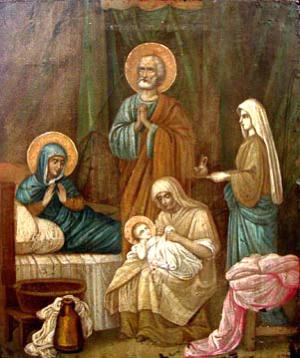
Life-For the Purpose of God – The Nativity of the Blessed Virgin ~ The Rev. Lady Sherwood, OPI

Today we celebrate the nativity of the Mother of Our Lord Jesus Christ and our heavenly mother.
All parents are filled with such joy at the birth of their children. We try to bring them up to be the best which they can be in the world. Our heavenly Father who created us and who knows each of us before our birth is no different. He also is filled with joy at our birth and wants the best for us.
God already has plans for each of our lives and for exactly which role we shall fill within his kingdom on earth.
Some may eventually become Bishops, priests, ministers of the word or professed religious. For others, it may be growing up to work in the care profession, to be a Dr or nurse, carer and so on,or to teach our future adults in schools, colleges or universities. They may be in support roles such as social or charitable work. Whatever the role the Father has planned for us, all are valuable and necessary for his Kingdom on earth.
But just imagine if you can, that in this case, we have St Joachim and St Anne, who were both unable to bear children. Imagine the joy here when, because of their faith, they were given their daughter Mary. What such a special gift and blessing!!
However, not just St Joachim and St Anne were blessed by the birth of Mary, as indeed we all have been blessed!
God chose that Mary would grow up to become the Mother of Our Lord Jesus Christ, when he came down to earth as one of us. It is Mary who loved and nurtured Our Lord and who suffered so much incomprehensible sorrow and heartbreak when Jesus gave himself to be crucified for the atonement of our sins.
Through this most blessed role, Mary became our Mother in heaven who is there interceding with her Son on our behalf.
This innocent new baby, Mary, grew up so full of faith and gave herself totally and freely to the will of God our Father. When the angel Gabriel came to her to proclaim that she would bear a son and that he would be the Son of the Most High, Mary replied, “I am the Lord’s servant” May your word to me be fulfilled”.(LK 1:38 NIV)
Such Faith and devotion!
We can all learn so much in our lives from the life and faith of Mary. Her life clearly shows us how we should accept in true faith the plans that God our Father has for our lives, so that like Mary, we may be instruments of his glory.
With this in our hearts and minds, let us pray:
God Our Father, give your chosen people your help and strength. The birth of the Virgin Mary’s Son was the dawn of our salvation. May our celebration of her nativity bring us closer to lasting peace and may the virtues that she modelled develop in our lives,to love you and our neighbours more perfectly. Grant this we pray, through Christ our Lord.
Amen.
Follow Me ~ The Rev. Dennis Klinzing, Novice

When Jesus left the Pharisee’s house, great crowds followed Him, but He was not impressed by their enthusiasm. He knew that most of those in the crowd were not the least bit interested in spiritual things. Some wanted only to see miracles, others heard that He fed the hungry, and a few hoped He would overthrow Rome and establish David’s promised kingdom. They were expecting the wrong things.
Jesus turned to the multitude and preached a sermon that deliberately thinned out the ranks. He made it clear that, when it comes to personal discipleship, He is more interested in quality than quantity. In the matter of saving souls, He wants His house to be filled, but in the matter of personal discipleship, He wants only those who are willing to pay the price.
A ‘disciple’ is a learner, one who attaches himself or herself to a teacher in order to learn a trade or a subject. Perhaps our nearest modern equivalent is ‘apprentice,’ one who learns by watching and by doing. The word disciple was the most common name for the followers of Jesu Christ and is used 264 times in the Gospels and the book of Acts.
Jesus seems to make a distinction between salvation and discipleship. Salvation is open to all who will come by faith, while discipleship is for believers willing to pay a price. Salvation means coming to the cross and trust Jesus Christ, while discipleship means carrying the cross and following Jesus Christ. Jesus wants as many sinners saved as possible, but He cautions us not to take discipleship lightly, and in the three parables He gave, He made it clear that there is a price to pay.
To begin with, we must love Christ supremely, even more than we love our own flesh and blood. The word hate does not suggest positive antagonism but rather ‘to love less.’ Our love for Christ must be so strong that all other love is like hatred in comparison. In fact, we must hate our own lives and be willing to bear the cross after Him.
What does it mean to ‘carry the cross?’ It means daily identifications with Christ in shame, suffering, and surrender to God’s will. It means death to self, to serve Him as He directs. A ‘cross’ is something we willingly accept from God as part of His will for our lives. The Christian who called his noisy neighbors the ‘cross’ he had to bear certainly did not understand the meaning of dying to self.
Jesus gave three parables to explain why He makes such costly demands on His followers: the man building a tower, the king fighting a war, and the salt losing its flavor. The usual interpretation is that believers are represented by the man building the tower, the king fighting the war, and we had better ‘count the cost.’ Truthfully the builder and the king represents not the believer but Jesus Christ. He is the one who must ‘count the cost’ to build the church and battle the enemy. He cannot get the job done with halfhearted followers who will not pay the price.
Discipleship is serious business. If we are not true disciples, then Jesus cannot build the tower and fight the war. If we will tell Jesus that we want to take up our cross and follow Him as His disciples, then He wants no false expectancy, no illusions, no bargains. He wants to use us as stones for building His church, soldiers for battling His enemies, and salt for bettering His world, and He is looking for quality.
After all, He was on His way to Jerusalem when He spoke these words, and look what happened to Him there! He does not ask us to do anything for Him that He has not already done for us.
To some Jesus says, ‘You cannot be MY disciple.’ Why? Because they will not forsake all for Him, bear shame and reproach for Him, and let their love for Him control them. They are the losers. Will you be His disciple?

St. Bernard of Clairvaux ~ Br. Chip Noon, Novice

Today is the Memorial of St. Bernard of Clairvaux. He was born in 1090 in France, and died there in 1153. He was the abbot of a monastery in what became known as Clairvaux, a confessor, and a Doctor of the Church. From our vantage point today, looking back 800 years, we recognize that he was a man of sincere beliefs, a lover of God and the Blessed Mother, a mediator and salesman for the Roman Catholic Church, and a man of contradictions.
First, let us look at the reading from today’s Mass, Ezekiel, Chapter 43, Verses 1 through 7.
The angel led me to the gate which faces the east,
and there I saw the glory of the God of Israel
coming from the east….
It continues to describe the vision he had of the temple, and of the calamities befalling the Holy Land and its inhabitants, and in this passage illustrates the temple itself and what happened to him there. God was speaking to him: “…here I will dwell among the children of Israel forever.”
And in the Responsorial Psalm, we see the echo of these words:
- The glory of the Lord will dwell in our land.
The LORD himself will give his benefits;
our land shall yield its increase.
Justice shall walk before him,
and salvation, along the way of his steps.
How fitting that these readings should be found in the memorial mass of St. Bernard.
Isn’t it true that we tend to look backwards in time and see only a few highlights? Don’t we think of the early Middle Ages as a time of kings and queens and knights and pages and wars and the beginnings of the crusading spirit? Don’t we see it as a time fixed in amber, with what we consider “history” encapsulating a small insect or artifact representing the whole era?
In reality, St. Bernard lived in a time about as tumultuous as our own. Yes, there were kings and queens and all the characters of our historical novels and movies. But just as today, there were disputes over territory, the wording of Bible passages, the meaning of life…all the issues we face but with considerably more complexity since the forms of governance and separation of powers and cultural norms were not nearly as codified as we know them today.
And in this mix is St. Bernard, a man of God who had all the temptations and misdirections and questions we have. He was a man of such intellect, charisma, and organizational expertise that the monastery he founded at Clairvaux grew so rapidly that they had to send out monks to other parts of Europe to relieve the overflow in the founding house.
He travelled around France and Italy and Sicily to garner support for the legitimacy of Pope Innocent II, disputed with Peter Abelard, and preached the Second Crusade, among his many activities. His disagreement with Abelard centered on what he said was the application of logic where logic didn’t belong and was therefore illogical. Admittedly, this is a major condensation of the argument, but it points to an important contribution of St. Bernard to the time.
St. Bernard was not one to close his eyes to the new applications of philosophical thinking, but with Abelard showed that while reason and logic were valuable to the growth of our intellect, there are certain truths, embodied in the teachings of Jesus and the scriptures that should not be disputed “logically.” One example of this kind of thinking can be found in his complete devotion to the Blessed Mother. St. Bernard referred to her as the Mediatrix, but did not believe in the Immaculate Conception. Faith and reason residing in the same person. It was his desire to bring order and sense to the tumult which was the 12th Century that resonates with the first reading where Ezekiel is showing God’s desire to set things aright after a period of chaos.
Which brings me to today’s Gospel.
To me, this completely encapsulates St. Bernard’s life and work. All worldly show, all human knowledge, all accomplishments and discoveries, in fact, everything that humans strive for are nothing as compared to the love of God and one’s neighbor. Whatever we show to the world and desire from the world must be put to this test: “You have but one teacher, and you are all brothers.” So no matter how learned he was, how fervent in his warlike desire to protect the Holy Land, how partisan he was in backing one pope over another, beneath all this he was a servant of man and of God. And he remained true to this devotion to Jesus and Mary to the end of his life.
Would that we could all be like this.
Lord, move in us the desire to search out new vistas, new knowledge, new advancements. But keep us always mindful of your humility and grace, and give us the courage and logic of St. Bernard that after 800 years still holds truth as that precious artifact within the gemstone of amber.

On Being an Ostrich ~ Br. Chip Noon, Novice

Nobody wants to hear bad news. We think that maybe if we don’t hear it, whatever it is won’t come true. The old trick of the ostrich. How long can we ignore it? It seems some of us can ignore bad news and stories of impending disaster for a very long time.
So just imagine Jeremiah’s frustration, as we hear in today’s first reading. Time and again he has warned the king and his subjects that the good times are ending and the bad times are coming. “Yeah, but what proof do you have, Mr. Jeremiah?” they all wanted to know. “You see,” they thought, “if we ignore your warnings, maybe they won’t come true.”
But Jeremiah was prophesying that the people would be between a rock and a hard place. He foresaw that the kingdom was to be overcome by the Babylonians, which was bad enough. But he also said that if they resist they will be annihilated, but that if they surrender, they will be spared.
Not a great choice there – in fact, a true dilemma.
But instead of ignoring Jeremiah this time, they ask the king if they might deal with him in their own way. And as further evidence that the whole system was breaking down, King Zedekiah lets them haul Jeremiah off, not wanting to incite their ire.
A weak king, a weak kingdom, weak-willed advisors and populace, and a man who was fearless in the service of God…something’s got to give.
In the Responsorial Psalm, though, we get the solution: The Lord heard my cry. He drew me out of the pit of destruction. And this is immediately followed by the second reading from Hebrews with the same message: Just as Jesus gave himself up for us and suffered and died, so we too, living his own example, can endure opposition from sinners, running the race until we cross the finish line which is our God.
But then we listen to today’s Gospel. What a message! Has Jeremiah returned to badger us with lamentations? I have come to set the earth on fire… Do you think that I have come to establish peace on the earth?
Now wait a minute! Yes, we are taught that Jesus came to establish peace on earth. So now what is Jesus saying here?
He is echoing Jeremiah in the first reading. He is saying that we’re not getting out of this life alive, but that if we take the choice of submission, then we will have eternal life. Yes, there will be problems. There will be troubles. There will be divisions and conflict. We can’t just sit back and hope that nothing bad is going to come our way. It’s already here. But what use is fighting against it? We can resist and be mowed down, or we can submit and be spared.
Some people just acquiesce, thinking that if they play the game, all will turn out well. Like King Zedekiah: to get along, go along. Isn’t this the old trick of the ostrich all over again? Today’s Gospel comes from Luke Chapter 12, which opens with Jesus saying, “Be on your guard against the yeast of the Pharisees, which is hypocrisy. There is nothing concealed that will not be disclosed, or hidden that will not be made known. What you have said in the dark will be heard in the daylight, and what you have whispered in the ear in the inner rooms will be proclaimed from the roofs.” So we can get down there in the sand all we want. Somebody, whether the court official, Ebed-melech who tells King Zedekiah that he’s been discovered allowing one of his subjects to be harmed, or whether it is Jesus who knows what is in the Pharisee’s hearts, or God who knows our innermost thoughts, as we read in Psalm 139, Lord, you have examined me and know all about me.
This world is a perplexing place. We are buffeted on all sides by adversity. We have numerous opportunities to give in and let the winds blow us where they will. But if we truly listed to the Lord, we know that that kind of cowardice or indifference will avail us nothing. Then why not submit? Why not just trust in God who loves us, sinners as we are? What have we got to lose?
Lord, help us today to put our whole life in your hands. Help us to see that the struggle is fruitless if it is not centered on you and your message of love and peace. Help us to “Let go and let God.”


You must be logged in to post a comment.