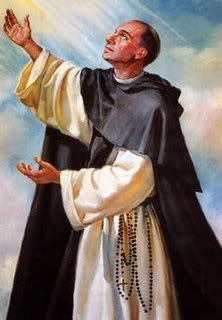
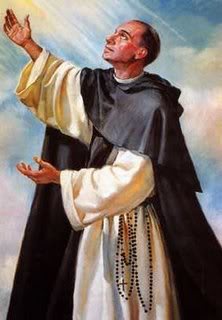
Guala was one of the first disciples of Saint Dominic, attracted by the Dominican ideal in 1219, when he heard the founder preach. He received the habit from Dominic at the time the friary opened in Bergamo. After a short novitiate, he was appointed prior there.

Guala proved to be an able superior and a practical administrator and builder. He was on the committee that planed the convent of Saint Agnes in Bologna. During a delay in the construction of the convent because of the opposition of the family of Blessed Diana d’Andalò, who was financing the project, Guala was sent to Brescia to assume the position of its first prior.

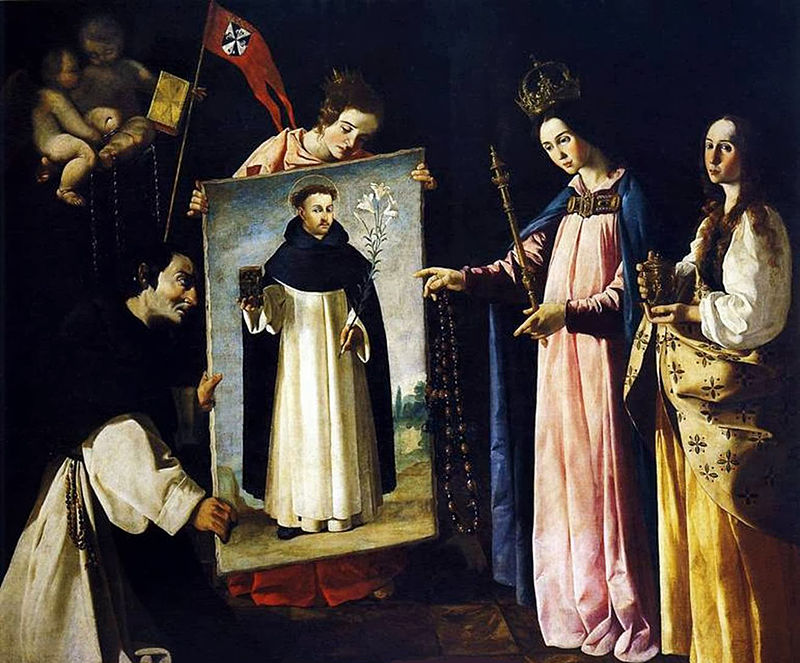
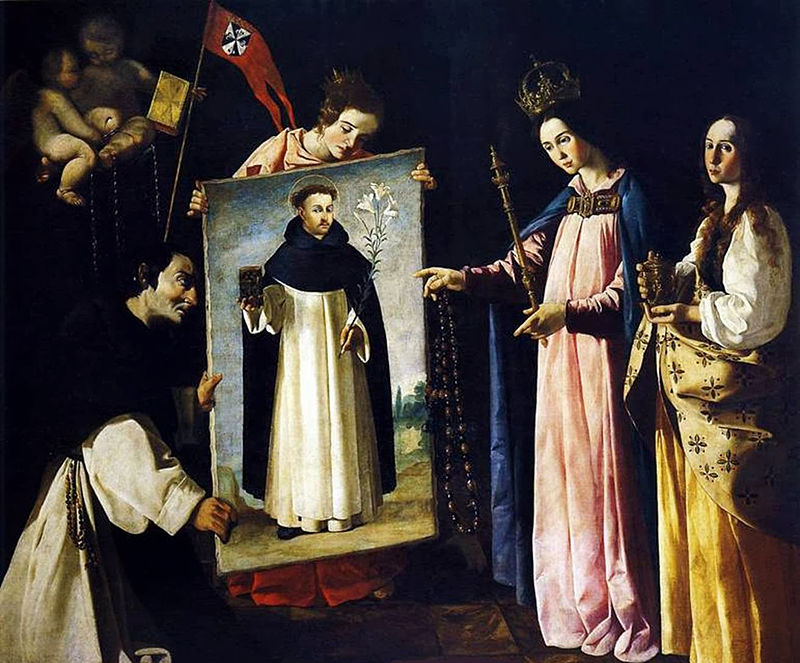
During this period Guala had the revelation of Saint Dominic’s greatness that became the subject of many early legends. Although they were good friends, Guala did not know that Dominic was dying on their return from a chapter. Guala had fallen asleep with his head leaning against the belltower of the conventual church at Brescia when he had a vision of two ladders coming down from heaven. Our Lord was visible at the top of one ladder, and Our Lady at the top of the other. Angels were ascending and descending on them. As Guala watched, a friar, who sat at the foot of one ladder with his face covered was drawn up to heaven and great glory surrounded him. Guala awoke, deeply affected by the vision, and went immediately to Bologna, where he found that Saint Dominic had died at the time of his vision.

In 1226, Guala was named the prior of Bologna’s Saint Nicholas abbey, famous for its regularity and fervor. While there, Pope Honorius III appointed him arbiter between Bologna and Modena. Guala worked hard to forge a treaty that lasted 10 years. The following year Pope Gregory IX asked him to negotiate between Emperor Frederick II and the Lombard confederacy–an even more daunting diplomatic task. Guala was also commissioned to convince Frederick to keep his vow to lead a crusade. He was unable to resolve matters between the parties, but at least they maintained the status quo of an uneasy peace.

In 1228, Guala was consecrated bishop of Brescia. As such, he negotiated a number of treaties between warring cities. Frederick broke all the promises he had made and attacked the cities that had remained loyal to the pope. In 1238, Frederick’s army besieged Brescia, but the attackers had to withdraw within three months, which is credited to Guala.

Guala’s contemporaries described him as “a man of great prudence, well acquainted with the world, and of accomplished manners,” and said that “he governed the diocese entrusted to his care with such holiness that, both during his life and after his death, he wrought many wonders through God.”

The years of labor and civil strife wore him down. He resigned his see in 1242 in order to enter complete seclusion and pray without interruption in preparation for death. Therefore, he retired to the Vallumbrosan monastery of San Sepolcro d’Astino, where he lived as a hermit until his death. He was buried in the Benedictine church, and after many miracles at his tomb, his cause was promoted.

Born: in Bergamo, Italy

Died: in San Sepolcro d’Astino, Italy, in 1244

Beatified: cultus approved in 1868 by Pope Pius IX.

Continue reading

The Beheading of John the Baptist ~ Dcn. James Dominic

The Herod who ordered the beheading of John the Baptist is Herod Antipas, one of the sons of Herod the Great. His first wife was from the neighboring Arabian kingdom of the Nabateans. I am sure you can visualize its capital city Petra cut into the cliff face in modern day Jordan because Indiana Jones went there to rescue the Holy Grail. While married to his first wife, Herod met Herodias, and they lived adulterously at first and then they both divorced their spouses so they could marry. Sin often brings its own punishment and it did in this case. The Nabateans were enraged with Herod for slighting his first wife, one of their own, and in 39 AD there was open conflict between them which resulted in the exile of Herod.

John the Baptist, following in the footsteps of the prophets of old who confronted the kings over immorality, confronted Herod the tetrarch. John the Baptist preached the truth about fidelity in marriage to Herod Antipas. Obviously John’s preaching to Herod was not successful; Herod and Herodias remained together. On this occasion, John the Baptist was like the prophets of old who enjoyed little success. Jeremiah, the prophet, despite all his pleadings would eventually see Jerusalem in the hands of the Babylonians because the people would not listen to his pleas to repent and return to living a life under the Covenant with God. The prophets were not called to be successful; rather they were called to preach the word of God whether welcome or not. John the Baptist preached to Herod without success, but John fulfilled his calling; he preached the word of God welcome or unwelcome. The hostility to his preaching on marriage means that just as he preceded Christ in his birth he would also precede Christ in his passion and death.

St. Augustine in one of his sermons sees John the Baptist taking the role of a priest (Sermon 293:1-3). Augustine reflects on John the Evangelist’s describing of Jesus as the Word in the Fourth Gospel. John is the voice preceding the Word. The Vox before the Verbum. The role of the priest is to be like John, a voice for the Word. Through the voice the Word enters the heart of another. This is done without the speaker, the priest, having lost any of the Word himself. The voice is a mediator, helping the Word to enter the heart of another. Commenting on St. Augustine’s sermon, Cardinal Ratzinger in Pilgrim Fellowship of Faith: The Church as Communion (p164) wrote,

Ultimately, the task of the priest is quite simply to be a voice for the word: “He must increase, but I must decrease”—the voice has no other purpose than to pass on the word…On this basis the stature and the humbleness of priestly service are both equally clear: the priest is, like John the Baptist, purely a forerunner, a servant of the Word. It is not he who matters, but the other.

Blessings vs. Woes ~ Dcn James Dominic, Novice


As Jesus’ passion and death draw near, his teaching becomes more intense. According to the chronology of St. Matthew, the Lord’s triumphal entry into Jerusalem is a prelude to the dramatic cleaning of the Temple. There follows a series of parables that emphasize the theme of judgment and repentance. In the Gospel of today’s Mass (Matthew 23:13-22), Jesus rebukes the Scribes and Pharisees for their hypocrisy.

As we have seen, Jesus gives great importance to the virtue of sincerity. To be sincere is to live in the truth, and the source of all truth is God. To be sincere involves living as God would have us do, so that our desires, words, and actions are authentic and all spring from the same source.

The hypocrisy of some of the scribes and Pharisees stands in stark contrast to this ideal. Jesus doesn’t criticize these religious leaders simply for being sinners; no one can escape that condition. Nor does he rebuke them for being unrepentant; he must still have hope for them in that regard. They are criticized, however, for manipulating the precepts of their religion, and for failing to share the riches of their faith with others.

“Woe to you, scribes and Pharisees, you hypocrites. You lock the Kingdom of heaven before men. You do not enter yourselves, nor do you allow entrance to those trying to enter” (Matthew 23:13).

This is the first in a series of seven “woes” in the Gospel of St. Matthew. In a way, they are the “reverse side of the coin” to the eight Beatitudes (Matthew 5:3-12). Whereas the Beatitudes proclaim the pattern of blessedness for the Christian, these “woes” reveal the barrenness that is the rotten fruit produced by the rejection of Christ and his Gospel.

Blessedness versus barrenness. This is the contrast presented by Christ. If we want to find blessing, grace and peace in our lives, we will strive, with God’s help, to live the virtues described in the beatitudes. On the other hand, the interior blindness that fuels the “woes” will only lead to corruption, cynicism, and unhappiness.

Particularly offensive to the Lord is the twisting of religious practice into something that resembles superstition.

“You say, ‘If one swears by the altar, it means nothing, but if one swears by the gift on the altar, one is obligated.’ You blind ones, which is greater, the gift, or the altar that makes the gift sacred?” (Matthew 23:18-19).

Where did the Pharisees get all of this? Their approach to religious duties seems to be little more than a series of well-choreographed rituals, far removed from the intentions of the heart.  It is almost as if religion has been reduced to a game of chance. “To attribute the efficacy of prayers. to their mere external performance, apart from the interior dispositions that they demand, is to fall into superstition” (Catechism of the Catholic Church, no. 2111).

We recognize, of course, that Jesus directs this warning not only to the Pharisees, but to us as well.  We never want to regard the outward practice of the faith as a kind of “good luck charm” with the power to manipulate circumstances to our benefit. Rather, the visible forms of the faith serve to cultivate and reinforce an interior disposition of belief, conversion, and worship.

Indeed, in the sacramental life of the Church, outward ritual is transformed by the power of Christ into a living and dynamic communion with God. The sacraments possess a power all their own, because it is Christ himself who is at work. When our faith is firmly rooted in the sacraments, it will not only be preserved, but it will grow in vigor and intensity.


Today, in the life of the Church, is the Memorial of St. Augustine.
A Saint, a sinner, a poet, a philosopher, an author, a father, a bishop, a doctor of the Church, a father of the Church – there are so many ways to look at the saint for today. Yet above all, he is Christ’s.  He is a disciple, or perhaps he, like St John the beloved, would describe himself as the disciple whom Jesus loved.

For a sinner the greatest thing about the Lord Jesus is that He identified Himself and revealed Himself to the lost. For St Augustine of Hippo, this was the greatest thing about Jesus Christ, which came through almost on every page of his writings. He never got over the fact that God called him out of darkness into his marvelous light.  However great and noble, lofty and poetic his writings may be – he never stopped rejoicing in the very simple truth that he is loved by God.

“You called, shouted, broke through my deafness; you flared, blazed, banished my blindness; you lavished your fragrance, I gasped; and now I pant for you; I tasted you, and now I hunger and thirst;  you touched me, and I burned for your peace.”

The world today needs people who are in love with God, or rather witnesses who reveal themselves as disciples whom Jesus loves. The only thing that can break through the complexity and the confusion of the people of our time is the simple and holy Love of God.

Ever try teaching chastity to a teen, correcting a person who is hurting many, or consoling a person who is suffering in the wake of immeasurable loss?  Without the love of God, these things are impossible or perhaps even futile.  It is only the Spirit of the living God, that lives and sings in the hearts of disciples that can ignite this fire in others.

This is the fire of St Augustine, his song, his instruction, his beautiful Latin poetic praise of God, his mystagogy and catechesis, his heart and soul – the Love of God. This is why he has such appeal to disciples of every age and every land.  He is a man of sincerity.  A man who’s love is sincere.  There is no faking true love. He is a man on fire with God’s mercy.

There is great need for apostles of our age to be on fire with this love, to first burn brightly with it and then share it like fire that catches others.

May the prayers of St Augustine help us to be on fire with the Love of God and to share it with all.

Jesus Who? ~ Br. Brenden Humberdross, Novice

May the words of my mouth and the meditations of our hearts be always acceptable to you O Lord, our God and Our Creator.

“Who do you say that I am?” – this question from Jesus stands at the core of what it means to be Christian and is a question that all those who profess the faith have had to face. How we each choose to answer this question is of vital importance for to know who Jesus truly is is to know the path that leads to eternal life.

In the passage from the Gospel today Jesus aims this question at His Apostles and it’s interesting to see that they give a number of answers of varying nature; they said “Some say John the Baptist, others Elijah, still others Jeremiah or one of the prophets.” For those of us who have already accepted the Christian faith, standing some 2000 years from these events the answer of the Apostles seem perplexing. I have to admit that when I first read this passage preparing for the sermon I was puzzled as to why the writer of the Gospel left these incorrect understandings of Jesus’ identity in his account. If Jesus wants us to know who He is then why first tell us who he is not?

However, as I contemplated the passage I came to realise that these incorrect statements hold a very important message for us; Jesus had a purpose in drawing these false notions out from the Apostle. Jesus was showing us two things, firstly that we should not be afraid of false doctrine as the light of truth will always show the darkness found in falsehood, and secondly it points out to us that it’s important to understand falsehood so that we can combat it with the truth. Imagine if you were trying to discuss the truths of the Gospel to someone who was of another faith. How easy do you think it would be to have that discussion with no knowledge of what they already believed? I tend to think that it would be very difficult to have a truly meaningful faith conversation like this without a knowledge and understanding of the false beliefs of the person you’re talking with.

So, now we are left asking ourselves, if Jesus is not John the Baptist, Elijah, Jeremiah or one of the other prophets returned who is he? In response to this the Apostle Peter makes one of the clearest statements about the identity of Jesus, he says “You are the Christ, the Son of the living God.” At first glance this may not seem like a very profound statement, these are words that we here in relation to Jesus all the time. However, for the Apostles this is a pivotal moment, it’s the moment when they come to a realisation of exactly who and what Jesus is, it’s the moment when they realise that He is not just another man, a prophet, but something far more. In the words of Peter we see two aspects of Jesus identity revealed. Firstly Peter refers to Jesus as “the Christ” and secondly as “the Son of the Living God”.

To those of us who are already Christian the word Christ may not hold significant meaning; it’s a word that we use with great frequency and in fact we tend to use as part of the very name of Jesus, like it is his surname. However, if we go back to the root meaning of this word it holds great significance in the faith and by using it in relation to Jesus Peter was making a bold statement. The word Christ mean anointed one and finds its equivalence in the Hebrew word Messiah. So in saying that Jesus is the Christ Peter is declaring that He is the long awaited Messiah. Throughout the long history of Israel there had been a constant message of deliverance from oppression and it was firmly believed that the ultimate deliverance of Israel would come at the hands of an anointed king and saviour, the Messiah. In stating openly and boldly that Jesus is the Messiah Peter is acknowledging that Jesus is the one that was promised by God to his ancestors, that Jesus was the one who would deliver Israel from bondage and bridge the gap between God and man. This is a powerful statement and truly a brave one.

Peter also refers to Jesus as “the Son of the Living God”; now at first hearing this the Apostles may not have thought much of it as every child of Israel was a Son of God, but this is not what Peter was saying. Peter clearly did not say that Jesus was A son of God but rather that He was THE Son of God. Peter was declaring that not only was Jesus that promised saviour and liberator of Israel but that He was in a very real sense something more than the rest of humanity. He was declaring in the best way he knew how that Jesus was divine, that He was more than just a man and that He in fact was directly of God; that He was God incarnate.

It may seem like this is a lot to read into these two simple statements; but when we pray and contemplate these words we can easily see that held within them are the crux of the Christian faith. If we are going to be faithful to Jesus we need to recognise two things about Him. Each and every one of us must recognise that Jesus is the very Son of God, that his substance, that his being and essence is not merely that of a prophet or a man. Instead He is of the very essence and person of God; the Father and Jesus are one and to know Jesus is to know the Father. Once we have come to recognise that Jesus is the Son of God we must know that Jesus has come to save us that it is only through the name of Christ that we may gain eternal life. If we fail to recognise this we fail recognise these two things we fail to be Christians and have fallen short of our inheritance of a heavenly abode.

I would encourage each and every one of you hearing or reading this sermon to join me in the next week in contemplating who Jesus is. Each and every one of us should take this opportunity to search our hearts for what Jesus means to us. If we have failed to accept Jesus as the Son of God and as our personal Lord and Saviour now is the time to do so. If we don’t let Christ into our hearts, if we don’t let Him extend his saving grace to us then how can we expect to be welcomed by Christ and His blessed mother into a heavenly inheritance once we have “shuffled off this mortal coil”?

It is my unending prayer that we may all be strengthened in our faith in Jesus and that all those in the world who are yet to accept Christ as their Saviour may have the true faith kindled within their hearts.

If you are in need of a boost in your faith or if you are seeking faith in Christ please join me in this prayer:

Lord, I wish to believe in you. I ask that my faith may be full and unreserved, that it may penetrate my thought, my way of judging Divine things and human things.
Lord, let my faith be joyful and give peace and gladness to my spirit, and dispose it for prayer with God and conversation with men, so that the inner bliss of its fortunate possession may shine forth in sacred and secular conversation.
Lord, let my faith be humble and not presume to be based on the experience of my thought and of my  feeling; but let it surrender to the testimony of the Holy Spirit, and not have any better guarantee than in docility to Holy Scriptures and the Tradition and to the authority of the One, Holy, Catholic and Apostolic Faith. Amen.

The Feast of St. Bartholomew ~ The Very Rev. Lady Sherwood, OPI

Reading 1:RV 21:9B=14
R psalm: PS 145:10=13,17=18
Gospel: JN 1:45=51

Today we commemorate the Feast of St. Bartholomew. He is mentioned in all of the four lists of the Apostles, for example, in MT10:3.

Bartholomew who is also known as Nathaniel, was one of the first followers of our dear Lord Jesus Christ. He really isn’t known much about or mentioned about as much as other Apostles such as Paul, Peter, Matthew or John. However, St Bartholomew as little known and mentioned amongst the Apostles, is has greatness due to this very fact.
Bartholomew lived his life doing exactly as the Lord Jesus had instructed him to do, he preached, he baptised, he administered the Eucharist and he proclaimed the good news and salvation of Jesus to all nations. We are taught by tradition, that Bartholomew even travelled to India to Preach the good news of Jesus Christ. We are also taught by tradition that Bartholomew was martyred for his faith in the place that today we know as Armenia.

In the Lord’s Kingdom, true greatness is not to be found in the riches of a Gold crown and a Gold throne, but in a crown of thorns and the bloodstained cross of salvation. True greatness is demonstrated by proclaiming the Glory and the greatness of our Lord Christ. In the Lord’s Kingdom of which all true children of God are part, greatness is not to be found in positions of power, or titles, or in the personal strength of mankind, but rather is found in weakness, in service, and to the glory of the Lord Jesus whose victory over death on the cross for our sins, won for us the chance of eternal salvation.

St Bartholomew was great because of his service as he didn’t glorify himself, but glorified our Lord Jesus Christ. Dearest brothers and sisters, we as mere humans are not great, but however, our Lord and Master is!! By serving our Lord Jesus, we gain a share in his greatness. Our greatness is neither earned nor is deserved, it has been earned for each of us by our humble Lord and master and who is also yet our great servant.
Let us live by the example of St Bartholomew within each of our lives, serving and glorifying the Lord with all our hearts and souls. Let us not fall into the trap of glorifying ourselves as this earthly world does. We are part of the Lord’s Kingdom and are not of this world. Serving and proclaiming the glory of our Lord and God is vital if we are truly to be children of God and to belong to his heavenly Kingdom.

Let us pray:

Lord, sustain us with the faith and service which made St Bartholomew ever loyal to Christ your Son. Let your Church be the sign of salvation of the Lord for all the nations of the world.
Through Our Lord Jesus Christ, your Son, who lives and reigns with you in Unity with the Holy Spirit, One God, for ever and ever. Amen.


Jesus Loves the Little Children! ~ The Rev. Dcn. Dollie Wilkinson

This week marks the beginning of another school year for many children, my granddaughter included. She starts kindergarten this year, which means a new school, new friends, and a new routine. I imagine she is quite nervous her first day, but probably not as nervous as her Mom. As a grandmother, I admit to also being nervous. Will she like school, or her teacher? Will she make friends easily, or will the other kids make fun of her because she is different (being of mixed-race)? I also admit to fearing for her safety. Though school systems now have multiple safety measures and protocols in place, I imagine a lot of parents, grandparents, aunts, and uncles, will worry about their little ones. But there is someone who is always looking out for our children-Jesus.

I remember when I was little, attending a baptist church in West Virginia, one of the first songs we learned was “Jesus Loves the Little Children”, written by C. Herbert Woolston (1856-1927). The tune for the hymn was composed by George F. Root. It goes something like this:

Jesus loves the little children
All the children of the world
Red and yellow
Black and white
They are precious in His sight.
Jesus loves the little children
Of the world.”

Such a simple little tune, but it carried a big message. We all knew, from the youngest toddler to the oldest teenager, that no matter what, Jesus loves us! Doesn’t matter the color of our skin, if we are rich or poor, if we sometimes act out, we are always loved and cherished. This is illustrated so clearly in Mark 10:13-16:

People were bringing little children to Jesus to have him touch them, but the disciples rebuked them. When Jesus saw this, he was indignant. He said to them, “Let the little children come to me, and do not hinder them, for the kingdom of God belongs to such as these. I tell you the truth, anyone who will not receive the kingdom of God like a little child will never enter it.” And he took the children in his arms, put his hands on them and blessed them.”

What a powerful vision ~ this holy man, the Son of God, welcoming the little children to sit with Him a spell. For many children, I’m sure this is the first time they saw Jesus, who must have seemed like a stranger to them. Yet, they gladly went up to Him, as if they knew there was not anything to fear.

Even today, many children are eagerly seeking a personal relationship with Jesus. There was a movie out recently (based on the bestselling book), “Heaven Is For Real”. Its about the story of a 4-year-old boy named Colton Burpo. Colton claims to have visited Heaven during a near death experience. He shares his story about Heaven with his curious father, Todd Burpo. Of course, Colton’s family is not at first sure what to think of his story and his visit to Heaven. What I found interesting about this story is it also makes mention of a young Lithuanian girl, who felt compelled from a very young age, to draw the face of Jesus. This extraordinary little girl is Akiane Kramarik. At age 4, Akiane painted her vision of Jesus Christ, which is replicated in the film. Born in 1994 in Mount Morris, Illinois, to two Atheist parents, Akiane was seeing visions of God, Jesus and Heaven. What first began as pencil drawings, Akiane kept replicating these visions into beautiful expressions of art and moved to pastels. By 6 years of age, Akiane switched to acrylic paint and then oils. What an awesome example of Jesus’ words, “Let the children come to me, and do not hinder them”.

Here are just a couple of examples from the Bible of Jesus showing His love and mercy for the little ones:

John 4:46-52 (NIV)

Once more he visited Cana in Galilee, where he had turned the water into wine. And there was a certain royal official whose son lay sick at Capernaum. When this man heard that Jesus had arrived in Galilee from Judea, he went to him and begged him to come and heal his son, who was close to death. “Unless you people see signs and wonders, Jesus told him,“you will never believe.” The royal official said, “Sir, come down before my child dies.”  “Go,” Jesus replied, “your son will live.” The man took Jesus at his word and departed. While he was still on the way, his servants met him with the news that his boy was living. When he inquired as to the time when his son got better, they said to him, “Yesterday, at one in the afternoon, the fever left him.”

Luke 8:40-56 (NIV)

Now when Jesus returned, a crowd welcomed him, for they were all expecting him. Then a man named Jairus, a synagogue leader, came and fell at Jesus’ feet, pleading with him to come to his house because his only daughter, a girl of about twelve, was dying. As Jesus was on his way, the crowds almost crushed him. And a woman was there who had been subject to bleeding for twelve years, but no one could heal her. She came up behind him and touched the edge of his cloak, and immediately her bleeding stopped. “Who touched me?” Jesus asked. When they all denied it, Peter said, “Master, the people are crowding and pressing against you.” But Jesus said, “Someone touched me; I know that power has gone out from me.” Then the woman, seeing that she could not go unnoticed, came trembling and fell at his feet. In the presence of all the people, she told why she had touched him and how she had been instantly healed. Then he said to her, “Daughter, your faith has healed you. Go in peace.” While Jesus was still speaking, someone came from the house of Jairus, the synagogue leader. “Your daughter is dead,” he said. “Don’t bother the teacher anymore.”  Hearing this, Jesus said to Jairus, “Don’t be afraid; just believe, and she will be healed.” When he arrived at the house of Jairus, he did not let anyone go in with him except Peter, John and James, and the child’s father and mother. Meanwhile, all the people were wailing and mourning for her. “Stop wailing,”Jesus said. “She is not dead but asleep.” They laughed at him, knowing that she was dead. But he took her by the hand and said, “My child, get up!” Her spirit returned, and at once she stood up. Then Jesus told them to give her something to eat. Her parents were astonished, but he ordered them not to tell anyone what had happened.”

We now know that Jesus truly does love all the children of the world. Over the course of His ministry, Jesus often presented children as an example of the type of faith adults are to have. When Jesus blessed the children, He told His disciples, “Truly I tell you, anyone who will not receive the kingdom of God like a little child will never enter it” (Mark 10:15). In another instance, when the disciples were fighting about who would be the greatest in God’s kingdom, Jesus brought a child to stand in their midst. He then chided His disciples: “Truly I tell you, unless you change and become like little children, you will never enter the kingdom of heaven. Therefore, whoever takes the lowly position of this child is the greatest in the kingdom of heaven” (Matthew 18:2–4). According to Jesus, the qualities of children, including humility and simple acceptance were crucial for anyone who wishes a closer relationship with our Father.

Peace ~ The Assumption of the Virgin Mary ~ Br. Chip Noon, Novice

Let me tell you a personal story.

A few years ago, I was stricken with an allergic reaction. The doctors are still not sure what it was, but it was severe enough for me to go to the Emergency Room at the hospital. Everything was beginning to shut down and I got to the ER just in time.

As part of the treatment, I was given a sizeable shot of epinephrine which had quite a negative reaction on me. The scariest part was hearing a nurse say “He’s crashing!” Believe me, that’s not something you want to hear. I have no real memory of what was going on, except a lot of frantic to and fro from the staff, and my wife sitting by my gurney looking pretty grim.

When I saw her face, all I could think was “God, no matter what happens, take care of this wonderful woman, my wife.”

I’ll have to admit, I was scared.

I prayed again for the comfort of all my family and for their strength through what I thought was about to happen to me.

Then I looked to the foot of my bed, still asking for peace for my family, and I saw…someone standing there. It was not vivid enough to look like a person, but there was definitely an oval cloud around whomever or whatever was there.

The Blessed Mother, Mary.

That’s what immediately came to mind. And of course, the oval shape was the same as the Miraculous Medal I was wearing.

Mary.

I relaxed. There was no talking, no message, no revelation, but simply a feeling of peace. I absolutely knew it was Mary, the Mother of God.

I relaxed. The frantic staff’s movement started to slow. One of the nurses patted me on the shoulder. Sue was holding my right hand. I felt OK.

To that moment in my life, Mary had been an enigma. Whenever I thought of her during my readings of the Liturgy of the Hours, it was with some sort of annoyance, I think occasioned by the type of language we find in the Vigil Gospel for today, when Jesus corrects a woman in the crowd saying, “Rather, blessed are those who hear the word of God and observe it.” And the language Jesus uses at the wedding feast at Cana, “Woman, what does this have to do with me?”

I always had, if not a negative attitude toward Mary, then one of tolerance and annoyance.

I have no idea where it came from.

But I can tell you, from the day of my allergic reaction, my feeling for and about The Blessed Mother has changed completely.

“My soul proclaims the greatness of the Lord; my spirit rejoices in God my Savior…” These words from today’s Gospel began my new quest to become acquainted with The Blessed Mother. I found that almost every reference to Mary in the Bible portrays a humble, pious, and truly blessed woman. One whom I now can truly see as “The queen (taking) her place at your right hand in gold of Ophir.” One who, as we hear in The Annunciation readings, immediately accepts God’s grace and carries out his word. This woman, who is described in the first Reading as “clothed with the sun, with the moon under her feet, and on her head a crown of twelve stars.”

Now I must confess that I’m a skeptic. Always have been. Need a two-by-four to get most messages…but that night, lying on the hospital gurney, ready for whatever was to come, I unquestionably had a visit from Mary whose unspoken message to me was “Everything is going to be all right.” That message was not that I was going to make it, but that everything was going to be all right. The Blessed Mother.

So as I hear today’s Readings, Psalm, Alleluia, and Gospel I am washed again in the peace which The Blessed Mother represents to us and her acceptance and understanding of whatever God is preparing for us.

And especially after the disturbing image of a ferocious and terrible dragon from Revelation, with the words

Then I heard a loud voice in heaven say:
“Now have salvation and power come,
and the Kingdom of our God
and the authority of his Anointed One.”

With those words, it is as if Mary is telling me, again, “Everything is going to be all right.”

So as we contemplate the Assumption of The Blessed Virgin Mary, let us all draw comfort from The Star of the Sea who calms the waves and sends us peace as we travel these sundering seas.

Jesus, help us to go through life as your Mother did, praying and trusting in God’s mercy. Give us eyes to see her glory and ears to hear her silent words of comfort.

Amen.

Faith, Doubt, Tiny Voices, and Peace ~ Br. Chip Noon, Novice

“There was a tiny whispering sound.”

“I will hear what God Proclaims; the Lord – for he proclaims peace.”

“…and from them, according to the flesh, is the Christ, who is over all, God blessed forever. Amen.”

“…my soul waits for his word. Alleluia, alleluia.”

“O you of little faith, why did you doubt?”

These snippets from today’s readings speak to me. Do they speak to you?

And a calm descended…that is what I feel as I hear these words spoken in today’s Mass. A calm that passeth all understanding.

Well, that is fine for all of the readings but the Gospel. There, we are told of a storm, a near drowning, a helping hand at the last moment. None of us who have been in a life-threatening situation feels calm afterwards. The adrenaline rush takes over and we are at the height of our senses. Life-threatening events evoke strong and heavy winds crushing rocks, and earthquakes, and fire.

But Jesus lays his hand on us and all is calm. Is that the tiny whispering sound?

This week, as I am wont to do, I pondered my role as a Dominican. “The Order of Preachers.” First, “Order” and second, “Preachers.” In my mind, that used to mean getting up on a soap box and spouting off to all who would listen. Winning souls to Christ.

But in Jesus’s teachings, do we ever find the concept of a battle to make others believe…or to help them believe? Don’t we just find Jesus speaking from the heart to our hearts?

“O, you of little faith, why did you doubt?”

An exhortation to arms? A call to battle?  No, simply a question: can’t you already see that God is at hand? Right here, right now?

Of course, when we are in a calm place, a quiet retreat, we can hear the tiny voice. We can imagine and experience the calm. But what about when we are actually in the maelstrom? How easy it is to focus on that, on the danger, on the problems. We make plans, build barriers, put on the armor we need to fight the battle.

But then, as is also common with me…and maybe you…here comes St. Paul speaking to the Romans, and to me:

“…my conscience joins with the Holy Spirit in bearing me witness that I have great sorrow and constant anguish in my heart.”

So how did the prophet, experiencing hunger, chains, prison, beatings, how did he keep hold of that tiny voice? Perhaps it was his direct experience with the Risen Christ. Surely it was his deep understanding of and attachment to the message of Jesus. Whatever it was, that tiny voice was all he needed to get him through his many trials.

“My yoke is easy and my burden is light.”

So back to my “order” and “preacher” idea: There is nothing stern, no fire and brimstone, no mountains rending nor earth erupting. There is the simple message of Jesus inviting us to listen to the tiny voice that he says is already at work in us.

And although it is wrongly attributed to St. Francis, I still like the admonition: “Preach the Gospel always. When necessary, use words.” Which is to say, how I live my life is as much an act of preaching the Gospel as going from village to village proclaiming the Good News.

But it is not only to our role as Preachers that these readings speak. They also tell us that within ourselves, when we are in distress for whatever reason, there is comfort in knowing that the peace we seek is already within us, if only we could put aside the anxiety for a while and listen. And even if we begin to sink into the depths of despair, Jesus is there with his hand to hold us up, just as he held up St. Peter on the stormy waters.

Lord, open our ears that we may hear you calling to us. Help us to listen to your tiny voice amidst the noise and clamor of this world. Let us take comfort in receiving your benefits that are ours for the taking. In Jesus name, Amen.

For the Good of It All ~ The Rev. Dcn. Scott Brown, OPI


ROM 8:28-30

Brothers and sisters:
We know that all things work for good for those who love God,
who are called according to his purpose.
For those he foreknew he also predestined
to be conformed to the image of his Son,
so that he might be the firstborn
among many brothers and sisters.
And those he predestined he also called;
and those he called he also justified;
and those he justified he also glorified.

To understand this verse, we need to think through four truths:

  1. God has an eternal purpose and He is able to accomplish His purpose.
  2. God’s eternal purpose includes calling to salvation a people for Himself.
  3. God’s purpose for those whom He calls to salvation is their ultimate, eternal good.
  4. Knowing that God is working all things together for our good brings great comfort during difficult trials.

One of the most helpful things that you can learn about your Christian life is how to handle the trials that inevitably will come your way. Jesus explained that there are some who receive the word with joy, but their faith is only temporary. When affliction or persecution because of the word hits them, immediately they fall away. They didn’t expect affliction or understand how to handle it. They signed up for success, not suffering. They wanted prosperity, not persecution. So, they fell away when the trials hit. It is especially in times of suffering that Satan, whom Peter describes as a roaring lion, seeks to devour you. So, it is essential for your spiritual survival that you know and apply what the Bible teaches about trials.

Romans 8:28 is one of the most familiar verses on this subject. The NIV reads, “And we know that God causes all things to work together for good to those who love God, to those who are called according to His purpose.” All things don’t just happen to work out for good on their own. Rather, God providentially works all things together for good for His people according to His purpose. But while Romans 8:28 is a source of great comfort when it is properly understood, it is often misunderstood and misapplied. Some think that it teaches a positive outlook on life, that everything will turn out for our happiness in this life. But this denies or greatly minimizes the reality of suffering and evil. It insensitively says to those who are suffering: “Don’t worry, be happy, your loss isn’t really so bad.” But the verse isn’t saying that.

Sometimes well-meaning Christians recite Romans 8:28 to a person in the throes of grief, trying to help or comfort. But at the moment of loss, the grieving person mostly needs your presence and your help with practical matters. Later, if need be, you may be able to help him understand and apply this verse. But it will help us all to weather suffering better if we understand this verse before the storm hits.

All things are not good. It would be mockery to say that they are. The death of a child is not good. Cancer is not good, drug addiction is not good, war is not good, blasphemy is not good. Many of us have some salt with our meals. Table salt is made up of both sodium and chloride. By itself, sodium is a deadly poison, and so is chloride. Put them together, and you have table salt. Salt flavors food, and a certain amount of salt is necessary for health and life. We cannot live without some salt in our systems. God can take things that are bad and put them in the crucible of His wisdom and love. He works all things together for good, and He gives us the glorious, wonderful promise that He will do so.

We know that we have victory over sin and over Satan, but this verse in Romans teaches us that we also have victory over our circumstances. It says that all things work together for good. Many times, this promise has been trivialized. For example, someone may be driving down the road and a tire will blow out. The person may say, “Oh, well, the Bible says that ‘all things work together for good.'(1) Maybe there’s a sale on tires.” That isn’t what this verse means. The good is not to make us necessarily healthy or happy but to make us holy, to make us like Jesus. If the goal of our lives is not to be like Jesus, that goal is too small. Our goal must be to be conformed to the image of God’s Son. Whatever the circumstances that come to us, we can rely on God’s promise in Romans 8:28. No matter our circumstances, no one can take this verse out of the Bible–and may Satan never take it out of your heart.

Let’s ask ourselves these questions when we don’t understand how the situation at hand can be working for the good:

1: What are the most difficult trials that you have been through, and how may God be working these for our ultimate good.

2: Why does Romans 8:28 only work if God is sovereign over all the evil that happens? Why does denying that truth not help?

3: What does it mean to love God? Is it primarily a feeling? If it includes feelings, how can we keep our feelings passionate?

Lord, in your mercy give us the wisdom to understand that all things do work towards good for all who love you, help us to understand that You want good for Your people, and that we must be patient allowin You to put everything in the proper order so that good will happen in Your time. Amen.


Memorial of Saint Martha 2017 Br. Brenden Humberdross, OPI

May the words of my mouth and the meditations of our hearts be always acceptable to you O Lord, our God and Our Creator.

Today the Church celebrates the life of Saint Martha who is often remembered alongside her sister Mary. Martha doesn’t appear to play a central role in the biblical narrative, we see her only twice mentioned in scripture; once complaining about her sister and the other when her brother Lazarus is raised from the dead. Today I’d like to take the liberty of discussing both of these episodes with you and what they mean to me and how they can help shape and guide our understanding of our Christian walk.

The first time we see Martha in our Bibles is in the Gospel according to Luke where we read:

Jesus entered a village
where a woman whose name was Martha welcomed him.
She had a sister named Mary
who sat beside the Lord at his feet listening to him speak.
Martha, burdened with much serving, came to him and said,
“Lord, do you not care
that my sister has left me by myself to do the serving?
Tell her to help me.”
The Lord said to her in reply,
“Martha, Martha, you are anxious and worried about many things.
There is need of only one thing.
Mary has chosen the better part
and it will not be taken from her.”

An interesting thought occurred to me when I read this scripture in preparation for this sermon that had never occurred to me before. Jesus entered the village and was welcomed by Martha; he wasn’t welcomed by a crowd, he wasn’t welcomed by Mary and Martha but instead by Martha alone who invited the Saviour to her home. When she got home she got busy preparing a meal and taking care of Christ’s needs and what happened? Mary, her sister, got all of the attention from the guest.

Have you ever brought a friend home and found that your family or a sibling took all of their attention? This is the situation Martha found herself in. When I think about this situation and my own reactions to it I can see that Martha’s actions in this scripture aren’t that out of the Ordinary and they case them in a different light for me.

In the past I have often looked at this incident and seen in Martha a certain negative, unwarranted jealousy that is rebuked by Jesus. However, when I think of the incident in the new terms I’ve highlighted I’m not sure that is really the case. I don’t believe that Martha is necessarily jealous of Martha in the usual sense, instead I think that she invited an honoured guest to her home and was expecting that she would labour to make him comfortable and receive his praise and attention for it. However, that’s not what happens and so she is upset that Mary, who has not laboured in His service yet, is getting the attention.

In this light the rebuke from Jesus is not necessarily about her jealousy or Mary’s having chosen the better method of service. Rather it is a rebuke of Martha’s being distracted, worried and troubled that she was not receiving the expected praise for her active service of God. In fact Jesus suggests that Mary’s service at his feet is just as important as Martha’s active service.

The lesson that I believe we can all take from this, and that I know I will take personally, is not to look at the way that others are serving God and to judge our service by it. We are each called to different forms of service in His name and each are just as valid as another. If we are serving God in our own way that is what is important. He who reigns above sees into our hearts and knows our desire to serve and will reward that loving service that we render in His name in due time.


The second place we see Martha (and her sister Mary) is in the Gospel of John when Jesus arrives at the tomb of their brother Lazarus:

Many of the Jews had come to Martha and Mary
to comfort them about their brother [Lazarus, who had died].
When Martha heard that Jesus was coming,
she went to meet him;
but Mary sat at home.
Martha said to Jesus,
“Lord, if you had been here,
my brother would not have died.
But even now I know that whatever you ask of God,
God will give you.”
Jesus said to her,
“Your brother will rise.”
Martha said to him,
“I know he will rise,
in the resurrection on the last day.”
Jesus told her,
“I am the resurrection and the life;
whoever believes in me, even if he dies, will live,
and anyone who lives and believes in me will never die.
Do you believe this?”
She said to him, “Yes, Lord.
I have come to believe that you are the Christ, the Son of God,
the one who is coming into the world.”

This incident is somewhat reminiscent of the incident in Luke; Mary and Martha both react very differently to Jesus’ appearance at Lazarus’ tomb. Martha, having a more active style of service immediately rushes out to meet Jesus whilst Mary waits to be called by the Saviour.

Again in this meeting it is easy to take a very negative view of Martha and her words, however if we contemplate a little deeper and let the incident unfold to our spirits a new perspective on Martha can develop before our eyes.

At first glance it appears that Martha simply lacks faith; she essentially seems to be rebuking Christ and claiming that it is pointless his being there as there is nothing He can do. Now whilst this is true, that IS what she is saying, her words actually display great faith. Martha positively shows us that she has total faith that Jesus can heal from illness and even bring a person back from the brink of death. Instead of a lack of faith Martha shows a lack of understanding of who Christ is.

Martha’s response to the arrival of Christ shows that she is not aware of the full role and divinity of Christ. She knows that Lazarus will be raised from the dead in the resurrection but does not see that full divinity rests in Christ and that He can perform all that is within God’s power.

Jesus positively asserts His divinity in response to Martha’s misunderstanding removing any shadow of a doubt that He is God incarnate. As we know Jesus then goes on to show all present that He is “the resurrection and the life” by raising Lazarus from the grave.


Do you have total faith in Christ and in His divine nature? I know at times it is easy to be caught up in the daily work of the world, our ministry, our families, and Jesus can become an abstract ideal to us. However, we need to not fall into Martha’s trap and let our faith become an “it’ll be fixed when we meet God” or “when Jesus returns” type attitude. Jesus is real and alive today, He has the ability to perform great and glorious wonders this very day just as he did in the biblical narrative. We must all search the scriptures, search our hearts and take Martha as an example for us in ministry and developing our faith.

Let us pray together:

Generous God, whose Son Jesus Christ enjoyed the friendship and hospitality of Martha of Bethany: Open our hearts to love you, our ears to hear you, and our hands to welcome and serve you in others, through Jesus Christ our risen Lord; who with you and the Holy Spirit lives and reigns, one God, for ever and ever. Amen.